

February 2026 set a high bar for China’s smart electric vehicle makers XPeng, NIO, and Li Auto, as all three reported impressive delivery numbers underscoring both domestic demand and ambition to widen their global reach. While delivering more cars than ever, these companies are also ramping up investments in AI-driven driving tech and charging infrastructure, signaling a race not just in volume but in the sophistication of EV ownership.
February deliveries highlight market vigor
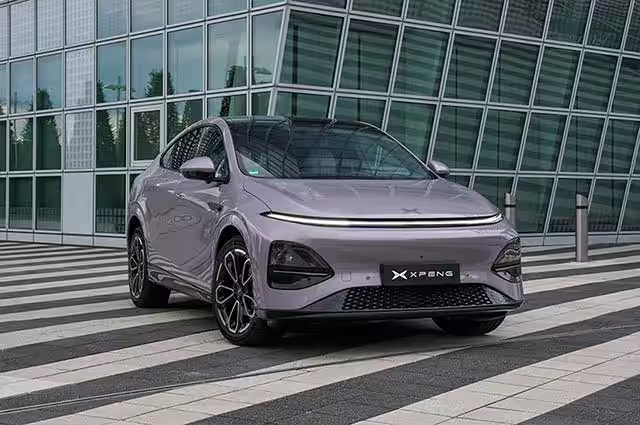
XPeng kept pace with 15,256 vehicles delivered last month, with a strategic push abroad marked by the initial rollout of its P7+ model to 18 countries. Positioned as a family-friendly and technologically advanced sedan, the P7+ aims to distinguish XPeng in a growing global market craving AI-enhanced features combined with spacious practicality. The company’s upcoming launch of its second-generation vehicle platform in early March promises to embed even stronger intelligent driving capabilities, a critical battleground for competing EV brands.
NIO’s results were even more striking: 20,797 units delivered in February, a year-over-year surge of 57.6%. This boost was supported by a diverse lineup, from premium models to family-oriented and niche high-end vehicles under its ONVO and Firefly sub-brands. Perhaps more significantly, NIO marked a major operational milestone by completing its 100 millionth battery swap, reinforcing its once-controversial but now-proven battery swapping model. Frequent use during the Chinese New Year holiday, with record daily swap volumes, strengthened the case that battery swapping can be a viable, scalable alternative to fast charging.
Infrastructure and tech upgrades shape ownership experience
Li Auto leads the pack in raw delivery numbers for February with 26,421 vehicles, reaching more than 1.5 million cumulative deliveries. Beyond volume, it shipped a significant over-the-air update (version 8.3), enhancing driver assistance, the smart cockpit, and electric system functionalities. This shows how Li Auto views software refinement as a key lever to keep customers engaged long after the sale. The company’s extensive charging network, with more than 4,000 supercharging stations and 22,000+ stalls, supported an impressive 1.45 million charging sessions during the Spring Festival travel rush, highlighting infrastructure’s role in user satisfaction and operational scale.
The trio’s moves reflect a broader trend in China’s EV arena: fierce competition based not just on how many cars they sell, but on delivering a seamless fusion of hardware, software, and service. NIO’s bold bet on battery swapping challenges the fast-charging orthodoxy, while XPeng and Li Auto’s emphasis on AI and OTA updates shows that their battle is equally about technology ecosystems. Meanwhile, the simultaneous international push, especially by XPeng, points to their confidence in transcending China’s hyper-competitive domestic market.
As these automakers prepare new product launches and software upgrades, the industry watches whether customers will reward innovation over price. Battery swapping’s extensive use could redefine EV convenience in China, but it remains to be seen if this model will scale globally. XPeng’s AI advancements could set a new consumer baseline, but standing out amid increasing global competition will test these Chinese automakers’ ambitions beyond their homeland.