

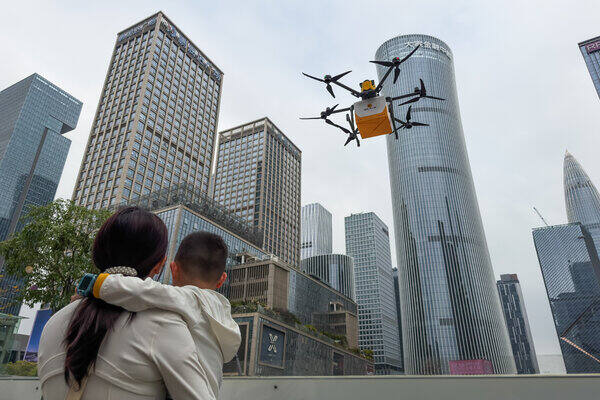
China built the world’s biggest drone industry, then started putting a tighter leash on the people who actually want to use it. New China drone rules now demand real-name registration, advance permits in many areas, and live data transmission to the government, while Beijing has gone further with a near-total ban inside the capital. The official line is public safety; the result, at least for many users, looks a lot like a country where flying a recreational drone is becoming a paperwork hobby with a criminal penalty attached.
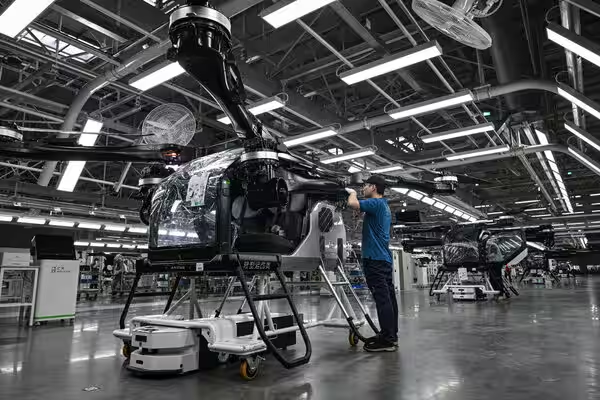
The shift is happening as Beijing tries to square two competing goals: clamp down on unauthorized flights and expand its ”low-altitude economy” for delivery, inspection, and farming. That tension is not unique to China – the United States and other countries have also moved to restrict foreign-made drones on security grounds – but China’s scale makes the policy especially consequential for the global market it helped create.
What the new China drone rules require
Starting in May, all drones must be registered under owners’ real names and tied to official identification or a cellphone number. In restricted zones, which cover most cities, permits will have to be secured at least a day ahead of time. Small drones flying below 400 feet are exempt in some open areas, but those zones are limited, and flight data will be sent to the government in real time.
Beijing’s version is harsher. Drones and their key components may not be sold, rented, or brought into the city, and people arriving from other provinces will have their bags checked. Existing owners get a narrow carve-out if they register with police by April 30, though even then they cannot keep more than three drones at one address. Special uses such as counterterrorism and research can be exempted, because apparently even a crackdown needs a footnote.
Why Beijing says it is cracking down
The Ministry of Public Security says the tougher line is about safety, pointing to risks of hacked drone systems and incidents involving flights too close to civil aircraft. It cited one case in which an operator flew within 800 meters, or about 2,600 feet, of a civil plane, and another in which a drone entered a no-fly zone near an airport to film landing paths. Last year, two drones collided midair and crashed onto a Shanghai skyscraper. The state’s message is blunt: ”The skies are not above the law.”
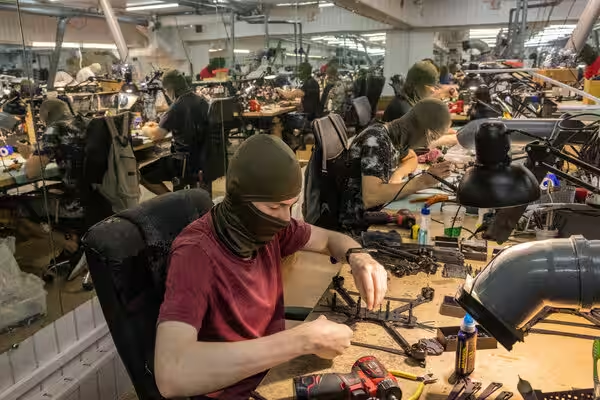
There is also a bigger layer here. Wars in Ukraine and Iran have shown how cheap drones can become battlefield weapons, and that reality has clearly sharpened Beijing’s appetite for control. China is both the world’s largest consumer drone manufacturer and a major supplier of drones or components used in those conflicts, which gives regulators a security case whether they want one or not.
Users say the crackdown is going too far
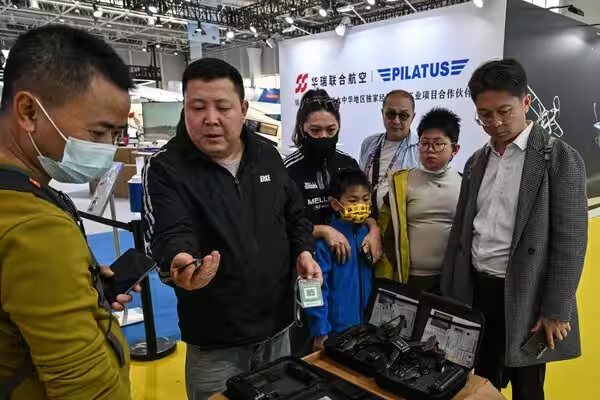
What officials call order, many drone owners describe as paralysis. Chinese social platforms are packed with stories of people being questioned, fined, detained, or having drones seized. One Shanghai resident said police approved her son’s flight in principle, then denied final clearance on the day of the outing without explaining why. Another user in northern China said more than three dozen applications produced just two approvals, both heavily restricted.
The market is feeling it too. Dealers say business has fallen sharply, used drones are piling up online, and some hobbyists are simply giving up. One enthusiast said he had spent about $2,000 on a DJI drone and gear to start a photography business, then abandoned the idea after more than two dozen rejected applications. The joke circulating on Douyin – a riff on DJI’s slogan – captures the mood better than any policy memo: if the sky is waiting, the police are probably not.
There is a real risk of overcorrection here. A system built to block bad actors can quickly smother ordinary users, and that is usually when underground workarounds start to appear. China says it wants a smarter airspace regime; so far, it has mostly built a more nervous one.
DJI, exports and the fight over the low-altitude economy
The timing is awkward for DJI, the biggest drone maker in the world. The company is already facing pressure in the United States, where authorities moved in December to ban foreign-made drones on national security grounds and block new DJI products from the market. DJI responded with a lawsuit in February, while in China the broader industry is being asked to live with tighter rules at home and less access abroad.
That leaves Beijing with a familiar policy puzzle: how to keep control without strangling the very sector it wants to promote. Some experts argue that regions should manage airspace more flexibly, and the logic is straightforward – if drones are meant to support delivery, maintenance, and agriculture, then making every flight a mini licensing campaign defeats the point. The bigger question is whether China loosens up enough to build a commercial drone economy, or whether security fears keep the skies locked down just as the market is supposed to take off.