

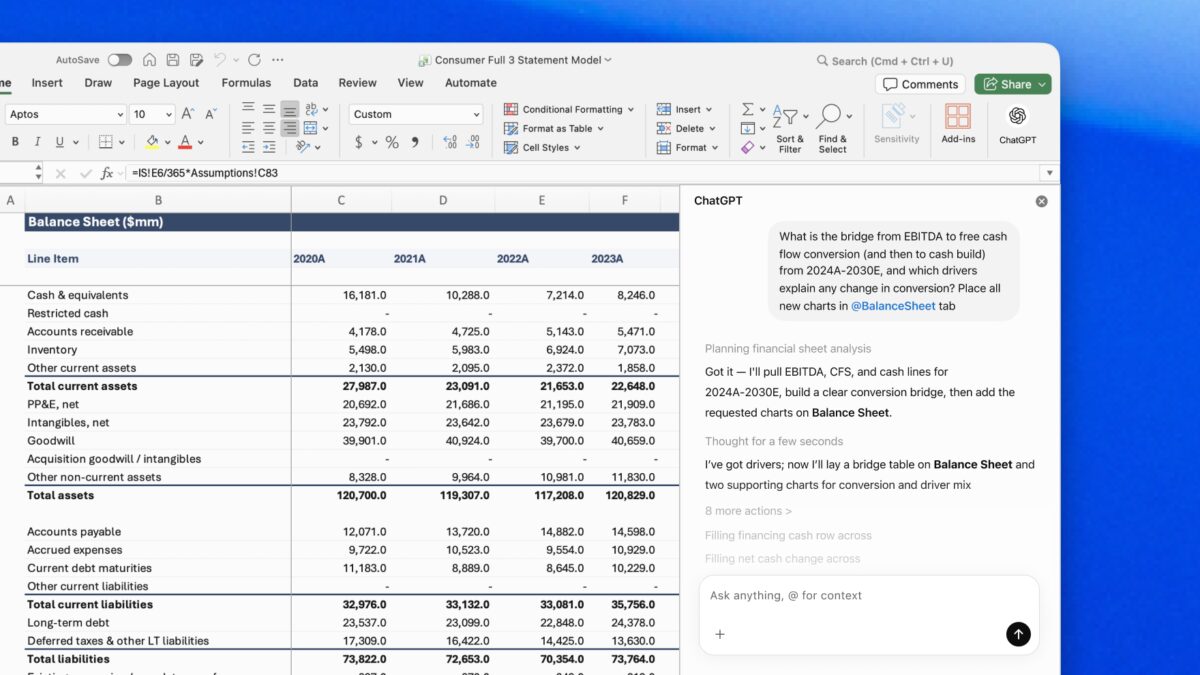
Excel users tackling financial models and data-heavy workflows now have a new tool: a beta add-in that integrates ChatGPT directly within spreadsheets. Powered by OpenAI’s latest GPT-5.4 model, this add-in helps users build, update, and analyze Excel models using everyday language and real-time formula execution. Alongside this, OpenAI is expanding its financial data ecosystem by linking ChatGPT to trusted providers like FactSet, Moody’s, and Dow Jones Factiva, streamlining the flow of market and company data into workflows that analysts rely on daily.
From hours of manual work to instant spreadsheet models
Financial analysts, accountants, and strategists often spend excessive hours wrangling Excel sheets-tracking formulas, chasing linked data, and debugging models. The new ChatGPT for Excel aims to cut through that tedium. Users describe their modeling needs in plain English, and ChatGPT generates or adjusts live Excel workbooks without losing the original structure and formulas. This keeps spreadsheets native and auditable while automating tedious data analysis, scenario planning, budgeting, and reporting tasks.
Crucially, ChatGPT clarifies its reasoning, links outputs to specific cells, and asks for user approval before making any edits. This hands-on transparency encourages trust, letting teams audit assumptions and verifications as they work instead of blindly accepting AI-generated results or wrestling with ever-complex formulas manually.
A new ally for financial workflows with proprietary data access
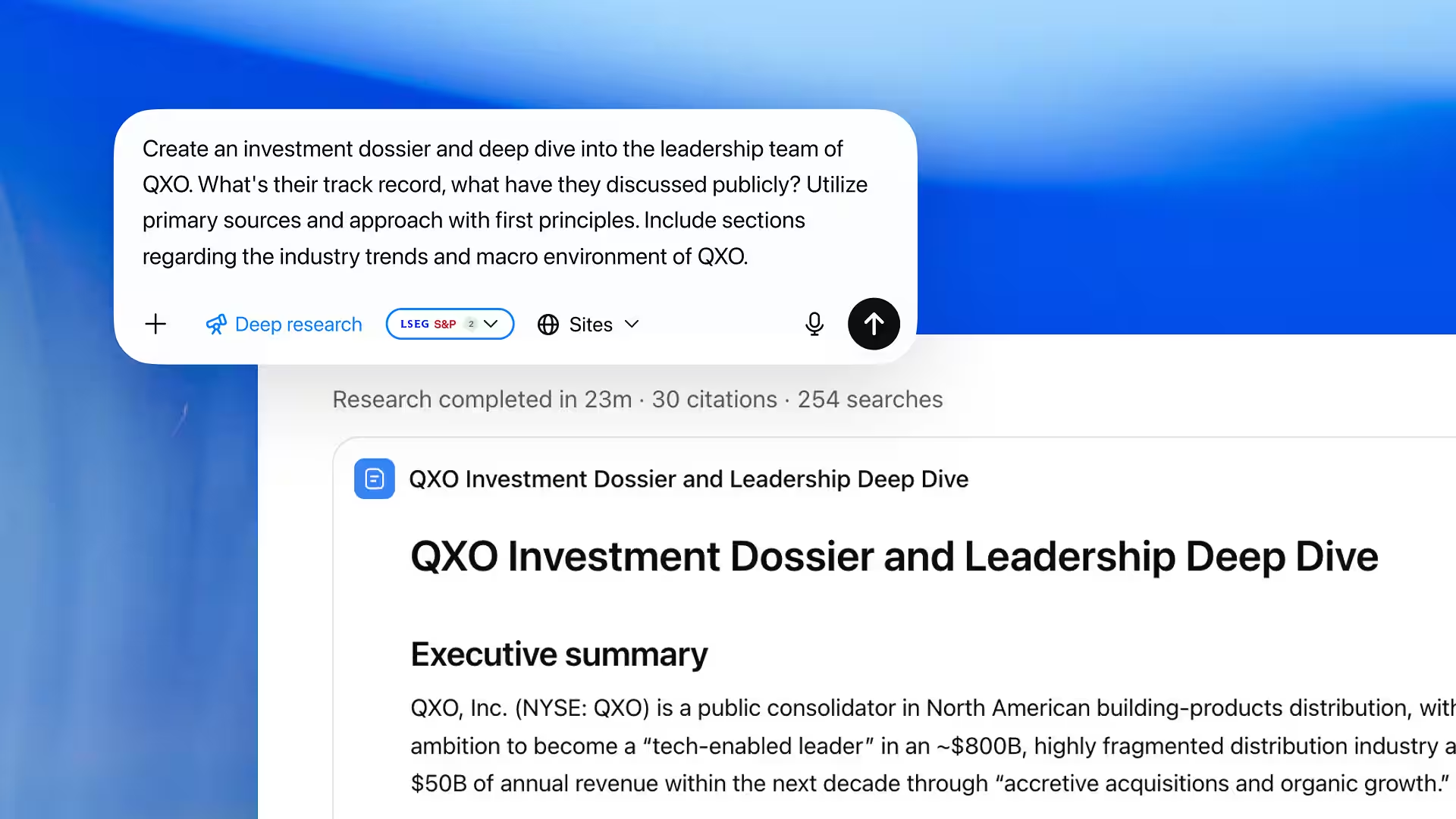
Beyond Excel integration, this update brings a swarm of financial data sources into ChatGPT’s orbit. With connectors for industry staples such as Moody’s, MSCI, Third Bridge, and soon FactSet, users can tap directly into filings, transcripts, equity research, and credit reports. This integration allows seamless generation of cited summaries, valuation snapshots, and credit memos, slashing the time spent hunting for inputs.

These capabilities add up to a giant leap for due diligence and investment research. Users can direct ChatGPT to pull from a curated set of sources, tailor their research path on the fly, and export structured, citation-backed reports directly into PDFs or Word documents. This could transform the speed and quality of investor decks, audit memos, and strategy presentations.
OpenAI’s focus on workplace security is evident in its enterprise-grade controls. Features like role-based access, single sign-on, encryption, and data residency guard sensitive financial information – a must for regulated firms. Access to ChatGPT for Excel is currently rolling out for business, enterprise, educational, and higher-tier users in select regions, with plans for Google Sheets integration later.
In the competitive AI-for-finance race, OpenAI’s approach stands out by embedding its most recent model directly into the ubiquitous finance tool Excel rather than forcing a jump to new platforms. While rivals like Microsoft’s Copilot for Excel also aim to automate spreadsheet work, ChatGPT’s expanded financial data connections add a layer of contextual intelligence and trusted data sources that may give it an edge for complex financial analysis.
GPT-5.4 reflects a significant jump in AI’s ability to manage real-world financial modeling tasks, doubling its accuracy on internal benchmarks. Still, nuances of complex or unusual financial formulas will require human refinement, highlighting the hybrid nature of future financial workflows.
The rollout raises interesting questions about how finance professionals will adopt AI-assisted modeling-whether it will accelerate reliance on automated outputs or encourage more rigorous review thanks to AI’s transparent linking and explanations. Watching how enterprises integrate these new capabilities with their existing data systems will be key to tracking this technology’s real impact.