

What’s new – and why it matters
Automakers know buyers want two things from modern EVs: more usable range and a nicer place to spend time when they’re not driving. BYD’s latest, the Song Ultra EV, makes that tradeoff explicit – glossy screens and a lounge-like cabin on one side, very long CLTC (China Light-duty Vehicle Test Cycle) range figures on the other. The package looks designed to sell the idea of a car that doubles as a comfortable mobile living space while promising distances that make charging anxiety fade on paper.
The car, in plain terms
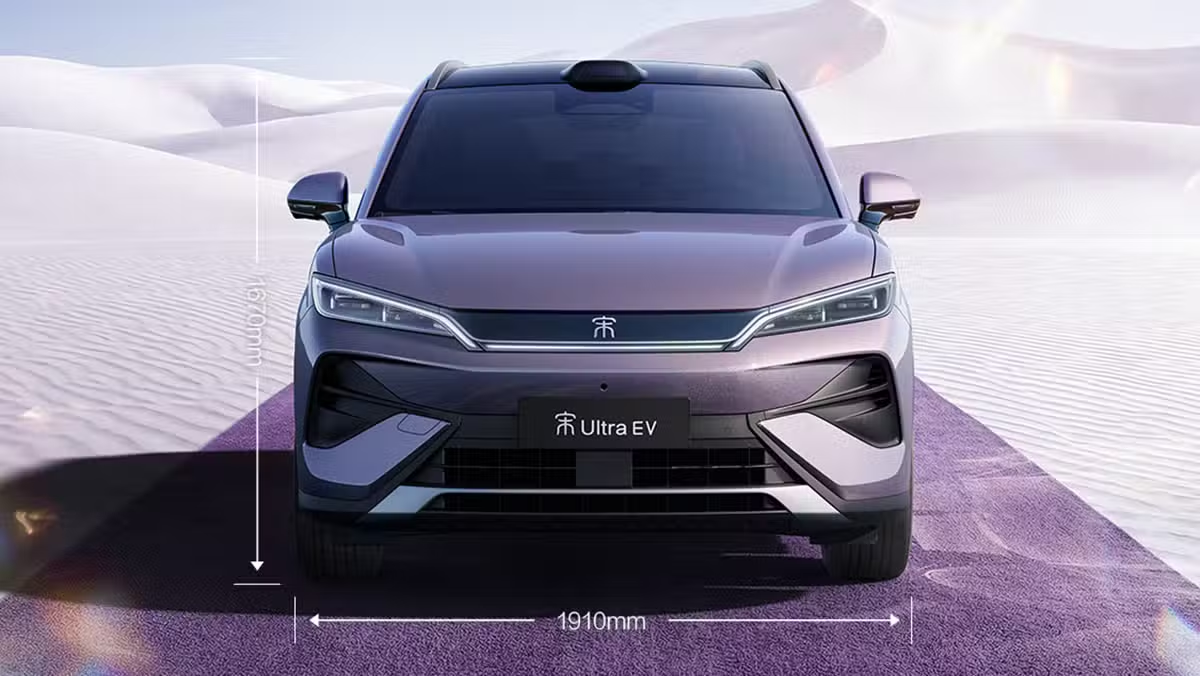
The Song Ultra EV carries BYD’s familiar styling cues: a closed front grille and a through LED light strip in a ”star ring” shape up front, solid rear light clusters and a large spoiler at the back. BYD offers an optional lidar sensor, which enables its driver assistance suite called ”God’s Eye B” to operate both in cities and on highways.
Inside, straight lines dominate the dash. There’s a built-in digital instrument cluster and a floating central screen. The cabin includes two wireless phone chargers, two cupholders, and a rotary multimedia controller. Sources attached to the initial disclosure also highlighted a fold-out bed as part of the interior package.
On paper, the Song Ultra’s numbers are conspicuous: a single electric motor rated at 270 kW (362 hp) and a top speed of 210 km/h. Two battery options are listed – 75.6 kWh and 82.7 kWh – with CLTC ranges of 620 km and 710 km, respectively. The car’s dimensions are length – 4,850 mm, width – 1,910 mm, height – 1,670 mm, and a wheelbase of 2,840 mm.
Context: CLTC, lidar and the ”mobile living” trend
Two useful comparisons make these claims clearer. First, the CLTC testing cycle used in China typically returns higher range numbers than WLTP (Worldwide Harmonized Light Vehicles Test Procedure, used in Europe) or EPA (U.S. Environmental Protection Agency) tests. That doesn’t mean the figures are lies, but it does mean buyers outside China – and anyone comparing across standards – should expect shorter real-world numbers than 620-710 km suggest.
Second, optional lidar is a recurring theme among Chinese EV makers who want to advertise advanced driver assistance without committing to full autonomy. Adding lidar hardware is one thing; making it reliable, well-mapped and legal across different markets is another. BYD’s ”God’s Eye B” sits in the same category of branded assistance systems as rivals’ suites – a step above basic lane-keeping but not a turnkey replacement for a human driver.
Finally, the interior choices – large screens, swivel controls, and even a fold-out bed – echo a broader push to sell cars as flexible living space. Tesla’s Camp Mode, reclining rear seats in executive sedans, and modular interiors in some vans point to the same idea: manufacturers are monetizing time spent stationary in the car as much as time spent moving.
Who wins and who loses
Short-term winners are BYD and buyers who prioritize perceived range and in-car comfort. Long CLTC numbers and showy interiors are effective marketing tools, especially in price-sensitive segments where headline figures drive showroom traffic.
Losers could be buyers who take the CLTC figures at face value without understanding test differences. Legacy automakers that rely on more conservative WLTP/EPA numbers will struggle in marketing comparisons unless they match or beat BYD on genuine real-world range. Regulators and insurers may also raise questions if aggressive driver-assist marketing outpaces the systems’ verified capabilities.
My read: smart moves, predictable caveats
BYD is playing to its strengths. Low-cost battery manufacturing and an ability to spec interiors that feel premium let it promise long-range and comfortable cabins without the price tag of luxury rivals. The optional lidar gives it a technological halo – at least until independent tests show how well God’s Eye B performs in varied conditions.
That said, beware the headline CLTC numbers. Expect real-world ranges closer to WLTP/EPA-adjusted figures – often 15-30% lower depending on speed, temperature and use. The fold-out bed and lounge touches are clever for marketing and for a niche of buyers who treat cars as weekend retreats, but they won’t change the economics of long-distance travel if charging infrastructure isn’t convenient.
What happens next
Watch for two things: independent range and driver-assist tests, and BYD’s export strategy. If BYD can translate those CLTC numbers into strong WLTP/EPA results and prove God’s Eye B in third-party evaluations, the Song Ultra could be a serious rival outside China. If not, the car will still look impressive on paper and in showrooms – but buyers who care about real-world performance will have to dig deeper.
Either way, the Song Ultra is a useful barometer: Chinese EV makers are now packaging range, sensors, and lifestyle interiors together, forcing competitors to answer on all three fronts rather than powertrain alone.