

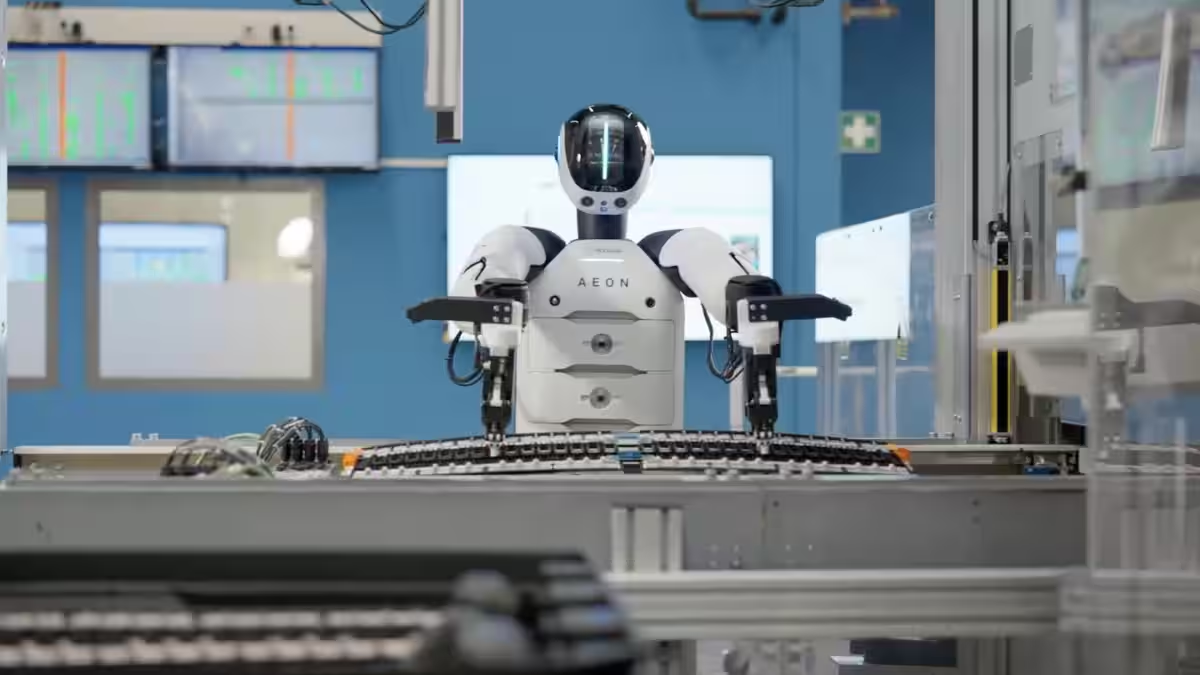
Factories are getting harder to run. Cars have more software, batteries, and delicate electronics, while longtime production jobs remain physically gruelling. BMW’s latest move – a small pilot putting humanoid robots on an assembly line in Germany – is less about a sci‑fi future and more about fixing those stubborn, everyday problems.
The news: BMW has begun a pilot at its Leipzig plant using AEON humanoid robots from Hexagon Robotics to assist on selected assembly tasks, including work on high‑voltage battery production. It’s the German automaker’s first deployment of humanoids in Europe, following a 10‑month trial with Figure AI’s Figure 02 robots at its Spartanburg, South Carolina plant. During that US pilot, the robots reportedly worked five days a week, up to 10 hours a day and were credited with contributing to the production of more than 30,000 vehicles.
What BMW is actually trying to solve
BMW’s explanation is straightforward: humanoid machines can take over repetitive or ergonomically demanding tasks and relieve human workers, not replace them. That’s a familiar line – one often used to soften the optics when expensive automation arrives – but it also points to a real operational pain point. Some assembly tasks are still better handled by a human body than an industrial arm, especially in cramped spaces or where multiple dexterous motions are needed.
Unlike traditional industrial robots – big, fixed arms that excel at repeatable motion – humanoids promise flexibility. In theory, a single humanoid could handle several different sub‑tasks that would otherwise require multiple specialised cobots or manual labour. That potential is why automakers from Tesla to Hyundai and Mercedes have signaled interest in humanoid robotics, and why analysts such as those at Morgan Stanley see a massive long‑term market (they project up to $5 trillion by 2050).
Why this pilot will tell us very little – for now
Scale matters. BMW says only a small number of units – in the single digits – will operate alongside human employees in Leipzig. That’s sensible: manufacturers rarely flip a production line overnight. But it also means the pilot will mostly produce qualitative learnings about safety, integration, and ergonomics, not definitive ROI numbers you can roll up into a CapEx plan.
Past trials give a hint of what to watch. In Spartanburg, the Figure 02 units handled physically demanding tasks such as placing sheet metal for welding and were touted as reducing strain on workers while keeping throughput steady. For any wider rollout, BMW will need humanoids to deliver reliable uptime, predictable cycle times, and low maintenance overhead – all areas where conventional industrial robots already perform extremely well.
Who stands to gain – and who could lose
Short-term winners are the robot makers. Companies such as Figure AI and Hexagon Robotics get validation and data from a blue‑chip automaker. Suppliers of vision systems, safety cages, and edge AI software could also see new demand as humanoids are integrated.
Workers aren’t automatically losers, either. If the technology genuinely reduces repetitive strain and injury risk, it can improve jobs. But history shows that automation often changes headcount and skill requirements rather than simply creating new roles for the same people. Expect a premium on technicians who can service robots, plus retraining pressure for line staff.
The hard questions BMW (and others) still need to answer
1. Integration costs: How many humans and special fixtures must be rearranged to accommodate a humanoid? Flexibility on paper often means complex process redesign on the floor.
2. Productivity math: Can a humanoid’s versatility justify its purchase price and operating costs compared with cheaper, single‑purpose cobots or ergonomic tools?
3. Reliability and safety: Humanoids introduce new failure modes in high‑throughput environments. Proving consistent, safe behaviour next to people is nontrivial.
Bottom line and what to watch next
BMW’s Leipzig pilot is an important step because it puts humanoids into mainstream European production lines, but it isn’t evidence of an imminent wholesale shift. Expect cautious, incremental expansion if the robots reduce injuries, avoid production slowdowns, and show reasonable economics. If they don’t, automakers will keep favouring specialised arms, fixtures, and software – the tools that have powered automotive assembly for decades.
The bigger story is that carmaking is experimenting beyond welded frames and taught trajectories. Whether humanoids become a broadly adopted part of that toolkit depends less on their headline capabilities and more on the dull, hard engineering of integration: uptime, cycle time, serviceability, and cost. That’s the kind of proof BMW’s single‑digit pilot will need to deliver before the debate stops being speculative and starts affecting assembly‑line headcounts at scale.