

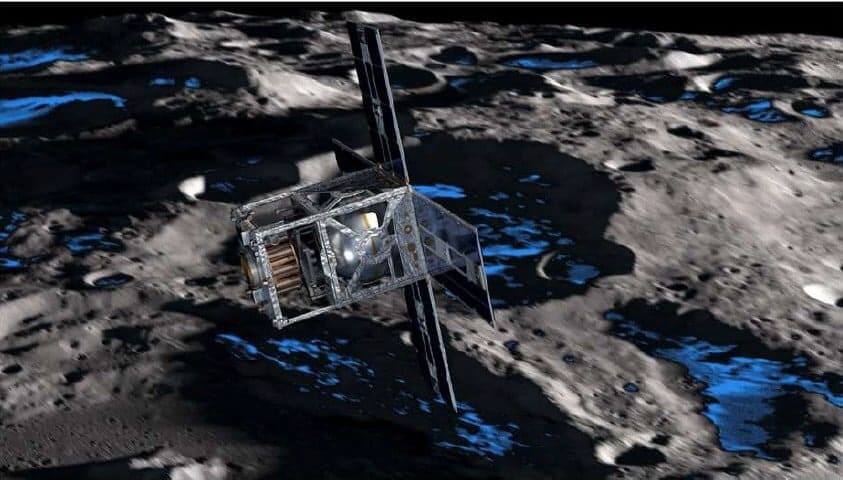
Blue Origin is lining up a Moon mission called Oasis-1, a two-satellite survey aimed at mapping water and other resources around the lunar south pole in far finer detail than current data allows. The launch is expected in 2027 or 2028, and the company is already talking about commercial licenses for the maps.
That matters because the Moon’s permanently shadowed regions, or PSRs, are where water ice is thought to be hiding, but nobody has a precise inventory yet. For any serious human presence on the Moon, ”there is some water here” is a nice headline; ”here is how much, where, and how deep” is what actually changes the business case.
Two small satellites, one very low orbit
Blue Origin outlined Oasis-1 at the Lunar and Planetary Science Conference. The mission uses two small satellites deployed from the company’s uncrewed MK1 lander, then sent into a highly elliptical polar orbit with a pericenter just 10 km above the lunar south pole.
That low pass is the whole point. The company says the setup should deliver about 15 km per pixel resolution, roughly nine times better than existing data. In space imaging, that is not a cosmetic improvement; it is the difference between broad speculation and maps investors, engineers, and scientists can use.
Each satellite carries three instruments. First is a hybrid gamma and neutron spectrometer, or GRNS, designed to detect water down to about one meter below the surface. Second is a magnetometer that will map crustal magnetic anomalies at 15-30 km per pixel, useful for both geologic work and spotting possible concentrations of platinum-group metals. Third is a multispectrometer aimed at finding helium-3, the rare isotope that keeps showing up in lunar ambition decks because of its long-shot appeal for future fusion reactors.
From science data to commercial licenses
The smart part is not just the instruments. It is the business model. Blue Origin wants to license the resource maps to other commercial players, which could help reduce exploration risk before anyone spends serious money on extraction hardware. Data with no obvious commercial value would be published through the European Space Resources Innovation Centre, or ESRIC.
That approach fits a broader shift in lunar planning: the first company to find a resource is not necessarily the one that benefits most. The winner is often the one that can turn a technical survey into a dataset others will pay for, and Blue Origin appears to be betting that data brokerage can fund the road from mapping to mining.
Oasis Campaign and the Blue Alchemist tie-in
Oasis-1 is the first stage of a three-part Oasis Campaign. The next phase would deploy mobile systems on the lunar surface for finer mapping, and the third would move toward resource extraction. Blue Origin says the campaign complements Blue Alchemist, its project for making components from lunar materials.
That sequencing is telling. NASA and its commercial partners have spent years circling the same basic problem: lunar infrastructure fails without local resources, but local resources are hard to quantify, let alone monetize. Blue Origin’s plan is to make the Moon look less like a myth and more like a supply chain, even if the first real payoff comes from selling the map before anyone sells the water.
If Oasis-1 works, the company could end up with something more valuable than a one-off science mission: a repeatable template for turning lunar prospecting into a business. The open question is whether other players will buy the maps first, or wait for someone else to take the risk of digging.