

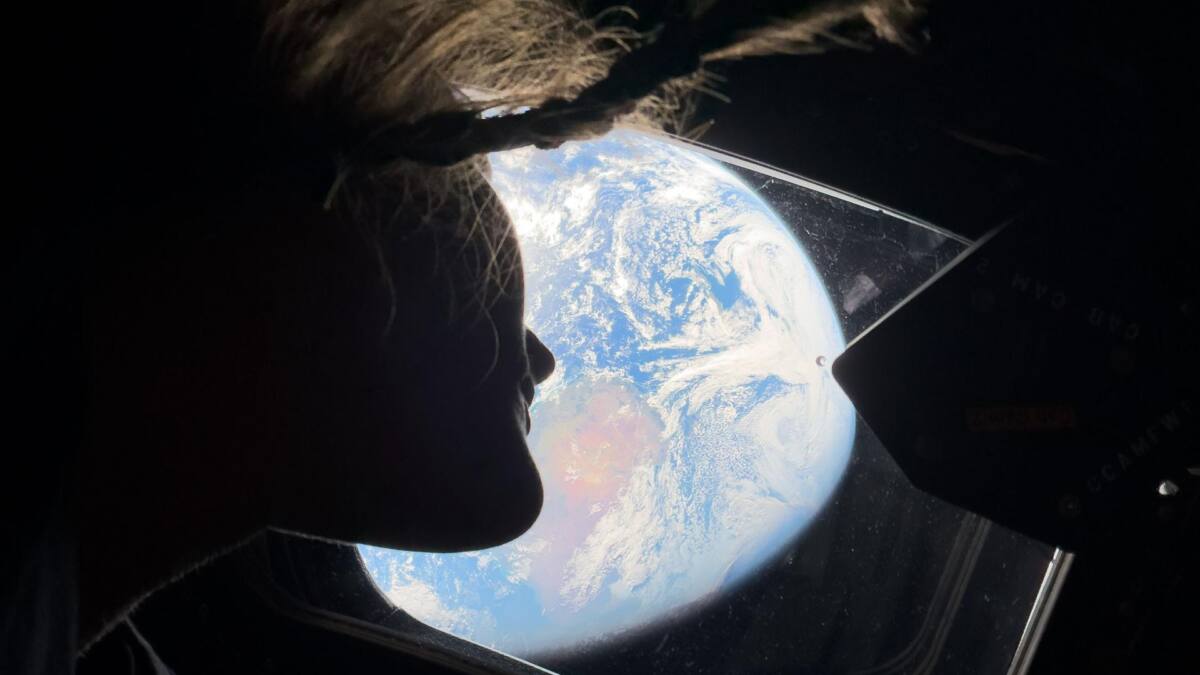
The Artemis II crew is almost at the Moon, and NASA has released new images of the astronauts staring back at Earth through Orion’s windows while they prepare for a historic lunar flyby on Monday. The mission is still a dress rehearsal in one sense, but it is also doing something no crewed spacecraft has done in decades: pushing humans farther from Earth than Apollo 13 managed.
That record-setting distance is set to fall later on Monday, April 6, when Orion passes beyond 248,655 miles from Earth. For NASA, the optics matter almost as much as the engineering; this is a test flight, a photo opportunity, and a public proof that the agency’s deep-space ambitions are no longer confined to PowerPoint.
What the Artemis II crew is doing before the flyby
Over the weekend, the four astronauts worked through manual piloting demonstrations, reviewed science goals for the six-hour observation window, and checked their spacesuits. Those suits are not just for show; they provide life support in an emergency and will help bring the crew home safely if something goes wrong.
Christina Koch, one of the mission specialists, was among the astronauts photographed looking out from Orion as the spacecraft headed toward the lunar neighborhood. It is a familiar human reaction in an unfamiliar place: training is serious, but the view still steals the scene.
Moon timing, closest approach, and blackout period
NASA says Orion will reach the Moon’s vicinity shortly after midnight on Monday, and the lunar observation period begins at 2:45 PM ET. A few hours later, the spacecraft will move behind the Moon and briefly lose contact with Earth.
The closest approach is expected at 7:02 PM, when Orion will be 4,066 miles from the lunar surface. From that distance, NASA says the crew will see the Moon’s full disk at once, including regions near the north and south poles. That is the kind of view satellite images can hint at, but only a crewed mission can turn into a very expensive, very dramatic selfie.
A solar eclipse from Orion
Later in the flight, the astronauts are expected to witness a solar eclipse as Orion, the Moon, and the Sun line up so that the Sun disappears behind the lunar body for about an hour. NASA will begin coverage of the flyby at 1 PM ET, giving the public a front-row seat to a mission that is equal parts navigation test and spectacle.
The more interesting question now is whether Artemis II will do for lunar exploration what Apollo once did for the public imagination: turn an engineering milestone into a political one. If Orion performs cleanly through the flyby, the pressure only grows on what comes next.