

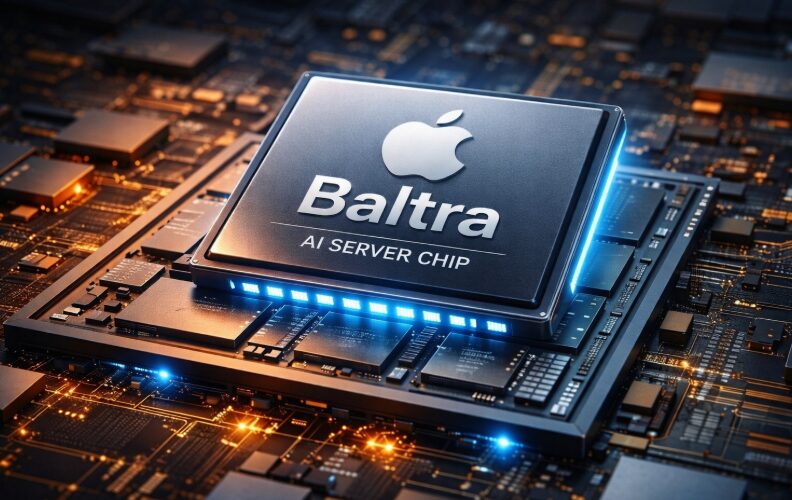
Apple is building a custom AI server chip called ”Baltra” for its cloud infrastructure, and the real goal looks bigger than a single silicon project: less dependence on NVIDIA, tighter control over its AI stack, and a more Apple-like way of running backend computing. The chip is reportedly headed for TSMC’s advanced 3nm process, which puts Apple in the same foundry queue as plenty of other companies trying to squeeze more performance out of less power.
The move fits a pattern Apple has followed for years: first dominate the customer device, then start bringing the supporting infrastructure in-house. That approach has worked well in Macs and iPhones, where custom silicon gave Apple a clear efficiency edge. Now it is being pushed into cloud AI, where the winners are increasingly the companies that own the chips, the software, and the servers in between.
What Apple’s Baltra chip is built to do
Baltra is designed for internal cloud infrastructure, not consumer devices. In plain English: this is the kind of chip that sits behind the curtain, handling secure data processing and backend AI workloads rather than showing up in an iPhone keynote with a glossy demo.
- Custom AI server chip for Apple’s cloud infrastructure
- Built with TSMC’s second-generation 3nm process, also known as N3E
- Uses SoIC packaging to stack chip components for better speed and power efficiency
- Reportedly based on a chiplet architecture for more scalable AI workloads
That chiplet approach is the interesting bit. Rather than forcing one giant slab of silicon to do everything, Apple can mix specialized pieces in one package and tune them for the jobs it cares about most. It is the same basic logic driving much of modern high-end computing: modularity beats brute force when power and heat are the enemy.
Why TSMC is central to the plan
Apple is also said to have reserved substantial production capacity at TSMC for the coming years, with a large share expected to go to AI server chips like Baltra. That is a loud signal, even by Apple standards. It suggests the company is not treating this as a side experiment, but as infrastructure it expects to rely on at scale.
The TSMC angle matters for another reason: the Taiwanese foundry is already the bottleneck for nearly everyone chasing leading-edge AI hardware. If Apple is locking in capacity now, it is trying to avoid the scramble that has made advanced AI chips so hard to source elsewhere. NVIDIA may still own the headline market, but Apple clearly wants a seat at the table – and preferably a chair with its name on it.
Apple’s AI stack is getting more vertical
Baltra points to a broader Apple strategy: control the silicon, control the packaging, control the cloud. That is classic Apple, except this time the company is not just optimizing an end-user device. It is trying to own the invisible machinery that makes its AI services faster, safer, and less dependent on outside vendors.
If the company can pull that off, the payoff is not only lower reliance on NVIDIA. It also gives Apple more room to tune its AI features around its own hardware rather than adapting them to someone else’s chips. The next question is whether that vertically integrated playbook can scale cleanly in AI, where demand is spikier, infrastructure costs are nastier, and rivals are spending like there is no tomorrow.