

Apple can point to a more repair-friendly MacBook and still get dragged by the repair crowd. A new U.S. PIRG Education Fund report on Apple repairability rankings puts the company near the bottom for both phones and laptops, arguing that a few improvements do not erase years of locked-down design, software restrictions, and short software support windows.
The twist is that Apple is no longer being singled out for making everything impossible to fix. The company has made real progress on parts pairing and the Repair Assistant in iOS 18, but PIRG says the overall experience still leaves too much control in Apple’s hands. That is the kind of praise-with-a-frown that repair advocates have been handing out for years.
Apple repairability rankings in Failing the Fix 2026
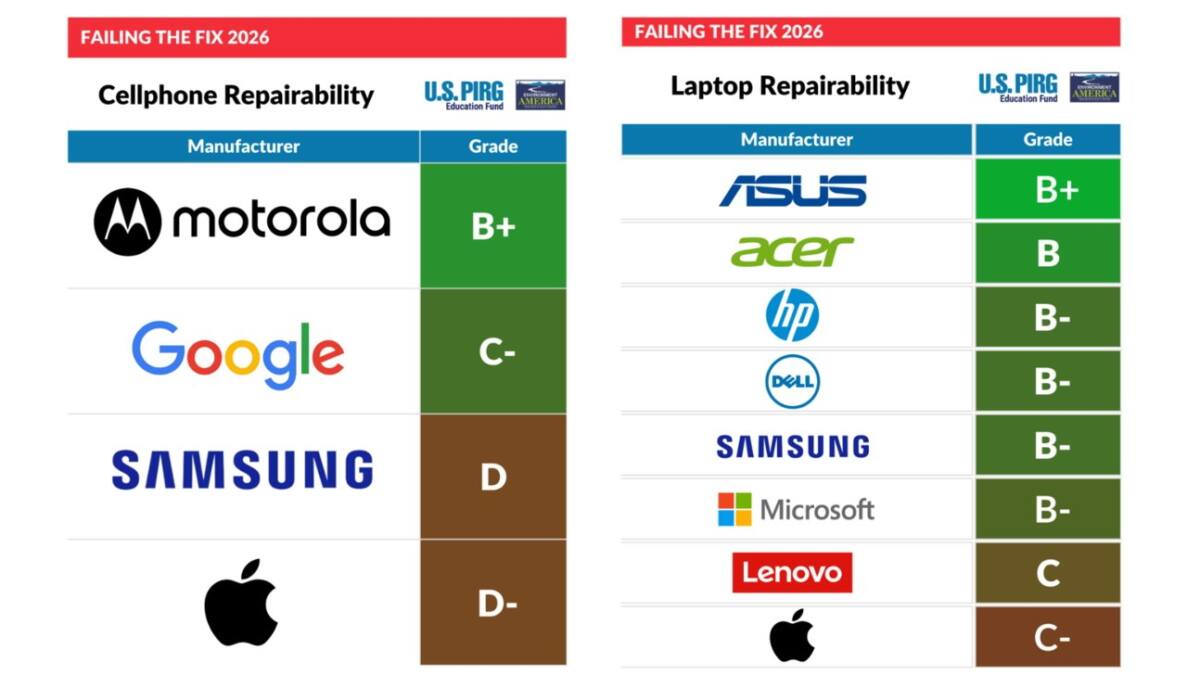
In the ”Failing the Fix 2026” scorecards, Motorola tops the cellphone list with a B+ grade. Google follows with a C-, Samsung gets a D, and Apple lands at the bottom with a D-. The laptop side is a little kinder to everyone else and still rough on Apple: Asus leads with a B+, Acer gets a B, HP, Dell, Samsung, and Microsoft are grouped at B-, Lenovo sits at C, and Apple again comes last with a C-.
Apple’s laptop result did not improve even with the MacBook Neo in the mix, which is awkward given that the machine has been praised as the company’s most repairable MacBook since 2012. The report effectively says the broader track record still outweighs one better teardown.
Parts pairing is still the sore point
PIRG spends a large chunk of the report on software barriers, especially parts pairing. Apple gets singled out because it has leaned on that approach more than most rivals, even if the company has reduced its reliance over time. The group credits Apple for a ”meaningful shift” away from requiring its own authorization for simple repairs and parts replacement, but says independent repair still hits limits, especially around third-party parts and Face ID.
There is also concern about Activation Lock being extended to individual parts, which PIRG sees as a way to keep usable components out of the repair market. Apple is not alone in using software restrictions, but it remains the most visible example, which tends to happen when you sell a lot of devices and invite a lot of scrutiny.
Europe supplies the scores
The report’s scoring method is not built from an iFixit-style teardown operation. Instead, PIRG pulls notebook data from French government reporting and phone data from the EU’s European Product Registry for Energy Labelling. That makes the exercise more bureaucratic than glamorous, but also more scalable – the kind of system U.S. repair advocates clearly want at home.
That European sourcing matters because it means the report can lag product launches and miss whatever happened after the data was collected. In other words, the MacBook Neo’s improved repairability may not have been reflected in the numbers yet, which is a nice reminder that scorecards are snapshots, not gospel.
What PIRG wants the U.S. to copy
PIRG wants a similar U.S. Right to Repair score so buyers can see device longevity and repairability before they spend money. The group argues that better repair information would save consumers money, cut e-waste, and make device support dates feel less like marketing fine print and more like a warning label.
- PIRG cites potential savings of $49.6 billion for U.S. families if more devices were repaired instead of replaced.
- The report says the U.S. generated over 7 million tons of e-waste in 2022.
- Apple classifies products as vintage after more than five years since they were last on sale, and obsolete after seven years.
The open question is not whether Apple can make better hardware – it clearly can – but whether a company that already sends similar repair data to France and the EU would ever find a U.S. reporting system painful enough to resist. The bigger challenge may be consumer attention: repair scores help the people who care, but plenty of buyers still choose a laptop the same way they choose a restaurant, by staring at the menu and hoping for the best.