

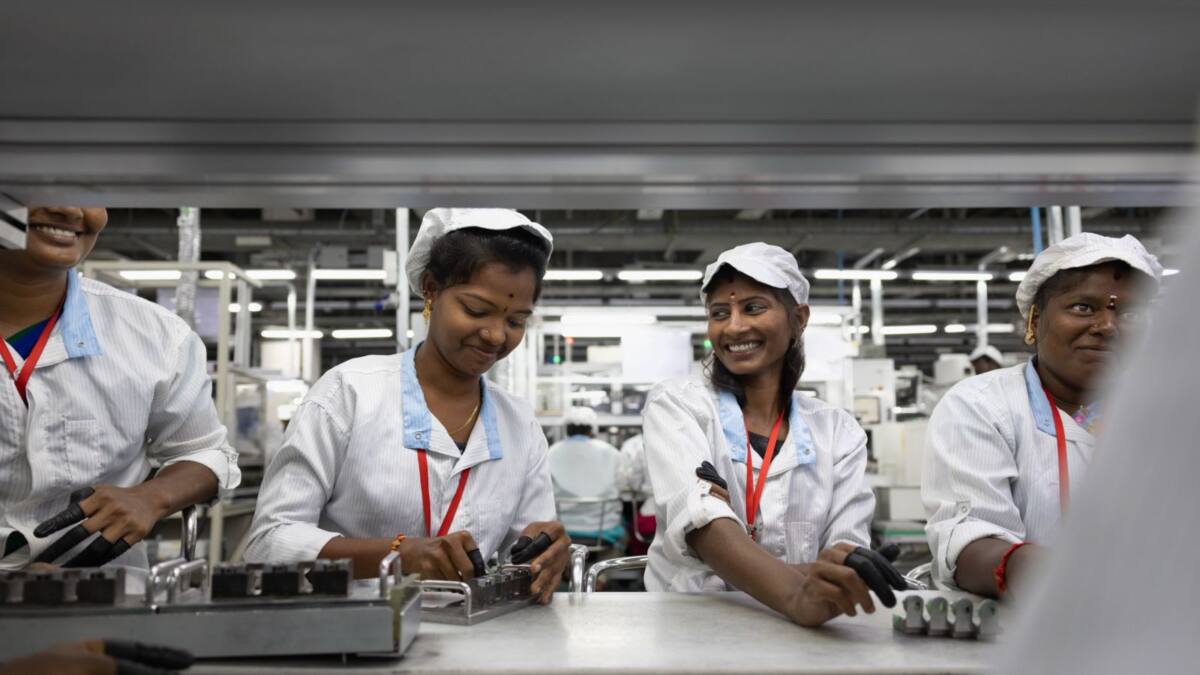
Apple has significantly ramped up its iPhone production in India, now assembling roughly one in every four iPhones there. Last year, the company boosted its output in India by about 53%, reaching approximately 55 million units-up from 36 million the previous year. This shift comes as Apple looks to reduce reliance on China amid ongoing U.S.-China trade tensions and to sidestep tariffs, aligning with India’s push to become a major electronics manufacturing hub.
Globally, Apple produces between 220 million and 230 million iPhones annually. The sizable increase in Indian assembly positions the country as a strategic node not just for local demand but also for exports, including to the U.S. This follows a Canalys report last year showing India surpassing China as the leading source of smartphones shipped to the United States.
Apple’s expansion benefits from India’s production-linked incentives (PLI) program, a government scheme designed to attract large-scale manufacturing by offsetting structural disadvantages compared to China, such as a less mature supply chain and logistical complexities. Even with incentives, assembling electronics in India remains more costly than in China or Vietnam. This has led Apple and other companies like Samsung to lobby for extended or new subsidy rounds focused on export growth.
The current smartphone production subsidies are set to expire on March 31, adding urgency to negotiations between manufacturers and Indian officials. These talks coincide with recent U.S. Supreme Court rulings that have rolled back some tariffs on Chinese imports-factors that could influence India’s positioning as a competitive manufacturing destination.
Apple now assembles its entire latest iPhone 17 lineup in India, including the premium Pro and Pro Max models. Indian manufacturing partners like Foxconn, Tata Electronics, and Pegatron also produce earlier models, such as the iPhone 15 and 16, for both domestic sales and exports. This broad-based local manufacturing marks a notable evolution from Apple’s previous strategy, which heavily favored China.
Apple’s India push comes amid broader industry moves. Other smartphone brands are similarly accelerating production in India to capitalize on government incentives and bypass tariffs. While costs remain higher in India, this diversification reduces risks tied to geopolitics and supply chain disruptions, marking a turning point in global smartphone manufacturing flows.