

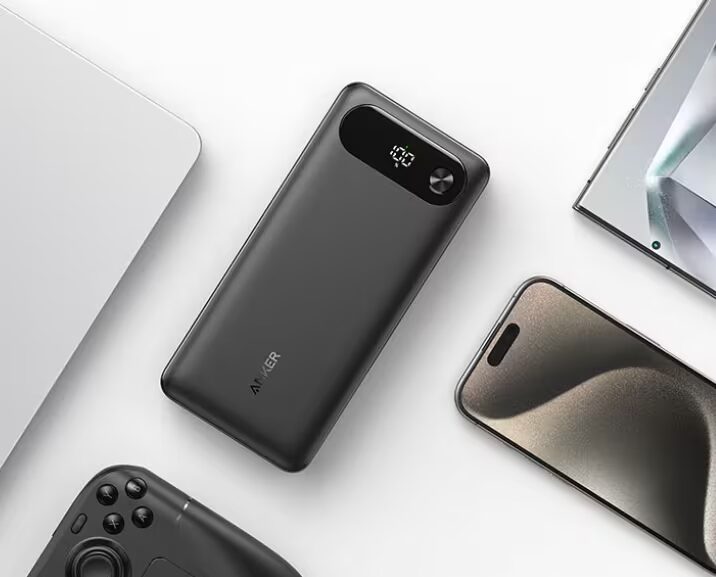
Anker has unveiled a powerful new 87W power bank with a 20,000mAh capacity, now available in China. The standout feature is a built-in USB-C cable that supports both input and output, so you don’t need to carry an extra cord. This USB-C cable can fast charge devices at up to 65W, enabling quick top-ups for compatible gadgets. Beyond the built-in cable, there are dedicated USB-C and USB-A ports arranged as 2C+1A. The USB-C port supports up to 65W input and output, while the USB-A delivers up to 22.5W output. When all ports run simultaneously, the total power output reaches 87W.
The power bank supports an extensive range of fast charging protocols, including PD 3.0, QC 3.0, PPS, FCP, SCP, AFC, Apple 2.4A, and BC 1.2. This broad compatibility covers major brands like Apple, Samsung, Huawei, Xiaomi, Oppo, and Vivo. Smart power distribution allows it to charge three devices at once without a significant drop in performance.
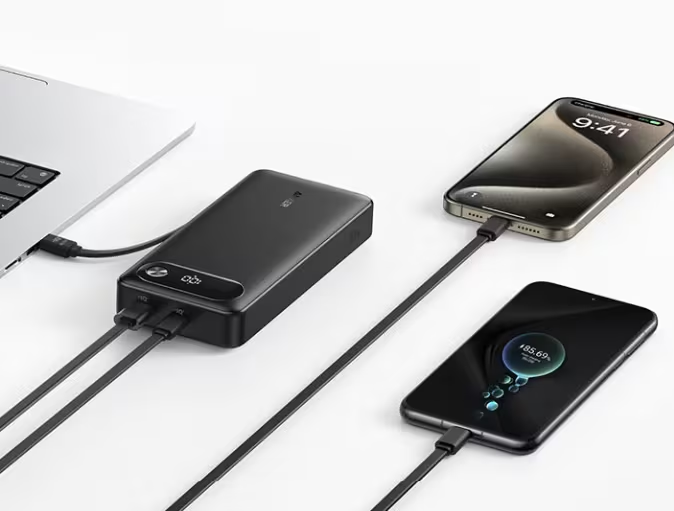
With its large capacity, the new Anker power bank can recharge flagship smartphones like the iPhone 15, Samsung Galaxy S24 Ultra, or even a MacBook Air multiple times. It’s also well-suited for low-power accessories such as wireless earbuds, smartwatches, and Bluetooth devices.
The device features a matte black body and integrates a cable management system to keep the built-in USB-C cable tidy and compact. An LED display on the front shows the remaining battery life. Designed to meet airline safety standards, this power bank is travel-friendly and easy to carry.
Anker’s ActiveShield temperature control tech monitors the battery with up to 864,000 temperature checks daily to ensure safe and stable operation. The power bank supports rapid recharging itself, capable of fully replenishing its charge in about 90 minutes when paired with a 65W (or higher) charger.
Compared to global competitors like Apple’s MagSafe Battery Pack or Samsung’s portable chargers, Anker’s latest model packs more power and ports into a single device, emphasizing versatility and speed. It positions itself strongly for users juggling multiple devices on the go who demand fast, reliable charging without extra cables.
Going forward, it will be interesting to see if Anker expands this design internationally and how it competes in markets dominated by integrated ecosystems and wireless charging trends. The emphasis on high wattage and multiple ports could appeal to power users but might face challenges as wireless charging and compact form factors continue to shape the category.