

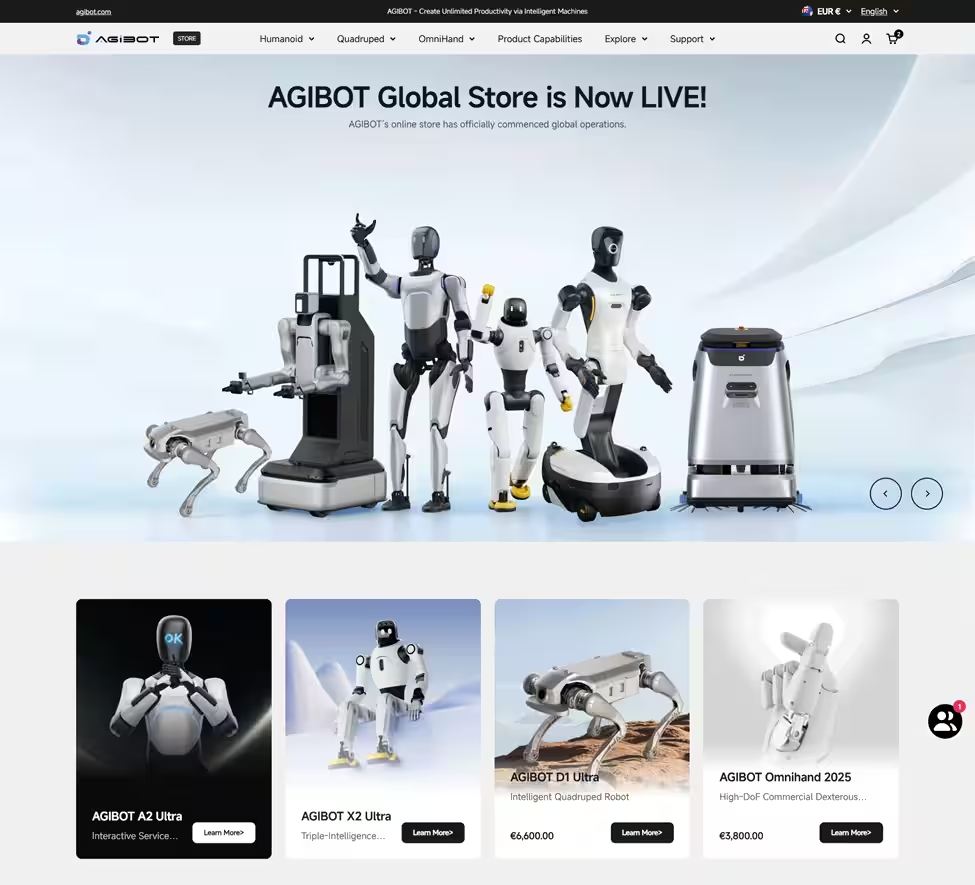
At MWC 2026 in Barcelona, AGIBOT unveiled not just an array of humanoid robots but a fresh approach to accessing them: a rental service spanning 17 countries, including key European markets. With options starting at €899 per day, the company is aiming to lower the barrier for businesses curious about robotics without the hefty upfront investment.
AGIBOT’s lineup caters to diverse sectors with tailored designs. The A2 Series targets reception and guidance roles in public-facing environments, while the X2 Series offers compact models fit for education and entertainment. For industrial settings, the G2 wheeled humanoids handle accurate assembly tasks. The company also highlighted the D1 quadruped for logistics and patrol duties, alongside the autonomous C5 cleaning robot and OmniHand, a versatile manipulator built for dexterous service and industrial work.
The rental platform, dubbed Robot-as-a-Service (RaaS), is a crucial pivot in AGIBOT’s strategy, signaling a shift from selling high-cost hardware to providing flexible robotic access. This model reflects broader industry trends where companies like Boston Dynamics and Unitree are experimenting with subscription and leasing plans to address hesitancy around robotic capital expenditure. AGIBOT’s move positions it as one of the first to integrate such a service with a full humanoid lineup.
On the connectivity front, AGIBOT showcased partnerships that add technological muscle to its robots. At China Telecom’s pavilion, the D1 quadruped demonstrated real-time 6G sensing capabilities. Meanwhile, the memorandum of understanding with Singapore’s Singtel Enterprise aims to harness 5G networks for robotics in Southeast Asia, underscoring AGIBOT’s commitment to embedding its technology within next-gen telecom infrastructures.
William Shi, AGIBOT’s president of Europe, emphasized the importance of collaboration in building an embodied AI ecosystem tailored to regional needs. This local focus contrasts with some rivals who concentrate on global platforms without addressing local market customization. It also hints at the company’s awareness that successful robotics deployment often depends on nuanced integration with existing infrastructure and workflows.
While humanoid robots still face challenges in cost, adaptability, and public acceptance, offering short-term rentals could help enterprises test and iterate use cases without committing heavy capital. Yet, it remains to be seen whether this rental approach will scale beyond pilot projects. AGIBOT’s initiative may prompt wider adoption if the model proves financially and operationally sustainable.
The robot rental program also raises questions about maintenance, software updates, and ongoing support-crucial factors for businesses adopting robotics but seldom detailed in announcements. If AGIBOT manages to streamline these aspects, it could set a new standard in how commercial robots are distributed and supported.
By launching this service alongside a broad robot portfolio and global partnerships, AGIBOT is staking its claim as a flexible, collaborative player in robotics. The success of its European venture might influence how embodied AI solutions evolve in other regions, especially as 5G and 6G networks open fresh possibilities.