

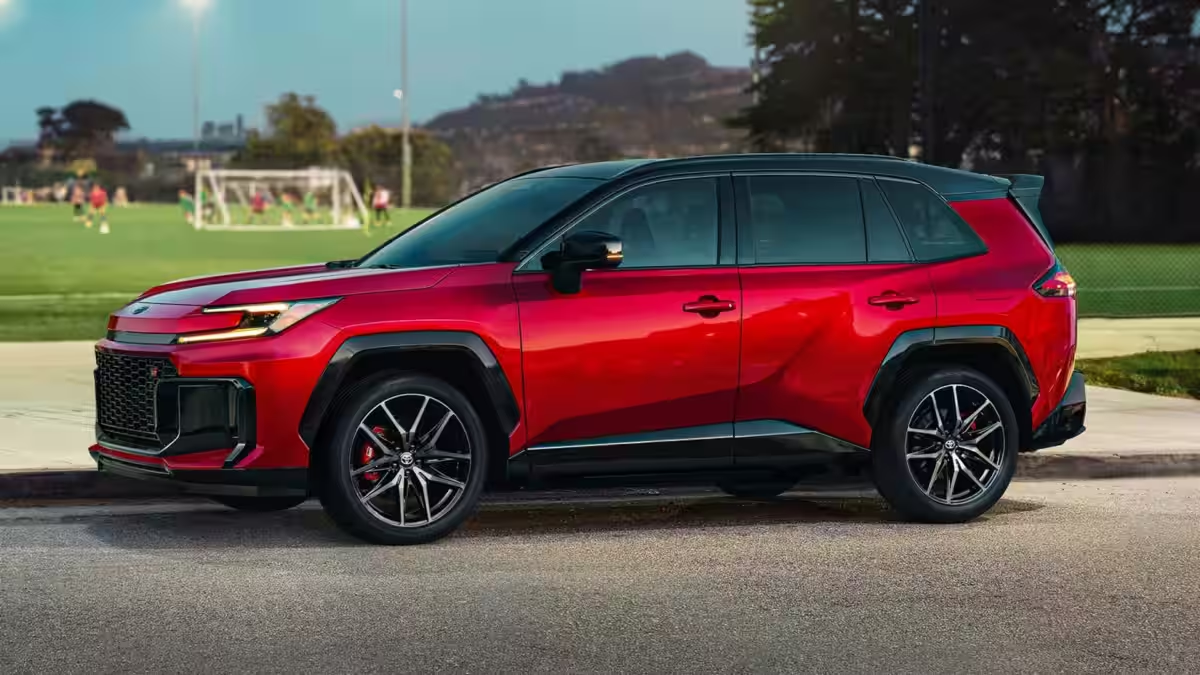
Homes losing power during storms is a problem that rarely inspires elegant engineering – until automakers notice a sales opportunity. Big electric trucks brag about how many kilowatts they can throw at a house. Toyota’s new approach with the RAV4 plug‑in hybrid quietly makes a different pitch: you may not be able to run everything at once, but you can stay powered for days.
Toyota has added an ”HV power supply” mode to the RAV4 PHEV sold in Japan. The system provides a 100‑volt outlet and can deliver up to 1.5 kilowatts to a home. Toyota says that, at an assumed average draw of about 400 watts, the RAV4 PHEV could keep a typical Japanese house running for up to 6.5 days.
That sounds modest when compared with headline figures from larger EVs. Ford’s F‑150 Lightning, for example, has a V2H capacity of 9.6 kW – a number that lets it carry a household through roughly three days at peak usage. The RAV4’s 1.5 kW won’t keep air conditioning, ovens, and electric heat humming together, but its lower sustained draw buys far more hours of backup.
Why lower kilowatts can be more useful
Peak output and usable duration are different tools for different outages. A truck with many kilowatts can run heavy loads but will exhaust a battery much faster. A smaller, efficient system can keep essential appliances – lights, fridge, a router or two – alive for days. For many households, that is the practical value of vehicle‑to‑home (V2H) capability.
Japan’s 100‑volt standard also changes the math. Delivering 1.5 kW at 100 volts equates to about 15 amps of current; in the United States, a similar amperage at 120 volts would produce roughly 1.8 kW. Those differences matter for how much load a single outlet can safely carry and for the design of onboard inverters and connectors.
A short history of ”cars as batteries”
V2H and related concepts are not new. Japanese owners have had early access to bidirectional charging features through networks like CHAdeMO, and Nissan experimented with ’Leaf to Home’ systems more than a decade ago. Globally, automakers and utilities have been testing vehicle‑to‑grid (V2G) and V2H use cases, but standards and regulations have been moving slowly.
Part of the delay is technical: CCS – the dominant fast‑charging standard in Europe and North America – only more recently added clearer paths for bidirectional power, and charging hardware must be certified for safety, islanding (isolating the home from the grid during an outage), and regulatory compliance. Manufacturers also worry about warranty, battery cycling, and aftersales complexity, which is why features like Toyota’s are sometimes region‑specific at launch.
What this means for buyers and Toyota
Toyota hasn’t said it will offer the RAV4’s HV power supply mode in the United States. The company is, however, promising a V2H function for the Highlander EV when it arrives later this year. That hints at a two‑track strategy: limited bidirectional functions on efficient PHEVs where grid and outlet standards make implementation straightforward, and fuller V2H/V2G deployments on purpose‑built EV platforms.
For buyers, the takeaway is simple. If your priority is short bursts of heavy power – running a workshop or whole‑house HVAC – trucks like the Lightning are more suitable. If you want long, low‑power resilience to cover refrigeration, lighting, and communications for several days, a PHEV with a dedicated outlet can be the smarter, cheaper option.
Expect automakers to keep using V2H as a marketing lever. The real hinge for broad adoption will be standardizing the hardware and approvals so homeowners can safely integrate cars into their electrical systems without calling an electrician for every trip to the grocery store. Until then, regionally tailored features – like Toyota’s RAV4 HV power supply in Japan – will offer useful glimpses of how cars can act as mobile fuel tanks for the grid, one household at a time.