

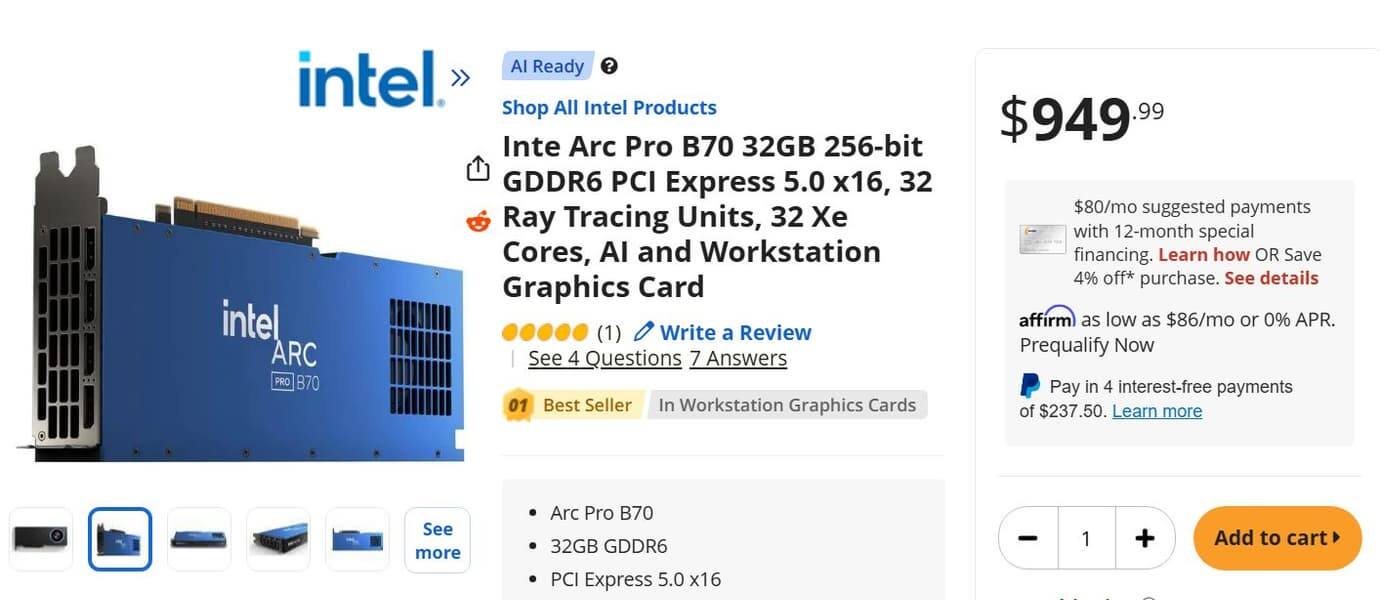
Intel’s new Arc Pro B70 is off to an unusually loud start. The professional graphics card, launched with 32 GB of memory and a $950 price tag, has already climbed to the top of NewEgg’s workstation GPU sales chart, even though it only went on sale there two days ago. For a niche card aimed at workstations, that kind of early traction suggests Intel may have found a sweet spot: enough memory to look serious, and a price that undercuts the usual workstation pain.
Intel introduced the card just over a week ago, and the Arc Pro B70 is the company’s first board built around the higher-end BMG-G31 chip with 32 Xe2 cores. That puts it in a very different lane from consumer gaming cards, where buyers tend to obsess over frames per second; workstation shoppers care more about memory capacity, stability, and whether the thing can survive a long render without throwing a tantrum.
Intel Arc Pro B70 specs and positioning
Here’s the quick snapshot:
- Model: Intel Arc Pro B70
- Memory: 32 GB
- Price: $950
- GPU: BMG-G31
- Xe2 cores: 32
The bigger question is whether Intel can turn a strong launch into something more durable. Nvidia still owns the professional GPU conversation, and that is not because it has better marketing copy; it’s because buyers trust the ecosystem. Intel, meanwhile, is trying to win on value and capacity, which is a sensible move when memory prices are making future launches harder to predict. The rumored Arc B770, for example, had been expected to use the same chip with 16 GB of memory, but that now looks less certain.
Why workstation buyers may be interested
For workstation users, the appeal is straightforward: more VRAM, less compromise. A card like this is less about headline gaming benchmarks and more about getting through creative and technical workloads without running into memory limits. If Intel can keep the Arc Pro line competitively priced and actually available, it may force rivals to be a little less comfortable with workstation margins.
The real test is whether NewEgg’s early bestseller badge reflects a broad wave of demand or just a thin market reacting quickly to a new option. My bet: if Intel keeps supply steady, this card gets a long look from small studios and pros who want 32 GB without paying the usual premium. If supply stumbles, the enthusiasm will cool just as fast as it arrived.