

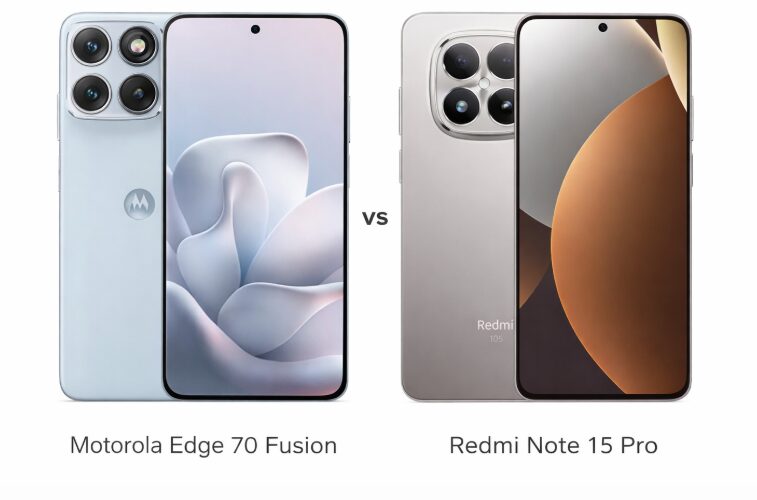
Motorola and Redmi are playing two different games with their mid-range phones. The Motorola Edge 70 Fusion vs Redmi Note 15 Pro comparison comes down to balance versus specs: the Edge 70 Fusion goes after a slimmer build, faster charging, and everyday smoothness, while the Redmi Note 15 Pro counters with a bigger battery, a 200MP main camera, and a more cinematic screen. Motorola is also the cheaper option here.
That split matters because the mid-range category is already crowded with phones that promise everything and compromise somewhere obvious. Here, the compromise is easier to spot: Motorola trims the fat, while Redmi leans into spec-sheet muscle.
Motorola Edge 70 Fusion vs Redmi Note 15 Pro design
The Motorola Edge 70 Fusion is the cleaner-looking phone of the pair. It uses Gorilla Glass 7i, carries IP68/IP69 protection with MIL-STD compliance, and is described as lighter and more refined in the hand. Redmi takes the tougher route with stronger drop resistance, Victus 2 protection, and an eco-leather option that adds a bit of flair.
On screens, Motorola focuses on motion and brightness with a 144Hz AMOLED panel, while Redmi pushes picture quality with Dolby Vision, higher color depth, and better PWM dimming. In plain English: Motorola should feel snappier day to day, while Redmi is aiming for the ”sit down and watch something” crowd.
Battery and charging speeds
Motorola is the quicker pit stop. The Edge 70 Fusion offers 5200mAh or 7000mAh variants and 68W charging, which gives it the edge for people who want less waiting and more plugging in on the move. Redmi counters with a 6580mAh battery and reverse charging, which is handy if your earbuds or another phone are gasping for life.
The catch is charging speed: Redmi’s 45W support is respectable, but it is still behind Motorola. That makes the choice pretty straightforward – endurance first, or speed first.
Camera hardware and selfie quality
Redmi goes for the headline number with a 200MP primary camera, and that should help with detail and cropping flexibility. But the rest of the setup is less ambitious, especially the 8MP ultrawide, which looks like the kind of corner-cutting that saves cost on paper and annoys buyers later.
Motorola’s approach is less flashy and more sensible: a 50MP main camera, a 13MP ultrawide with autofocus, and a 32MP front camera with 4K video. For anyone shooting selfies, calls, or short-form video, that front camera may be the more useful upgrade than a giant rear sensor number.
- Motorola Edge 70 Fusion: 50MP main camera, 13MP ultrawide with autofocus, 32MP selfie camera with 4K video
- Redmi Note 15 Pro: 200MP main camera, 8MP ultrawide, 20MP selfie camera without 4K support
Price and value
- Motorola Edge 70 Fusion: around $250 (₹27,000)
- Redmi Note 15 Pro: around $350 (₹30,000)
That extra money buys Redmi a bigger battery, a 200MP sensor, and a display with more premium video features, but it also buys slower charging and a weaker ultrawide camera.
Motorola’s pitch is more convincing for most people because it concentrates on the things users feel every day: speed, comfort, and consistency. Redmi is the phone for shoppers who still get excited by giant camera numbers and vivid screens – perfectly valid, just a little more billboard than blueprint.
The more interesting question is whether Redmi’s premium positioning can hold if rivals keep undercutting it on charging and balance. If Motorola keeps pairing faster hardware with cleaner pricing, that pressure on Redmi is only going to grow.