

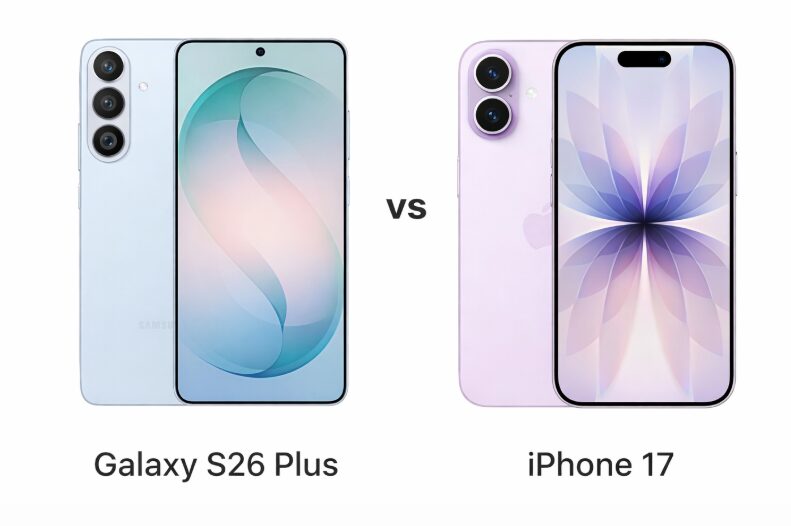
The Samsung Galaxy S26 Plus vs iPhone 17 comparison comes down to value: Samsung leans into hardware muscle, while Apple answers with tighter optimization and a lower price. The Galaxy S26 Plus and the iPhone 17 are both aimed at buyers who want a premium phone without jumping all the way to the ultra-tier circus.
Samsung is selling headroom. Apple is selling balance. And because both brands have spent years refining their own strengths, the winner depends less on raw numbers than on whether you care more about features you can point at or the ones you feel after a week of use.
Display size and build feel
The Galaxy S26 Plus uses a 6.7-inch Dynamic LTPO AMOLED panel with 1440p resolution, Gorilla Glass Victus 2 on both sides, and an Armor Aluminum frame. It is the bigger, sharper, more cinematic option, which still matters if your phone doubles as a tiny TV. Samsung’s flat design also gives it a cleaner flagship look.
The iPhone 17 goes smaller with a 6.3-inch Super Retina XDR OLED display, Ceramic Shield 2, and a polished aluminum frame. Apple’s panel is tuned for excellent color accuracy and higher peak brightness, so it should behave better outdoors. In practice, this is the classic trade: Samsung for immersion, Apple for polish.
Chipsets, RAM, and battery
Samsung ships the Galaxy S26 Plus with Snapdragon 8 Elite Gen 5 or Exynos 2600, depending on region, plus 12GB RAM. That gives it the sort of multitasking and gaming headroom spec hunters love. Apple counters with the A19 chip and 8GB RAM, but its tighter software integration is why iPhones still feel unnervingly quick even when the numbers look modest.
Battery is where Samsung stretches away: 4900mAh with 45W wired charging and reverse wireless support. The iPhone 17 has a smaller battery, but it leans on efficiency and improved wireless charging with MagSafe. That makes Samsung the obvious pick for heavy users, while Apple remains the safer bet if you care more about predictable endurance than headline numbers.
- Galaxy S26 Plus: 12GB RAM, 4900mAh battery, 45W wired charging, reverse wireless charging
- iPhone 17: A19 chip, 8GB RAM, improved wireless charging, MagSafe
Camera hardware and selfie features
The Galaxy S26 Plus comes with a triple-camera setup and a dedicated telephoto lens, so it can do real optical zoom instead of pretending digital crop is a personality trait. That extra lens gives Samsung more flexibility for portraits and distant subjects.
Apple’s iPhone 17 keeps a dual-camera setup, but both rear sensors are 48MP. That should help with detail and consistency, especially because Apple’s image processing tends to stay more natural and predictable than many rivals. Up front, the iPhone 17 also gets an 18MP ultrawide selfie camera with depth sensing and spatial video support, which makes it the more versatile choice for creators.
Galaxy S26 Plus vs iPhone 17 price comparison
Pricing is where this comparison stops being abstract. The Galaxy S26 Plus is priced around ₹1,20,000, while the iPhone 17 comes in at approximately ₹83,000. That gap is large enough to buy a lot of accessories, or at least a strong sense of smugness.
- Galaxy S26 Plus: around ₹1,20,000
- iPhone 17: approximately ₹83,000
Samsung’s case is straightforward: you get a sharper screen, more RAM, a bigger battery, faster charging, and extra camera hardware. Apple’s case is simpler and probably more persuasive for most people: excellent performance, strong cameras, and long-term software support at a much lower cost. The premium phone market has been drifting this way for a while – hardware bragging rights on one side, tighter value on the other – and Apple is still better at turning restraint into a selling point.
If you want maximum flexibility and productivity features such as Samsung DeX, the Galaxy S26 Plus looks built for you. If you want the more balanced phone, the iPhone 17 is the safer bet, and maybe the smarter one too. The real question is whether you want a device that wins spec comparisons or one that disappears into everyday use without arguing with your wallet.