

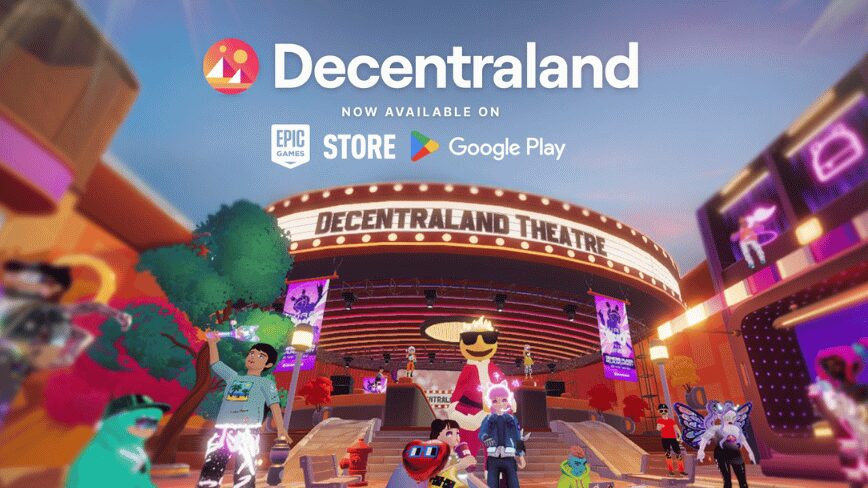
Decentraland has spent years selling a simple idea: the metaverse would be its own place. Now it is doing the opposite. On Monday, the virtual world landed on the Epic Games Store and Google Play, with an iOS app due later, in a clear attempt to borrow distribution from the platforms where people already spend their time.
That is less glamorous than the original metaverse pitch, but probably more realistic. Decentraland’s move to the Epic Games Store gives it access to a huge PC audience, while mobile opens the door to far more casual drop-ins – and fewer of the rituals that used to make virtual worlds feel like homework.
Why the Epic Games Store matters more than a new app icon
The Epic Games Store is the bigger swing here. Epic said it had 317 million registered PC users in 2025 and 78 million monthly active users in December, while third-party game spending on the store rose 57 per cent year on year to more than $400 million. For a project that has long battled the charge that its world is empty, that kind of traffic is the point: if you cannot summon an audience from scratch, go where the audience already exists.
There is a practical reason this matters. Decentraland is not competing only with other blockchain projects; it is competing with Fortnite, Roblox, live-service games, Discord, Twitch, and every other thing that claims a slice of attention. Epic already trained its users to browse, install and collect freebies, which makes it a better discovery channel than a standalone launch page no one finds by accident.
Decentraland on Google Play puts mobile access first
The Google Play release follows the same logic. Decentraland cites Mordor Intelligence figures showing mobile devices account for 71.55 per cent of the social gaming market, plus DataReportal data that says the average internet user spends three hours and 46 minutes a day on their phone. The Consumer Technology Association also pegs cross-platform play engagement at 61 per cent of gamers. In other words: asking people to plan a desktop session is a high-friction strategy in a low-patience world.
Gino Cingolani of DCL Regenesis Labs described the mobile push as a way to reduce the barrier to entry, and that feels right. Mobile will not magically make Decentraland mainstream, but it does turn ”I need to sit down and boot this up” into ”I can check in now.” That tiny difference has built empires elsewhere.
- Epic Games Store: 317 million registered PC users in 2025
- Monthly active users on Epic in December 2025: 78 million
- Third-party game spending on Epic: more than $400 million, up 57 per cent year on year
- Decentraland on mobile: Android now live, iOS to follow
Decentraland’s numbers are better than the narrative
The project is also leaning on signs of life inside its own economy. It says it had roughly 847,000 monthly unique visitors to its web client in late 2025, with daily unique visitors up 23 per cent since mid-2025 after a lighter desktop client shipped. In January 2026, it says it hosted 312 community events with average attendance of 127 unique visitors each. Those are not mainstream-gaming numbers, but they are a lot healthier than the zombie-metaverse caricature that has followed the sector around for years.
There is still plenty of baggage. The MANA token trades at roughly $0.08, down from a peak above $5 during the 2021 crypto run, and active-user tracking has long been disputed. Still, Decentraland has outlasted most of its rivals, and that matters in a market where many early metaverse projects have simply vanished or quietly pivoted away. It was founded in 2015, raised $26 million in its 2017 initial coin offering, and launched publicly in February 2020.
Meta’s retreat leaves room for someone else
The timing is hard to ignore. Meta, which spent roughly $70 billion on Reality Labs after making the metaverse its calling card in 2021, has since cut 1,500 Reality Labs employees, closed three internal game studios, slashed its metaverse budget by 30 per cent, and announced in March that it would shut down Horizon Worlds on VR headsets, before partially walking that back after backlash. The company that did most to popularise the term has shifted toward AI infrastructure and wearables instead.
Decentraland is trying to turn that retreat into a sales pitch. Its community-governed structure means users own land parcels and avatars as Ethereum-based tokens, and no single company can decide to pull the plug if the spreadsheet gets ugly. That is a cleaner story than Meta’s corporate about-face, even if it does not solve the harder problem: persuading enough people to care.
The project is offering an Epic-exclusive wearable called the Epic Arrival Shield to anyone who installs through Epic, and it will celebrate the launch with an in-world party on 2 April at 7pm UTC featuring Dúo Dø and DirkNeuenfels, with Twitch streams too. That mix of storefronts, apps, and streaming shows where virtual worlds live now: not in one grand destination, but in the seams between platforms. The open question is whether Decentraland can make those seams feel like a place worth returning to.