

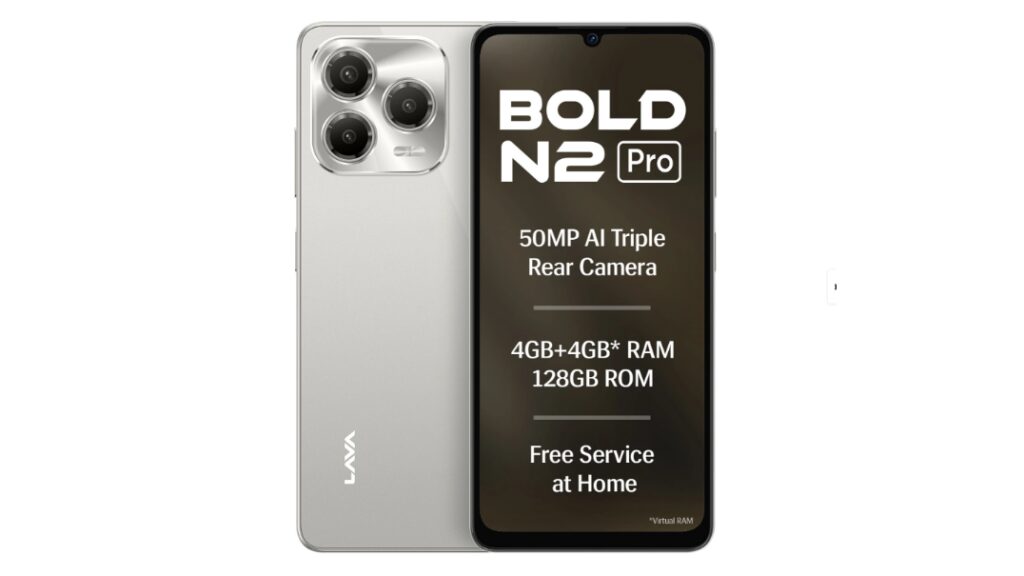
Lava has launched the Lava Bold N2 Pro, a budget 4G phone that tries to do the unglamorous job of feeling better sorted than its sibling. It arrives weeks after the Bold N2, costs less on paper, and swaps in a newer chipset, smoother display, and much stronger camera hardware – which is a pretty decent way to make a ”Pro” badge look less like marketing glue.
Unisoc T7250 and 4GB RAM
The Bold N2 Pro runs on the Unisoc T7250, a 12nm chip with Cortex-A75 and A55 cores plus a Mali-G57 GPU. Lava says it should handle the basics: calls, messaging, online payments, and YouTube, which is exactly the kind of sentence budget-phone buyers have learned to decode as ”don’t expect miracles.” The only configuration listed so far is 4GB RAM and 128GB storage.
- Display: 6.67-inch LCD
- Refresh rate: 120Hz
- Resolution: 720p+
- Battery: 5,000mAh
- Charging: 18W, with a 10W bundled charger
Lava Bold N2 Pro camera upgrade over the Bold N2
The biggest improvement is on the imaging side. Lava has fitted a 50MP main camera and an 8MP front camera, replacing the standard Bold N2’s 13MP rear and 5MP selfie setup. That does not make it a photography hero, but it does make the N2 Pro look more credible for everyday snaps, video calls, and the endless parade of scanned documents that define low-end smartphone life.
It also gets IP54 protection for dust and splash resistance. The regular Bold N2 counters with a slightly larger display and an IP64 rating, but it uses the much older UNISOC 9863A chip and Android 15 Go, so the ”better” phone depends on whether you care more about protection or actual speed.
Lava Bold N2 Pro price on Flipkart
The Bold N2 Pro is listed at ₹8,000 on Flipkart, undercutting the Bold N2’s ₹9,000 price. That makes this one a straightforward value play: less money, newer silicon, faster screen, better cameras. In a market where entry-level phones often win by trimming features until nothing is left, Lava has at least tried to move the trade-offs around instead of just chopping them up.
The lingering question is whether buyers will care that it is still 4G. In India and other price-sensitive markets, that can still be enough for a lot of people, but competitors keep pushing 5G into lower brackets, so Lava may have to keep leaning on price and camera upgrades to stay relevant.