

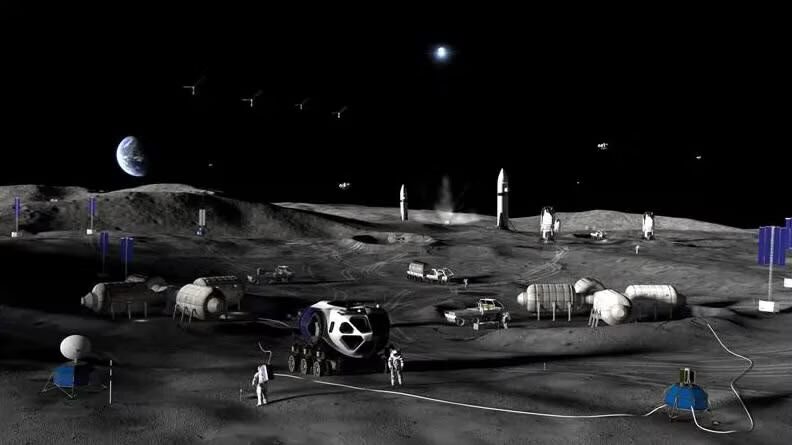
NASA is gearing up for the first crewed Artemis mission, with the launch window opening on April 1. As preparations accelerate, the agency has announced a major overhaul of its lunar strategy: the much-discussed Lunar Gateway orbital station project is officially paused in favor of building a permanent Moon base estimated to cost around $20 billion.
The Lunar Gateway was originally conceived as an international lunar orbit outpost to support Moon missions and deep space exploration. Now, NASA is redirecting resources toward establishing a sustainable foothold on the lunar surface to secure a long-term US presence in space.
NASA Administrator Jared Isaacman emphasized the urgency: the goal is to land humans on the Moon again before the end of this presidential term and lay the groundwork for continuous habitation on the lunar surface.
NASA’s phased plan for building the Moon base
The Moon base development is structured in three stages:
- Initially, robotic rovers and scientific payloads will be sent to the lunar surface through the Commercial Lunar Payload Services program, utilizing private contractors.
- Next, ”semi-habitable infrastructure” will be established with astronauts and international partners contributing on-site efforts.
- The final phase involves building full-scale facilities for long-duration habitation, including modules from the Italian Space Agency and lunar transport vehicles developed by the Canadian Space Agency.
Following the Artemis V mission planned for 2028, NASA aims to launch crewed Moon missions about every six months, marking a steady cadence of lunar exploration.
In the global space exploration context, NASA’s pivot away from the Lunar Gateway contrasts with earlier ESA and Canadian-led ambitions for an orbiting lunar station. The current focus on a surface base aligns more directly with China’s continuing expansion of its Chang’e lunar exploration program. Meanwhile, private companies are increasingly involved in NASA’s commercial lunar payload contracts, echoing the broader trend of public-private partnerships in space.
Comet 41P/Tuttle-Giacobini-Kresák’s spin changes dramatically
Stepping away from lunar news, astronomers recently recorded an extraordinary shift in the rotation of comet 41P/Tuttle-Giacobini-Kresák for the first time. Published in The Astronomical Journal, data from NASA’s Swift observatory and the Hubble Space Telescope show the comet’s rotation period shrank from 46-60 hours to about 14 hours.
Scientists attribute this acceleration to outgassing-solar heating causes surface ice to sublimate, producing jets that act like thrusters, altering the comet’s spin. David Jewitt from the University of California compared this to giving a carousel a series of nudges that can drastically speed it up or even reverse its direction.
New detailed images of Saturn’s atmosphere from James Webb and Hubble
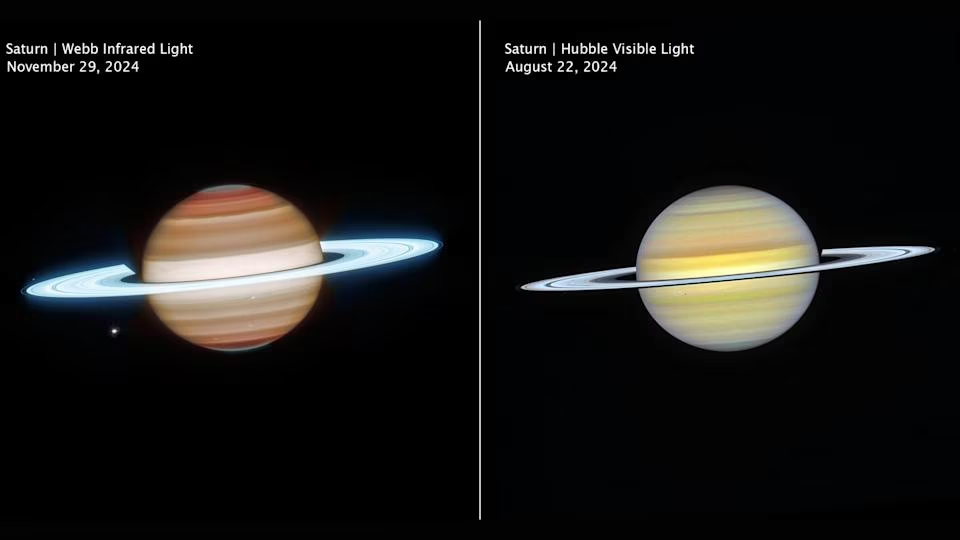
This week also brings stunning new visuals of Saturn captured by the James Webb and Hubble telescopes. The images reveal the planet’s complex atmosphere, showcasing storm systems, multiple cloud layers at varying depths, and powerful jet streams.
This week’s developments highlight both a shift in NASA’s lunar base ambitions and new discoveries in planetary science and comet research.
Looking ahead, NASA’s refocused Moon base strategy raises questions about international collaboration and budget allocation. Will this surface-first approach accelerate sustained human presence on the Moon, or does shelving the Lunar Gateway risk losing valuable orbital infrastructure benefits? Observers will be watching closely as NASA moves from concept to construction in a competitive and rapidly evolving space race.