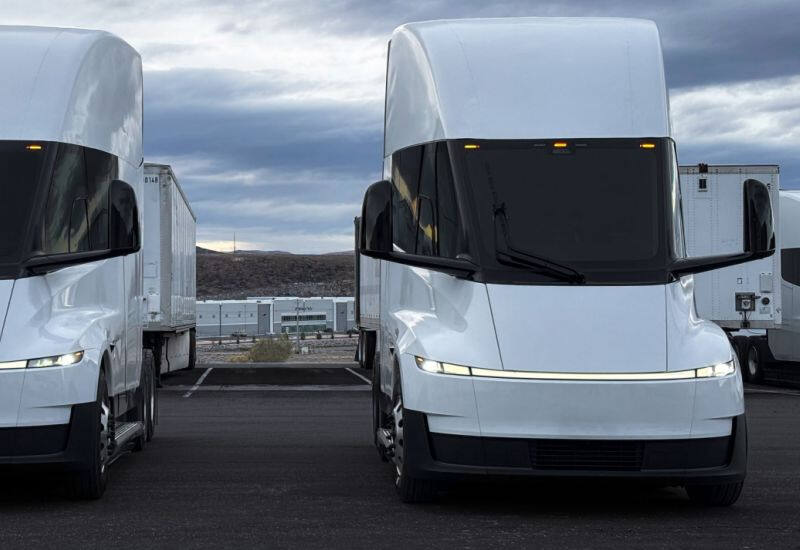
Tesla has made significant strides with its electric Semi trucks, targeting a durability milestone of 1.6 million kilometers on a single battery pack. Currently prepping for mass production in Nevada, the Semi has shed 454 kg of weight, improving payload capacity to rival traditional diesel trucks under US regulations that offer a 908 kg weight allowance for electric vehicles.
Dan Priestley, Tesla’s Semi program director, revealed in an interview with Jay Leno that customers testing the trucks daily haul loads exceeding 20 tonnes. The fleet’s uptime reaches 95%, with 75-80% of repairs completed within 24 hours, half of those lasting under an hour. Cost comparisons show Tesla’s Semi trucks are about 50% cheaper to operate than diesel trucks in California, and roughly 20% cheaper nationwide.
Priced at $290,000 for the long-range model capable of 800 km on a single charge, Tesla positions the Semi against a mostly vacated zero-emission competitor landscape, with Nikola’s bankruptcy removing a significant rival. Tesla claims the Semi’s battery packs won’t need replacement for up to 1.6 million kilometers-well within the typical lifecycle range that transport companies plan for trucks, between 800,000 and 1.6 million km.
Charging infrastructure is ramping up, with Tesla building 46 high-powered 1.2 MW charging stations nationwide by early next year. These stations can replenish 60% of the battery’s charge in just 30 minutes, providing roughly 480 km more driving range under load. Looking ahead, Tesla is exploring wireless inductive charging for the Semi, similar to technologies planned for its Cybercab autonomous taxis.
Tesla Semi battery and charging specifications
- Battery pack durability: up to 1.6 million kilometers without replacement
- Long-range model price: $290,000
- Range per charge (long-range model): 800 km
- Charging stations: 46 with 1.2 MW power across the US by early next year
- Charging speed: 60% charge in 30 minutes (~480 km added driving range)
- Future wireless inductive charging in development
Aerodynamic and mechanical improvements in Tesla Semi
Aerodynamic improvements include a 7% reduction in drag coefficient from earlier designs, already outperforming supercars like the Bugatti Veyron. The shorter wheelbase of the 520 km range Semi allows for a turning radius comparable to Tesla’s Model 3 and Model Y, enhancing maneuverability over typical heavy trucks.
Mechanical features blend legacy and innovation: the steering uses a mechanical shaft with electronic assistance, and hydraulic brakes are electronically controlled to integrate with standard third-party semi-trailers. The drive system smartly switches between dual driven axles, optimizing one for climbing and starting and the other for efficient highway cruising.
Technical synergy with Tesla Cybertruck and driver convenience features
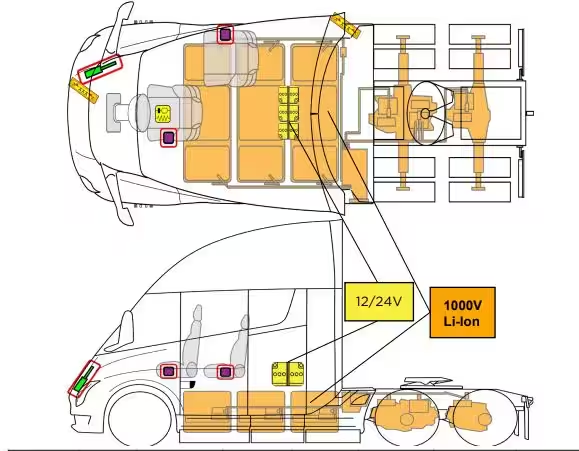
Technical synergies with Tesla’s Cybertruck include the use of 4680 battery cells and a 48-volt auxiliary system architecture, which reduce wiring weight and boost range. Notably, the Semi can power refrigerated trailers directly from its main battery without relying on diesel generators, reducing emissions during transport.
Driver convenience is prioritized with features like fully lowering side windows, enabling easy payment and interaction at checkpoints without exiting the cab. Tesla aims to produce up to 50,000 Semi trucks per year at its Nevada facility, expanding its push into sustainable freight transport.