

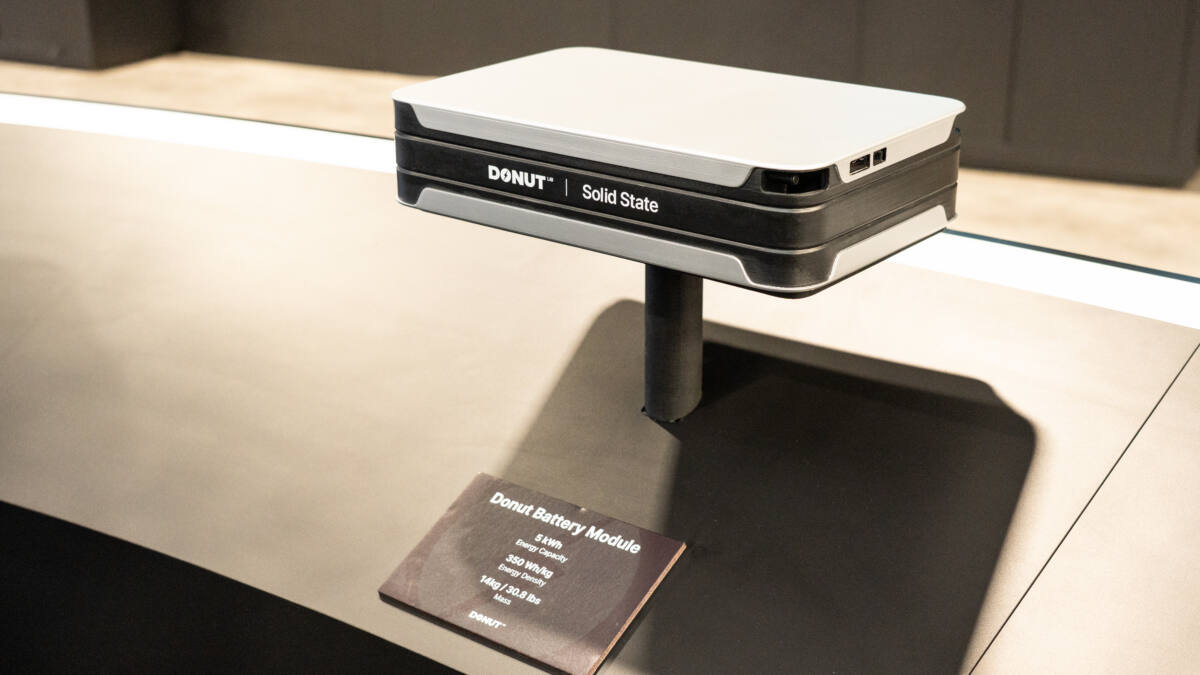
Donut Lab continues to push its solid-state battery technology into the spotlight with independent testing focused on its behavior under physical damage. The latest experiments, conducted by Finland’s VTT Technical Research Centre, revealed that while the battery’s energy capacity sharply dropped after damage, it avoided the thermal runaway and fires commonly seen in damaged lithium-ion cells. This safety-first approach underscores the startup’s pitch that its battery fails gracefully rather than catastrophically.
Results of Donut Lab’s solid-state battery damage tests
The damaged state of Donut’s battery arose after an earlier extreme heat test compromised its vacuum-sealed pouch. Researchers ran three sequential tests: an initial baseline of five charge cycles at 1C (26 amps), a high-stress 50-cycle test at 5C (130 amps), and finally another five-cycle baseline at 1C to assess degradation. Results showed the cell’s energy capacity plunged dramatically-from 24.7 amp-hours down to 11.2 Ah-representing a 55 percent loss. Efficiency dropped from roughly 90 percent to 83 percent, while the battery experienced a bulky 17 percent volume increase due to swelling.
Why the battery degraded after damage
The swelling and accelerated degradation were mostly attributed to the loss of the vacuum seal, allowing environmental factors to degrade the cell faster than normal. Still, the battery remained stable with no dangerous temperature spikes or fires, which Donut Lab points to as progress in creating inherently safer energy storage solutions compared to conventional lithium-ion batteries. This safety advantage could prove critical for electric vehicles and large-scale energy storage, where thermal runaway remains a significant risk.
Unverified claims on durability and energy density
However, these damaged-condition tests mark the closest Donut Lab has come to cycling its solid-state battery so far. The company has yet to provide proof of long-term durability through accelerated aging tests simulating thousands of charge-discharge cycles under undamaged conditions. Donut Lab has previously claimed remarkable longevity-up to 100,000 cycles, far beyond the typical 1,000 to 2,000 cycles seen in current EV batteries, equating to about 270 years of use. This claim remains unverified by external parties.
Moreover, Donut Lab has yet to submit its battery for independent validation of its claimed 400 watt-hours per kilogram energy density, a standard benchmark measuring the ratio of weight to output. Given the hype around its technology, the absence of this standard test raises questions about how the battery performs under real-world conditions.
Next steps for Donut Lab’s solid-state battery verification
While Donut Lab’s damage test provides insight into the battery’s safer failure mode relative to lithium-ion, proving its technology’s readiness for commercial use still requires transparent, rigorous verification on durability and energy density. Industry watchers are keen to see forthcoming independent results to separate genuine breakthroughs from optimistic claims in the crowded solid-state battery space.