

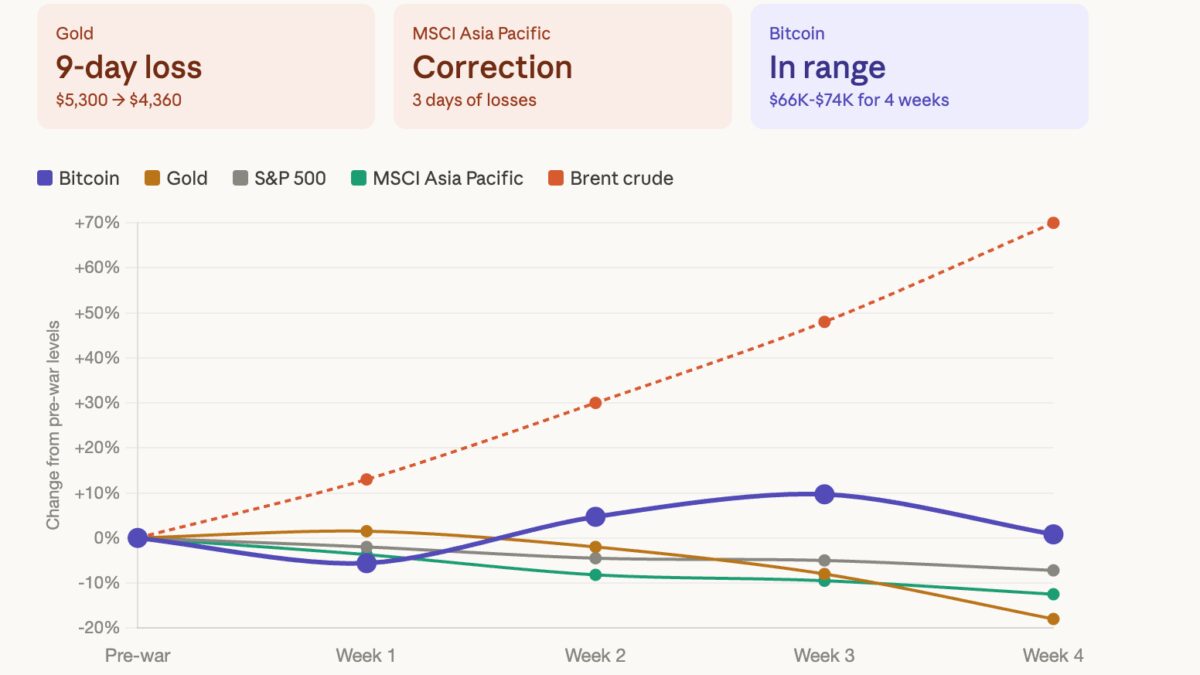
Bitcoin remains resilient above $68,000 even as gold suffers its longest losing streak in years amidst the ongoing Iran conflict, defying traditional safe-haven expectations. Gold prices tumbled for a ninth consecutive day to around $1,360, marking an 18% drop from recent highs, while Asian equities slid toward correction territory amid rising inflation fears and hawkish central bank moves.
The geopolitical turmoil, now in its fourth week, has upended the usual market dynamics where investors flock to gold amid uncertainty. Instead, shrinking liquidity and intensified conflict pressures are steering capital away from metals. Despite this turbulence, Bitcoin’s price climbed modestly, trading near $68,316 with a 1.5% rise over 24 hours, demonstrating relative stability compared to other major cryptocurrencies and global assets.
Bitcoin price resilience amid geopolitical tensions
Ethereum and XRP showed gains of 2.7% and 2% respectively, while tokens like Solana and Dogecoin struggled, illustrating broad sector volatility. Bitcoin’s weekly performance, down about 6%, surprisingly outshines gold’s dramatic decline and reflects its maturing role as a nontraditional safe haven amid conflict-driven market stress.
Impact of Iran conflict on commodities and energy markets
Macroeconomic factors exacerbate the downturn for stocks and bonds, as bond yields climbed on expectations of inflation fueled by the drawn-out conflict. Brent crude oil prices surged past $113 a barrel this year, sparking concerns over supply disruptions, especially with the Strait of Hormuz-a strategic oil shipping lane-facing potential blockage. Goldman Sachs upgraded Brent’s full-year forecast to $85 a barrel, citing this strain as the largest supply shock ever for crude markets.
Shift in gold demand amid global liquidity concerns
Two Prime’s CEO Alexander Blume explained that the weakness in gold results partly from China and other nations reversing earlier aggressive gold purchases aimed at decoupling from the U.S. dollar, shifting instead toward liquidity amid intensifying warfare. Meanwhile, Bitcoin and its derivatives markets have maintained steadier footing, with some investors betting on rising funding and futures rates as a sign of bullish contrarian positioning.
Potential geopolitical risks impacting financial markets
The geopolitical cliffhanger continues as former President Trump’s ultimatum to target Iran’s power plants nears expiration, with Tehran vowing to retaliate by indefinitely closing the Strait of Hormuz and striking energy infrastructure across the region. This standoff adds uncertainty, underpinning volatility across commodities, stocks, and digital assets.

Global market reactions and investor sentiment
Meanwhile, global equity futures are signaling further downside, with S&P 500 and European indices mirroring Asian markets’ declines. The widening inflation fears and hawkish central bank bias suggest that safe-haven flows may remain unsettled, potentially leaving Bitcoin’s relatively firm stance as a growing, albeit still unconventional, refuge in turbulent times.