

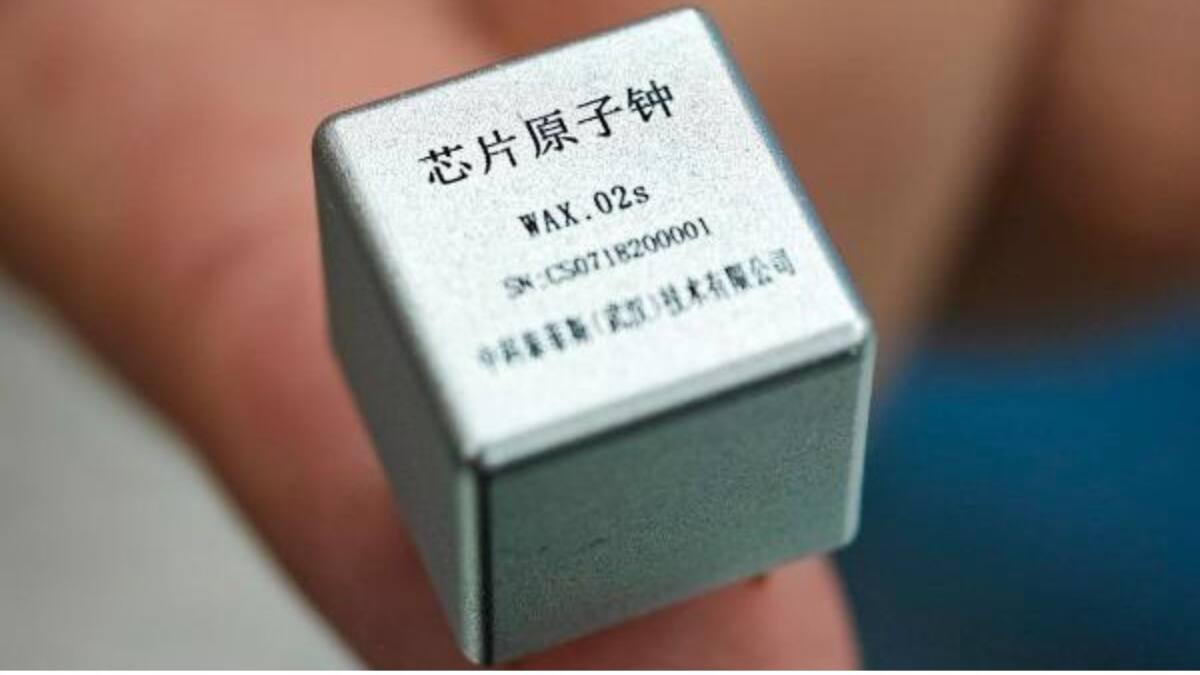
China’s Wuhan University has developed and begun mass-producing what it claims to be the world’s smallest atomic clock, a breakthrough that could redefine timing accuracy in military drones, missiles, and underwater navigation. The clock’s minuscule size-just 2.3 cubic centimeters, roughly the volume of a fingernail-does not skimp on performance, losing merely one second every 30,000 years. This level of precision enables highly synchronized operations, crucial for coordinated drone swarms and secure battlefield communications.
The innovation hinges on replacing the bulky microwave-cavity resonance method typically used in atomic clocks with a quantum-optical technique called coherent population trapping. This technique leverages microfabricated vapor cells containing alkali atoms such as rubidium, combined with modulated semiconductor lasers to achieve stable frequency references in a dramatically reduced form factor. Unlike conventional compact atomic clocks, which often require several hundred cubic centimeters and higher power consumption, this chip-scale device operates at a fraction of that size and with significantly less energy consumption, facilitating its integration into compact platforms like drones and missiles.
The leap in timing precision for military drones and missiles
Timely precision is everything in modern military operations, where nanoseconds can dictate the success of drone strikes or missile targeting. This tiny atomic clock promises synchronization levels that could enable drones to operate in more tightly coordinated swarms. China’s new clock is notably smaller than American rivals, at less than one-seventh the size of leading US models, offering comparable precision in a form more suitable for miniaturized platforms. With mass production underway and support from Yangtze River Industry Group, China is positioning itself to extend use of these clocks beyond the military, potentially transforming secure communications and navigation systems.
The UK is also advancing atomic clock miniaturization, with the National Physical Laboratory developing a portable atomic fountain clock that shrinks the vacuum system by a factor of 20. Such global efforts underscore a broader trend: precision timing is becoming more compact and accessible, a key enabler for emerging technological domains such as autonomous vehicles, quantum communications, and tactical defense.
Technical challenges and future applications of miniaturized atomic clocks
Despite the impressive miniaturization, challenges remain that cloud widespread adoption. The specialized lasers and demanding fabrication processes increase costs, and production scaling is still underway. The Wuhan University team aims to overcome these barriers by tapping into chip-level fabrication techniques that promise cost reductions and broader distribution. If successful, these atomic clocks could soon become staples in both military and civilian communication networks, providing ultra-precise time references critical to secure, synchronized transmissions.
As militaries invest in swarm robotics and underwater operational capabilities, integrating such highly accurate timing devices could provide decisive advantages. Beyond the battlefield, the technology points to a future where ultra-compact atomic clocks enhance GPS alternatives, mobile network timing, and quantum cryptography infrastructures.