


Director Denis Villeneuve just dropped the teaser for ”Dune: Part Three,” set to hit theaters December 18, 2026. Shot predominantly on 65mm film with select scenes in IMAX and desert sequences captured on digital IMAX cameras, the trailer ignited the internet and reignited interest in the saga’s visionary tech. But beyond cinematic spectacle, the universe Frank Herbert created is surprisingly grounded-many gadgets from Arrakis are edging into our reality. Here are five standout Dune technologies already taking shape in the real world.
Technologies inspired by Dune’s visionary tech
Unlike most sci-fi, ”Dune” famously omits artificial intelligence and computers. Following a fictional war against thinking machines, Herbert imagined a universe where electronic brains are banned, forcing humanity to evolve through biology, ecology, mechanical innovation, and human potential instead of relying on digital computing. This makes the series’ tech concepts uniquely relevant today as they tackle survival, transport, and resources with biological and mechanical solutions rather than AI dominance.
Ornithopters-flapping-wing aircraft inspired by dragonflies
On the desert world of Arrakis, the ornithopter is the go-to flying machine-a vertical takeoff and landing craft with flapping wings mimicking insect flight, capable of slow, quiet, precise hover and navigation in tight spaces. Denis Villeneuve’s films highlight the ornithopter’s signature buzzing hum, making it a visual and audio icon of the trilogy.
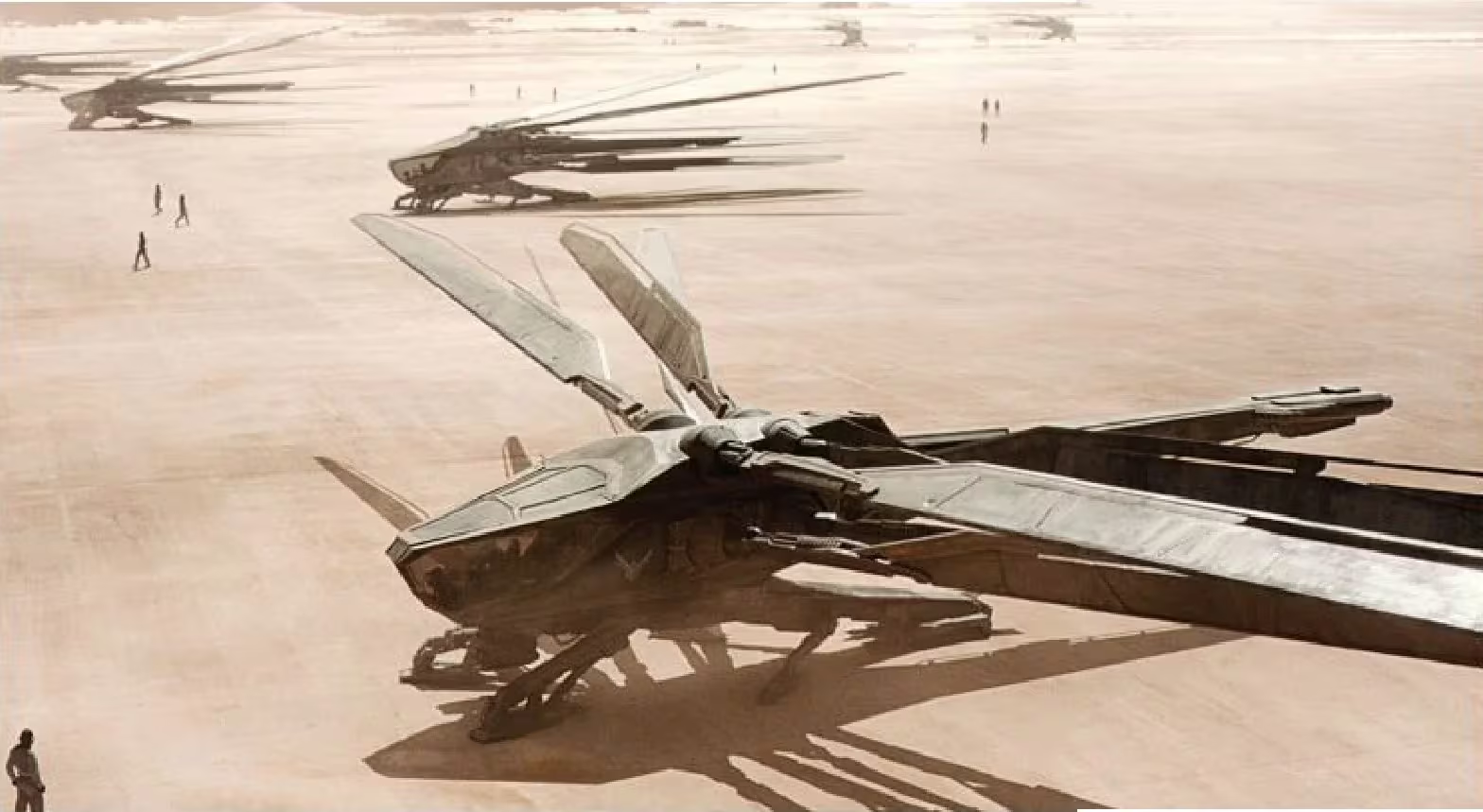
Herbert chose flapping wings for a reason: on a sand-covered planet where vibrations attract giant sandworms, a quiet, steady aircraft avoids deadly attention better than noisy fixed-wing planes or helicopters.
Ornithopters in today’s aviation and drones
The ornithopter concept dates back to Leonardo da Vinci, but practical prototypes appeared only in the 21st century as materials and computational modeling improved. In 2010, University of Toronto students built Snowbird-the first human-powered ornithopter with a 32-meter wingspan weighing just 42 kg. Test pilot Todd Reichert flew for 19.3 seconds on pure muscle power, setting an unbeaten world record. Earlier, the same team flew a turbine-powered ornithopter, ”Mr. Bill,” featuring a 13-meter wingspan.
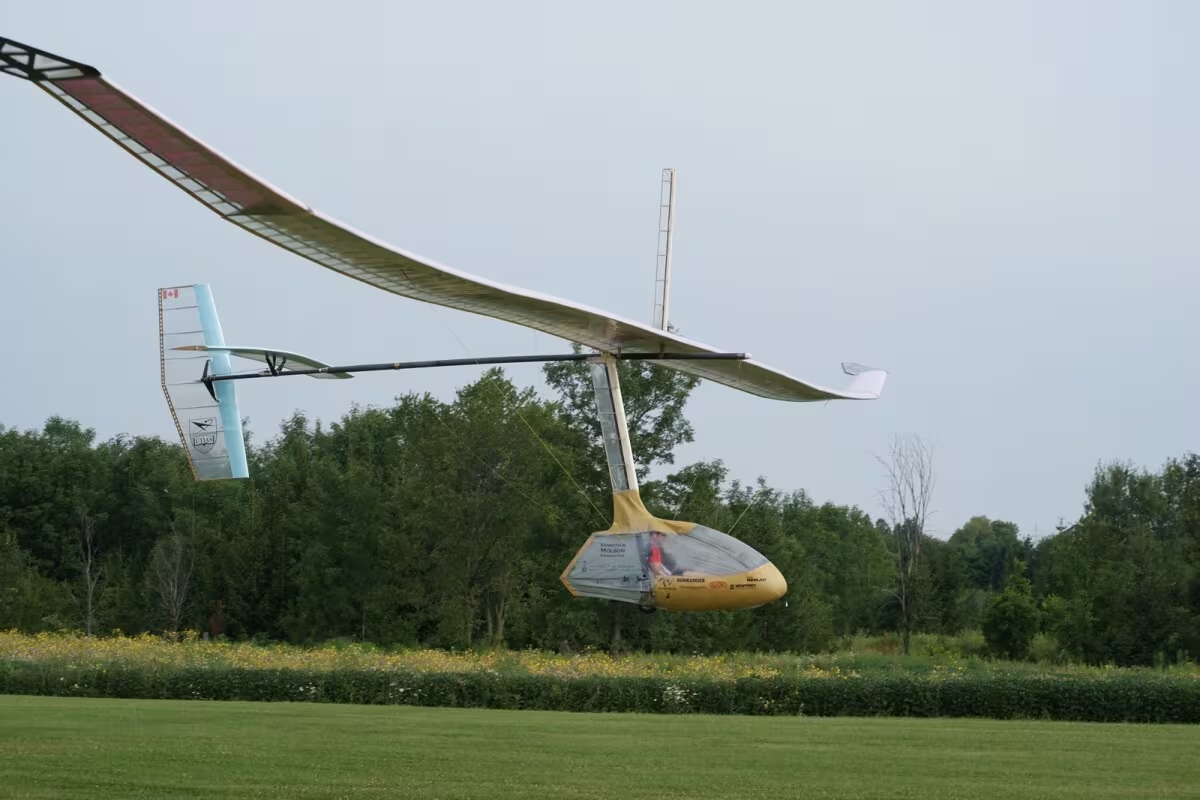
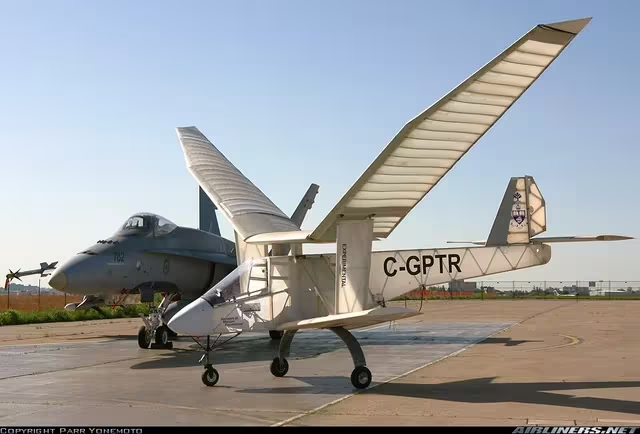
Studies show flapping-wing drones sized like birds use about a third less energy than equivalent quadcopters. Researchers now experiment with hummingbird-sized drones for silent indoor reconnaissance, able to mimic real birds. The physics challenge? Scaling ornithopters. As wings grow bigger, stress and fatigue on materials increase exponentially. Today’s flapping drones stay small, but future passenger-sized ornithopters will depend on next-gen carbon composites and metamaterials.
What is a Dune ornithopter? It’s a flapping-wing aircraft modeled after bird or insect flight, used for quiet, precise travel over the desert planet Arrakis. Its design suits the need to avoid attracting dangerous predators sensitive to vibrations.
Stillsuits-wearable systems turning sweat into drinkable water
Stillsuits are among the most meticulously devised tech in Herbert’s universe. Designed for survival in the desert, these full-body suits recycle the wearer’s sweat, breath moisture, and even urine through multilayer filters and heat exchangers, then store reclaimed water in reservoirs accessible via a neck tube. Properly fitted stillsuits lose less moisture in a day than a thimbleful.

Real-world stillsuit technology and water recycling
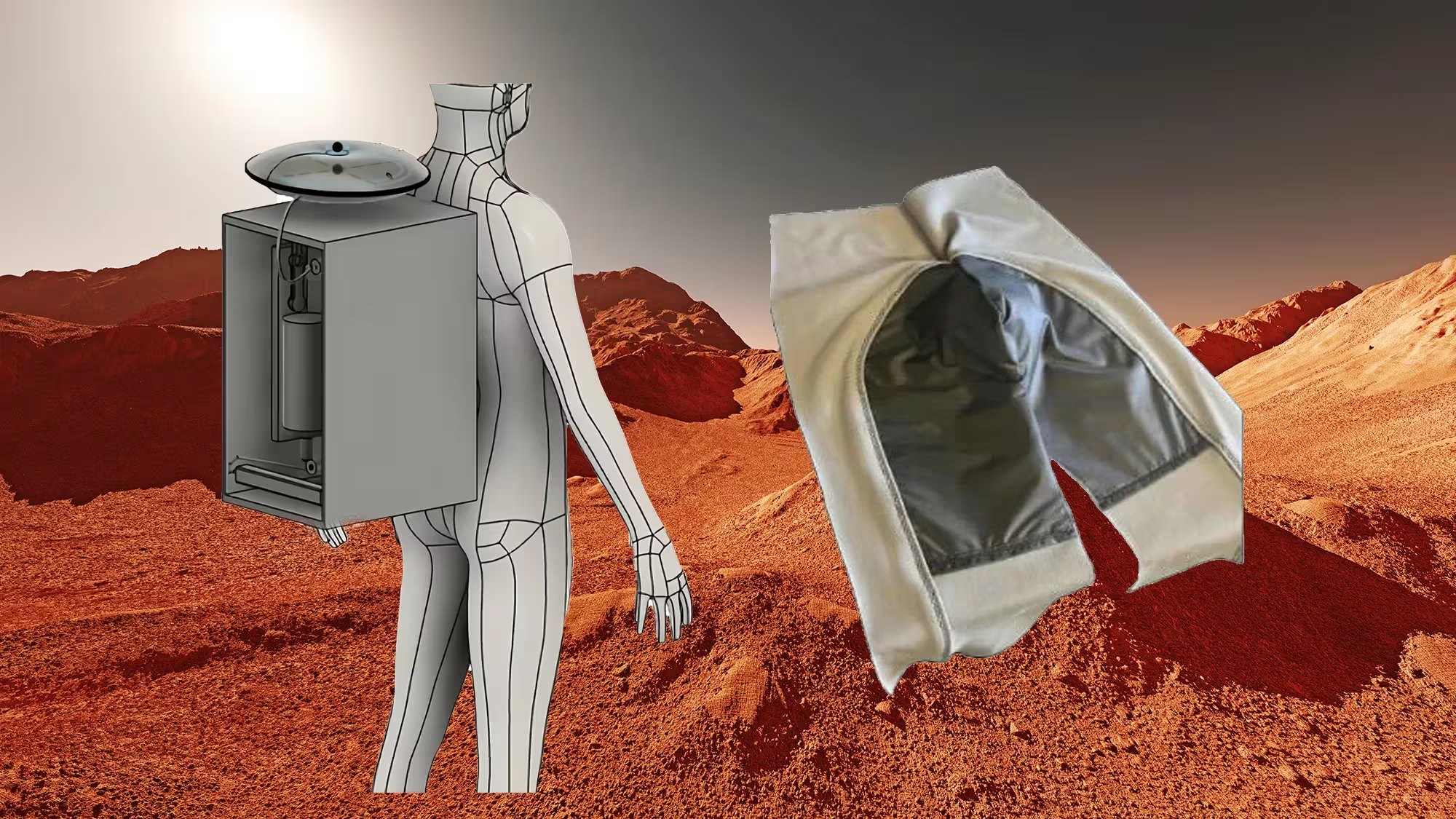
In 2024, Cornell researchers unveiled a prototype inspired by stillsuits for NASA spacesuits: a vacuum catheter coupled with a direct and reverse osmosis filtration system that continuously converts urine into drinkable water during spacewalks. According to lead author Sophia Ettlin, it ”provides continuous potable water delivery with multiple safety layers,” designed for Artemis lunar missions.
The International Space Station’s closed-loop water recycling system recovers 98% of crew wastewater-including sweat and breath moisture-producing water purer than many city supplies on Earth. NASA regularly highlights this system’s effectiveness.
Also in 2024, the YouTube channel Hacksmith Industries built a stillsuit prototype from household items: a suit layered with Peltier-effect heat exchangers and a filtration module. Under sauna-like conditions, it collected enough moisture from the wearer’s neck sweat to provide several sips of water.
With climate change intensifying water scarcity, stillsuit-like tech gains relevance on Earth. The UAE and Saudi Arabia test atmospheric water generators extracting moisture even at 10% humidity. Military units develop water-recovery gear for desert operations. What Herbert imagined for Arrakis now mirrors harsh realities in parts of our world.
What is a stillsuit and how does it work? In Dune, it’s a protective suit that traps body moisture-including sweat, breath, and urine-filters and reclaims it through layered heat exchangers, returning it as drinkable water. Real NASA systems mimic this principle for lunar and Martian spacesuits, while the ISS recycles nearly all crew water waste similarly.
Mentats-human minds as supercomputers
Since computers are outlawed in the Imperium, Mentats fill their role: humans trained over decades to perform complex calculations, analyze massive data sets, and predict outcomes faster than machines. Characters like Piter De Vries, the Baron Harkonnen’s Mentat, swiftly unravel political intrigues with dozens of variables in moments.

Mentats aren’t magic-they result from extreme mental discipline, special diets (including small doses of the spice melange), and years of methodical training. Herbert described them as people who ”think so clearly that clarity becomes dangerous.”
Modern parallels to Mentats in cognitive enhancement
The concept of humans augmenting cognition is enjoying a renaissance-not replacing, but enhancing minds. In 2024, Neuralink successfully implanted a brain-computer interface allowing a paralyzed patient to control a computer and play chess with thought alone. The non-invasive Synchron system lets users type at 62 characters per minute using only their minds. These advances echo Herbert’s vision of expanding human potential.
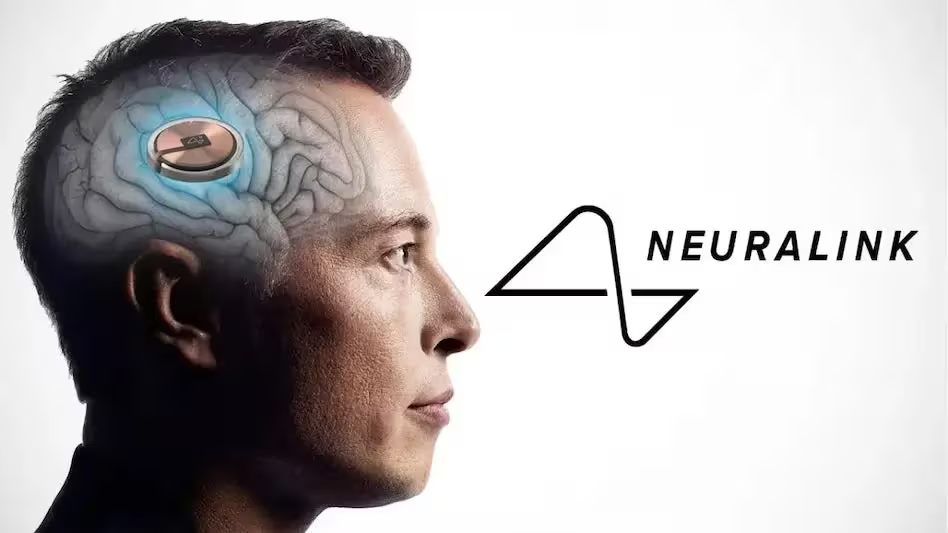
Ultimately, the real ”Mentats” today are expert minds-grandmasters, intelligence analysts, surgeons-who train their brains to spot patterns where most see only noise. Herbert took this potential and pushed it to the extreme.
Who are Mentats in Dune? They are humans trained to perform tasks computers would normally handle: fast calculations, complex probability analyses, and pattern recognition-all without electronic assistance. Real-world equivalents include neural interfaces like Neuralink and cognitive augmentation software.
Terraforming-transforming barren planets into livable worlds
Planetologist Liet-Kynes’s century-spanning plan aims to turn Arrakis from desert wasteland into a green, sustainable world by planting hardy vegetation in sheltered spots, creating humid microclimates, accumulating water reserves, and reshaping atmospheric circulation. The ecological catch: the sandworms producing the all-important spice melange would perish, highlighting the tension between ecological balance and economic gain-a core theme of the saga.

Terraforming efforts currently underway
In October 2025, NASA published the Green Mars Workshop summary outlining terraforming strategies for Mars. These include seeding photosynthetic bacteria to produce oxygen, melting polar ice to release greenhouse gases using robotic factories, and establishing a closed water cycle. Mars rovers found water ice underground in 2012-essential for jumpstarting photosynthesis. Researchers estimate that transforming Mars will take centuries.
On Earth, large-scale ”eco-terraforming” projects are underway. China’s ”Three-North Shelter Forest Program” plants a 4,500-km green barrier to halt the Gobi Desert’s advance-the largest ecological project ever. Africa’s Great Green Wall aims to create a forest belt spanning the southern Sahara. The UAE develops atmospheric water extraction systems working at just 10% humidity-parallel to the Fremen’s air condensers in Dune.
What is terraforming and can it really happen? Terraforming means altering a planet’s atmosphere, temperature, and ecosystem to make it hospitable for humans. Dune’s Fremen and scientists work for centuries to green Arrakis. NASA is developing similar Mars terraforming plans using bacteria and greenhouse gases, with timelines of several hundred years.
Space folding-warp drive for interstellar travel
Guild Navigators propel colossal starships across interstellar distances by ”folding” space-time. They immerse in spice gas tanks that grant limited precognitive vision to chart safe paths through the warped fabric of space before travel. This spice dependency cements control over Arrakis’s supply and thus immense power.
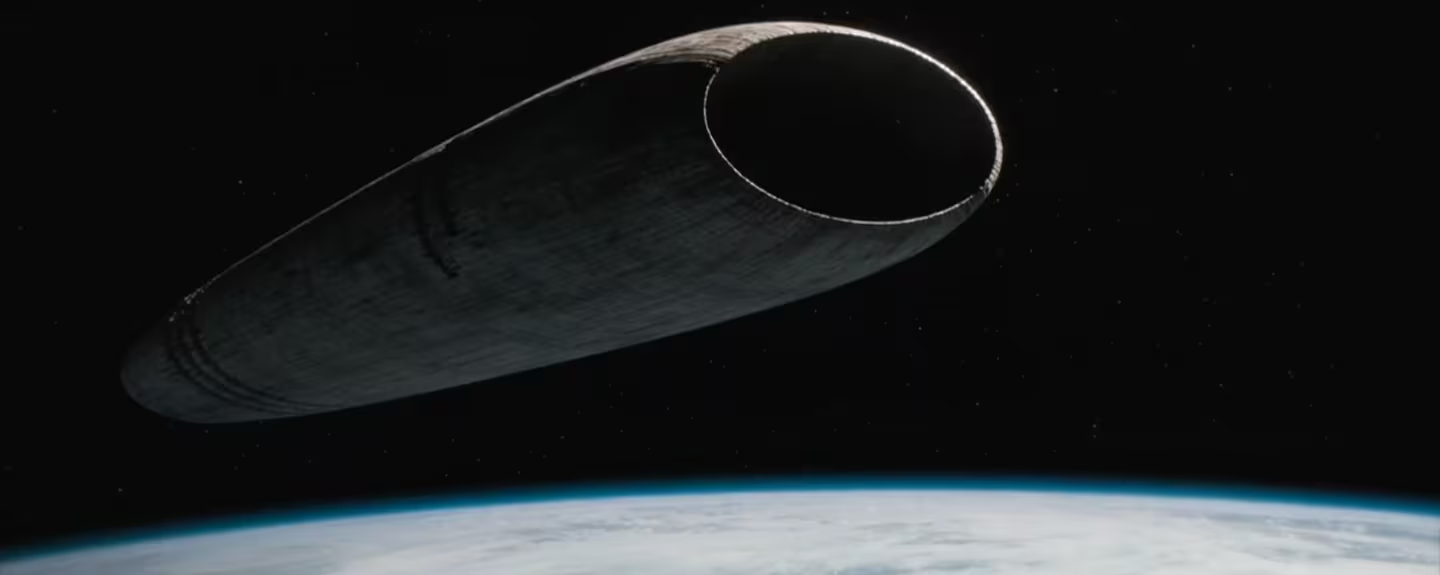
The science behind Dune’s space folding
Dune’s space folding draws on Einstein’s general relativity: massive bodies curve space-time, a fact proven since 1919 by starlight bending near the Sun, GPS satellite corrections, and direct gravitational wave detection in 2015. In 1994, physicist Miguel Alcubierre proposed a theoretical ”warp bubble” where space in front contracts and behind expands, allowing faster-than-light travel inside the bubble without breaking physics laws.
The catch: this requires exotic matter with negative energy density, which remains hypothetical. A 2024 Leiden University study refined warp bubble models lowering exotic matter needs but didn’t eliminate them. In 2023, a Limitless Space Institute team reported tentative lab evidence of nanoscale space-time distortions-controversial but intriguing.
Though still speculative, remember special relativity was also ”just theory” in 1905 before becoming integral to technologies like GPS and smartphones.
Could Dune’s space folding happen in real life? Dune’s warp drive is based on legitimate general relativity math. Alcubierre’s warp bubble is theoretically possible but requires exotic negative-energy matter, which we haven’t found. Practical warp drives remain beyond current tech, but research continues.

Frank Herbert’s foresight in sci-fi technology
”Dune” was written in 1965. Six decades later:
- Cornell researchers publish stillsuit designs for future NASA spacesuits.
- Physicists refine warp bubble models and conduct early experiments.
- Neural interfaces enable thought-based computer control.
- NASA advances real Mars terraforming plans.
These aren’t coincidences. Herbert tapped into real science-ecology, psychology, physics, pharmacology-and projected it tens of thousands of years ahead. It turns out some ideas arrive decades earlier than he imagined.
With ”Dune: Part Three” coming in late 2026, expect audiences and engineers alike to keep inching closer to the desert planet’s technology and mysteries.
This article was prepared by the itzine.ru editorial team, based on open scientific sources including Frontiers in Space Technologies (2024), arXiv Green Mars Workshop Summary (2025), and University of Toronto research.