

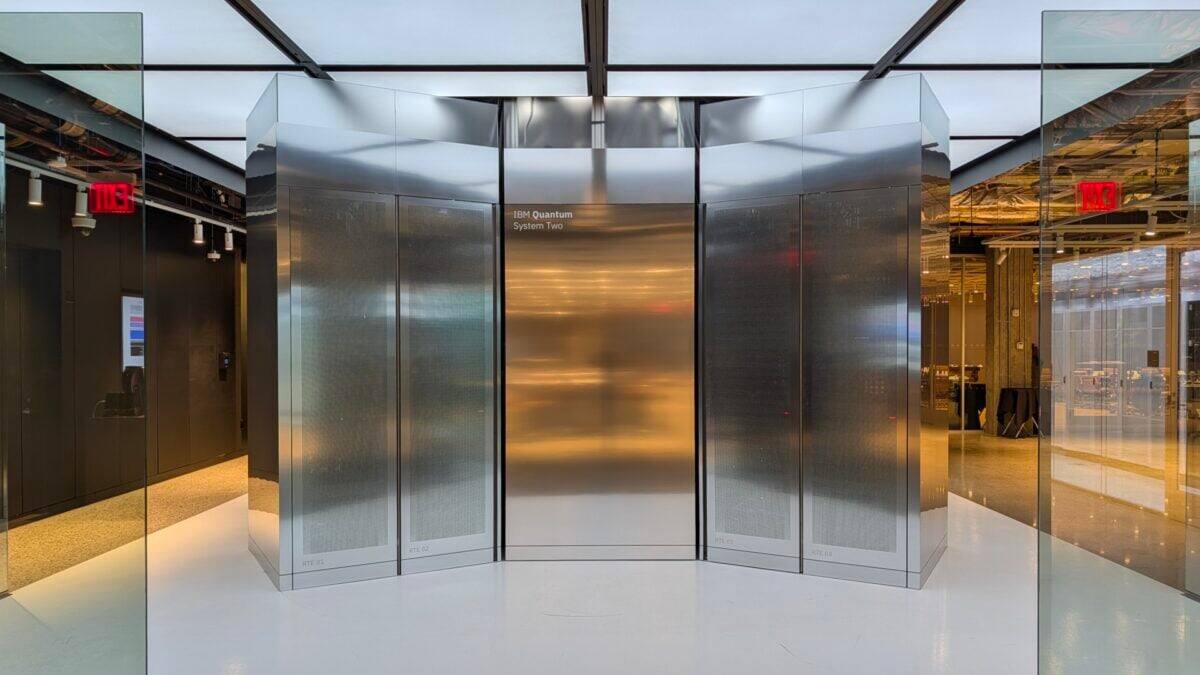
Quantum computing’s promise of vastly outperforming classical machines might have a ceiling after all. A recent theoretical proposition from University of Oxford physicist Tim Palmer suggests that the mathematical foundation of quantum mechanics could be tweaked to impose a hard limit on quantum hardware’s power. If correct, this would mean quantum computers will not scale infinitely, drastically reducing concerns about their potential to crack today’s strongest encryption schemes like RSA.
Palmer’s idea, called ”Rational Quantum Mechanics,” questions the continuous nature of Hilbert space, the mathematical framework underpinning quantum calculations. In standard quantum theory, the state space grows exponentially with the number of qubits, enabling advanced algorithms such as Shor’s method to factor large numbers efficiently-a capability that threatens modern cryptography. But Palmer argues that physical reality favors discrete rather than continuous geometry, causing quantum information capacity to increase only linearly with qubit count.
Under this model, once a quantum system hits roughly 1,000 entangled qubits, it runs out of sufficient informational content to maintain a quantum advantage. This cap is significant because cryptographers estimate that cracking RSA encryption typically requires around 4,099 qubits. Therefore, even the most powerful quantum computers built under these assumptions wouldn’t reach the scale necessary to break encryption as feared.
Rethinking the mathematics of quantum space
Palmer’s skepticism targets the infinite-dimensional Hilbert space used in conventional quantum computing theory. While this abstraction has enabled remarkable advancements, it remains an idealization without direct experimental confirmation of continuity at the fundamental level. The idea that nature ”abhors a continuum” points to a world where spatial elements are discrete, restricting the exponential scaling needed for quantum supremacy.
This is a bold departure from decades of quantum mechanics validated through countless experiments. Yet Palmer offers that his refined theory is testable with current quantum devices within five years by entangling many qubits and observing performance degradation as the system surpasses a critical size.
Limits of qubit scalability and encryption security
If verified, this cap on qubit scalability would reshape expectations around quantum computing’s impact on encryption. The persistent fear that quantum computers will soon render standard cryptography obsolete may be premature. It also brings a dose of realism to the hype around ”infinite” quantum advantage, emphasizing that engineering challenges may be compounded by fundamental physical limits.
That said, the proposal remains speculative and will face rigorous scrutiny. Quantum mechanics is one of the most experimentally confirmed scientific theories, and no existing data suggests a breakdown of Hilbert space continuity. However, the possibility that quantum states represent only a finite amount of information calls for fresh perspectives as the field pushes toward larger, error-corrected quantum machines.
With several companies racing to build quantum processors exceeding hundreds of qubits, Palmer’s theory introduces an intriguing question: are we chasing a mirage of unlimited qubit power, or will future hardware hit a hard informational boundary? Upcoming experiments will be crucial to determine if quantum computers will genuinely tap out before threatening encrypted data or if they will eventually live up to their formidable potential.