

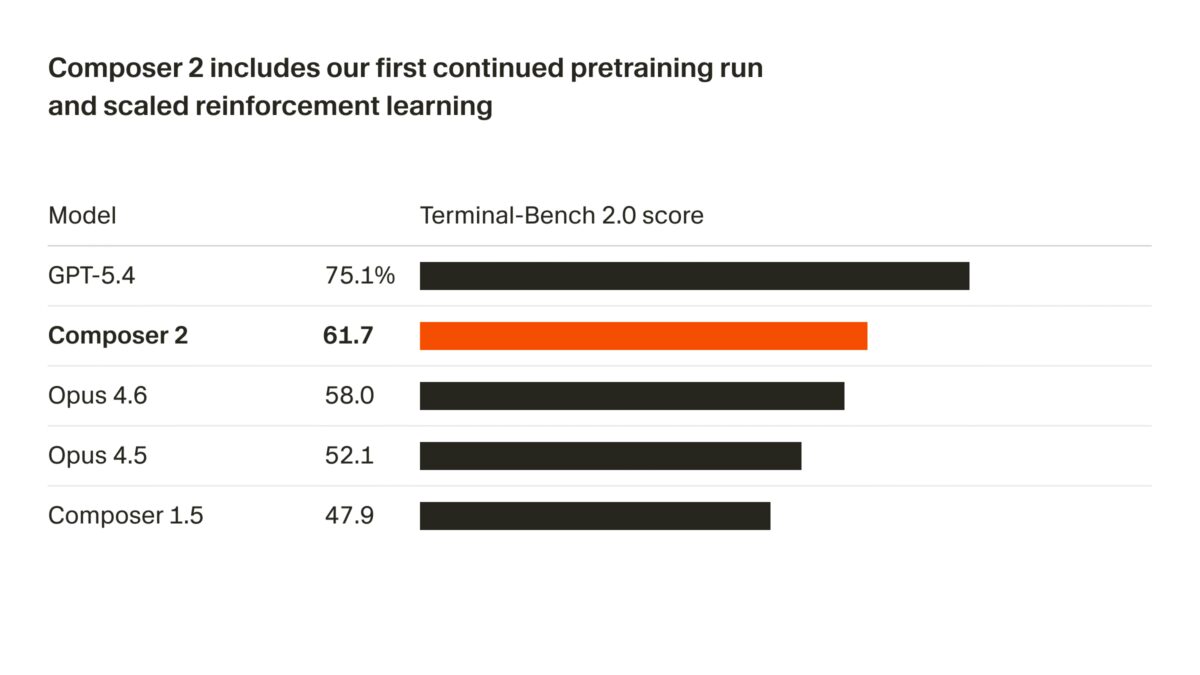
Cursor, a San Francisco-based AI coding startup valued at $29.3 billion, has rolled out Composer 2, its latest in-house programming model integrated into its AI coding environment. This release marks a notable improvement over its predecessor, Composer 1.5, delivering significantly better benchmarks and drastically reduced pricing, while maintaining a focus on supporting extended coding workflows rather than just one-off code generation. Although Composer 2 outperforms competitors like Anthropic’s Claude Opus 4.6, OpenAI’s GPT-5.4 remains the top performer on key benchmarks.
Composer 2 offers two pricing tiers: a Standard version priced at $0.50 per million input tokens and $2.50 per million output tokens, and a Fast variant costing $1.50 and $7.50 respectively. This represents an approximately 86% reduction in cost compared to Composer 1.5’s $3.50 input and $17.50 output token rates, making the new model more accessible for frequent use. Cursor aims to make the faster, more expensive option the default for users, emphasizing speed alongside cost-effectiveness.
Where Composer 2 stands out is its specialization for long-horizon agentic coding tasks-workflows that involve multiple steps such as reading repositories, making sequential edits, running commands, and interpreting errors. Cursor highlights that this capability comes from continued pretraining and scaled reinforcement learning focused on handling hundreds of actions per task. Its 200,000-token context window facilitates these extended interactions, along with integration into Cursor’s agent tool stack that includes semantic code search, file operations, shell commands, and even web access.
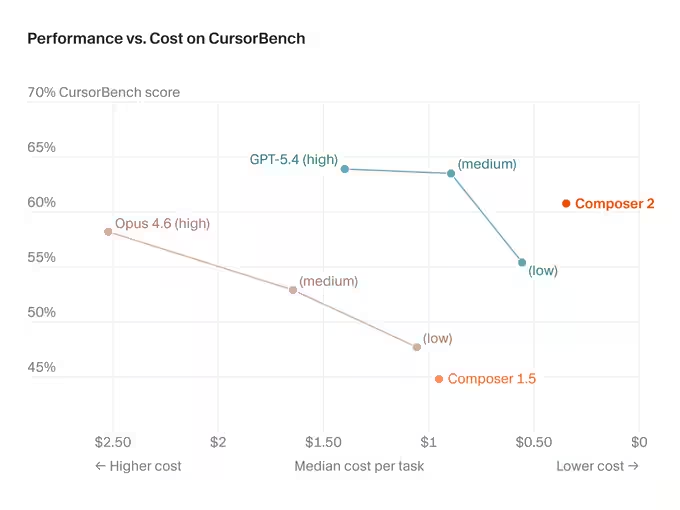
Benchmark results demonstrate meaningful progress: Composer 2 scores 61.3 on CursorBench, 61.7 on Terminal-Bench 2.0, and 73.7 on SWE-bench Multilingual, compared to Composer 1.5’s 44.2, 47.9, and 65.9, respectively. However, GPT-5.4 outpaces all with a Terminal-Bench 2.0 score of 75.1. This nuance underlines Cursor’s candid messaging-they are not claiming total dominance, but rather a more practical powerhouse within their own ecosystem at a better cost-performance ratio.
Cursor’s strategic emphasis on Composer 2 is less about securing AI model prestige and more about enhanced operational value. The model’s integration with Cursor’s full coding environment and toolset allows developers to tackle real-world software development workflows within a familiar interface. This approach contrasts with generic APIs or standalone models, tethering Composer 2 tightly to Cursor’s platform but potentially limiting appeal for teams seeking cross-platform deployment.
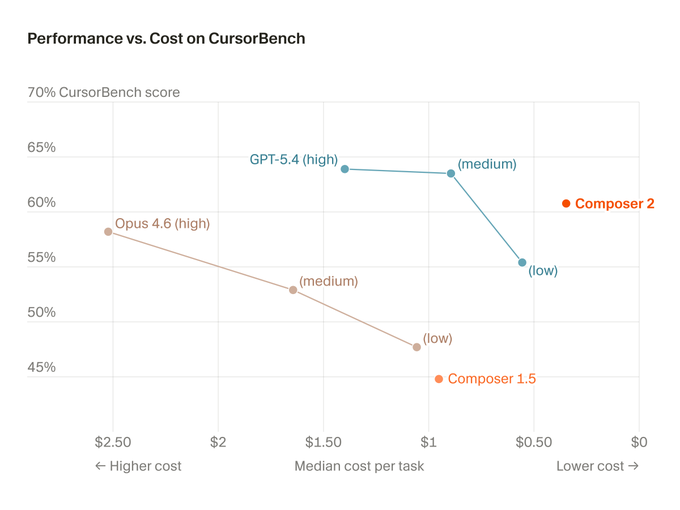
Cost-efficiency may be Composer 2’s best selling point as Cursor shows it competes favorably against pricier options like GPT-5.4 and Anthropic’s Opus 4.6 when considering performance per dollar. This could attract engineering teams looking to optimize for longer coding sessions without ballooning expenses. Cursor also provides an array of subscription tiers ranging from free Hobby plans to enterprise offerings priced individually, bundling access to multiple AI model providers and team collaboration tools.
Despite these gains, Cursor faces tough competition. Larger AI vendors like OpenAI and Anthropic are integrating their own coding models more deeply into dedicated coding interfaces and agent workflows, blurring the line between model providers and development platforms. Emerging chatter among developers suggests some users are switching from Cursor to alternatives like Claude Code, attracted by more native agent behavior and perceived lower friction.
Ultimately, Cursor’s challenge with Composer 2 is proving that an integrated platform combined with cost-effective, purpose-built models adds enough value beyond raw AI prowess to justify its place amid increasing direct competition from model creators themselves. The release signals their commitment to cater to the practical demands of sustained coding support, betting on tight integration and lower pricing as keys to staying relevant in a rapidly evolving industry.