

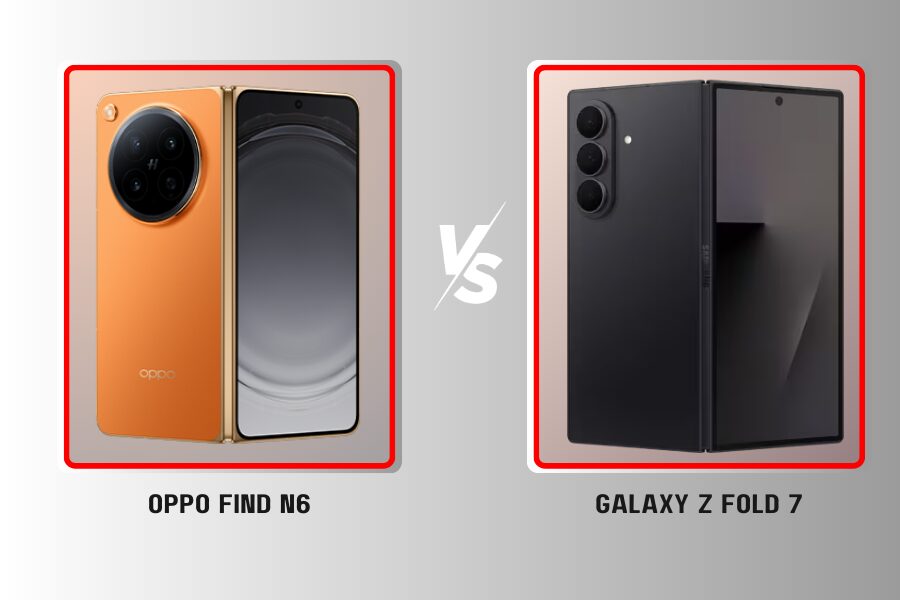
Oppo’s Find N6 and Samsung’s Galaxy Z Fold 7 are flagship foldable smartphones that look similar on paper but take distinct approaches to design, performance, and features. Both phones fold to similar thickness and boast large inner screens, but Oppo focuses on advanced materials and raw hardware power, while Samsung emphasizes refinement, software longevity, and ecosystem integration.
Oppo Find N6 design and durability innovations
At first glance, Oppo Find N6 and Galaxy Z Fold 7 share the same 4.2mm thickness when unfolded and 8.9mm when folded, making size a draw. However, Oppo pushes durability further with a titanium alloy hinge, an aircraft-grade aluminum frame, and its proprietary Nanocrystal Glass. It also offers IP58/IP59 ratings, meaning both waterproofing and dust resistance-even against high-pressure water jets-features that remain rare among foldables.
Samsung sticks to its signature Armor Aluminum and Gorilla Glass Victus Ceramic 2 while achieving a slightly lighter 215-gram weight versus Oppo’s heftier build. The Galaxy Z Fold 7 holds an IP48 water resistance rating, less rigorous than Oppo’s. Oppo’s ”Zero-Feel Crease” hinge design promises less visible creasing over time, contrasting Samsung’s Armor FlexHinge evolution that prioritizes durability but retains subtle crease visibility.
Display technology and crease innovations
The Find N6 sports an 8.12-inch inner display, slightly larger than the Galaxy Z Fold 7’s 8-inch screen. Oppo also touts far higher brightness peaks-up to 2,500 nits inside and 3,600 nits on the cover-surpassing Samsung’s maximum 2,600 nits peak brightness. Both phones deliver strong AMOLED panels, but Oppo focuses on minimizing crease visibility through memory glass and a redesigned hinge, improving foldable screen aesthetics and feel.
Samsung’s decision to drop S Pen support enabled a thicker ultra-thin glass layer, enhancing screen toughness but removing one of the Fold series’ standout features, potentially disappointing stylus fans seeking precision input on foldables.
Performance and software support comparison
Under the hood, Oppo Find N6 leads with the Snapdragon 8 Elite Gen 5, a newer chip running at higher clocks with a new GPU architecture, alongside faster UFS 4.1 storage. Samsung’s Galaxy Z Fold 7 features the still-powerful Snapdragon 8 Elite, using UFS 4.0 and similar LPDDR5X RAM. Both flagships handle demanding tasks smoothly, but Oppo’s setup hints at better efficiency and faster data transfer.
Software-wise, Samsung offers One UI 8 with seven years of OS updates, promising extended support for long-term users. Oppo counters with ColorOS 16, granting five years of OS updates plus six years of security patches, a strong commitment though slightly shorter than Samsung’s guaranteed lifespan.
Camera system differences between Oppo and Samsung foldables
Both phones use a 200MP main sensor, but Oppo supplements it with a robust trio of cameras:
- 50MP ultrawide
- 50MP periscope telephoto with 3x optical zoom
- Hasselblad color tuning for superior image quality
Samsung pairs its 200MP main camera with more modest lenses:
- 12MP ultrawide
- 10MP telephoto lenses, borrowed from its Ultra models
On video, Oppo supports Dolby Vision recording at 4K/120 fps, appealing to creators seeking dynamic range and smooth capture, while Samsung offers 8K video at 30 fps, suitable for those prioritizing ultra-high resolution footage.
Battery life and charging speed comparison
Battery endurance is another area where Oppo pushes ahead:
- Oppo Find N6 battery: 6,000mAh silicon-carbon battery
- Samsung Galaxy Z Fold 7 battery: 4,400mAh
- Oppo charging: 80W wired and 50W wireless fast charging
- Samsung charging: 25W wired and 15W wireless fast charging
Oppo’s larger battery capacity and faster charging speeds are likely to appeal to power users requiring longer usage between charges and quicker top-ups.
Additional features and user preferences comparison
Oppo adds stylus support on both screens, satellite connectivity (on select versions), and an infrared port-features that might appeal to niche uses or specific markets. Samsung counters with Ultra Wideband support and DeX, catering well to users entrenched in its ecosystem seeking desktop-style functionality and spatial awareness.
Both phones support Wi-Fi 7 and modern location services, ensuring fast, reliable connectivity. The choice depends on whether you prioritize raw hardware specs and battery life or ecosystem depth and software longevity.
The Oppo Find N6 represents a bold push in hardware where it counts-battery, charging, display brightness, and cameras. Samsung’s Galaxy Z Fold 7 offers a more cautious evolution, refining proven design and providing extended software support with useful extras for loyal fans. The decision comes down to choosing advanced specs with some trade-offs or a refined package built for long-term use.