

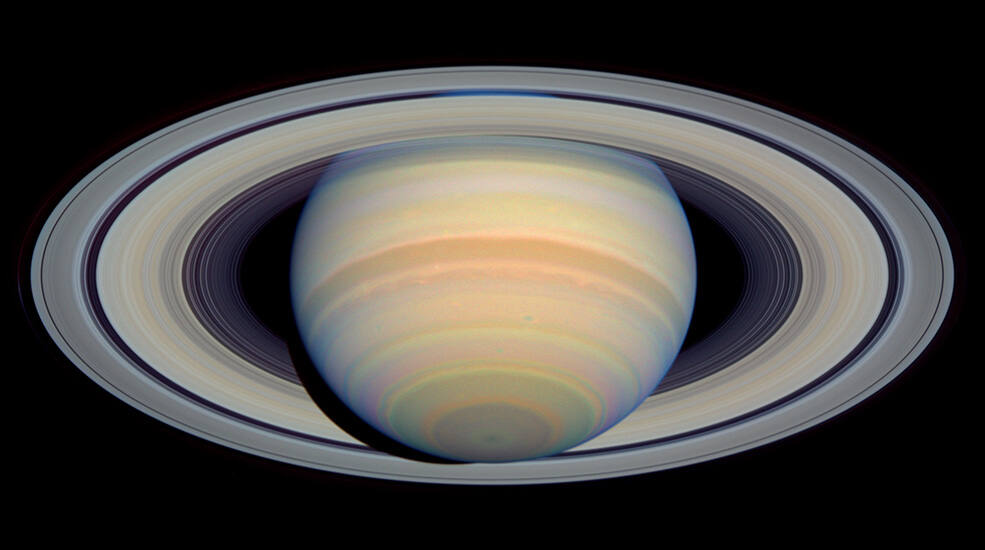
Saturn has expanded its lead as the most moon-rich planet in our Solar System with the discovery of 11 new natural satellites, bringing its total moon count to 285. According to data from the Minor Planet Center, these newly identified moons outnumber Jupiter’s roughly 100 known moons by a wide margin, reinforcing Saturn’s cosmic bragging rights.
The newly catalogued moons belong to a category called irregular satellites. These are small, distant bodies, often just a few kilometers across, that orbit Saturn on highly elongated and tilted paths. Many of these orbits are retrograde, meaning the moons travel opposite the planet’s rotation. Unlike larger moons such as Titan or Enceladus that formed alongside Saturn, these irregular moons are thought to be captured objects, gravitationally snared during the early days of the Solar System’s formation.
The new observations provide detailed orbital parameters-distance from the planet, orbital tilt, and other characteristics-that will aid astronomers in clustering these satellites into families. This helps researchers determine if they are fragments of once-larger bodies shattered by ancient collisions. Identifying such families sheds light on the chaotic history of Saturn’s extensive satellite system.
These findings were made possible through modern telescopic technology combined with long-term sky surveys that detect faint moving objects amidst the starry backdrop. Following multiple nights of observation, astronomers confirmed the moons’ gravitational ties to Saturn, ruling out the possibility of their being mere passing asteroids.
Saturn’s expanding moon roster highlights how even well-studied planets continue to surprise us. As telescope sensitivity improves, it’s likely more tiny, irregular satellites will be uncovered around the gas giants, gradually filling in gaps about the early Solar System’s turbulent past.