

Microsoft announced DirectStorage 1.4 at GDC 2026, introducing native support for Zstandard (Zstd) compression and a new Game Asset Conditioning Library (GACL). These features aim to enhance game asset streaming on Windows by making compression more efficient and decompression more flexible, potentially improving load times and overall streaming performance in PC games.
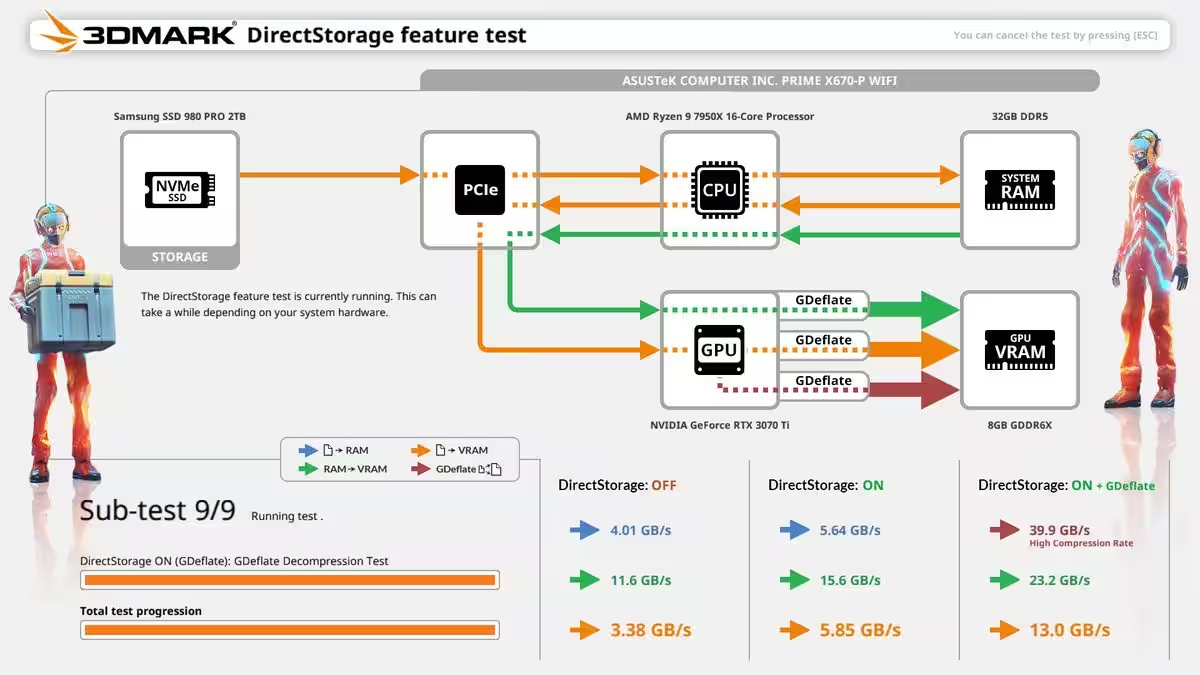
DirectStorage 1.4 adds Zstd compression with dual decompression paths-developers can offload decompression to either CPU or GPU compute shaders. This update supplements, rather than replaces, Microsoft’s earlier GDeflate format introduced in DirectStorage 1.1. Zstd is a modern, widely used compression algorithm known for balancing compression ratio and speed, and this integration allows developers greater flexibility in optimizing game asset pipelines.
Despite its promising technology, DirectStorage’s real-world impact has been mixed. Although early demos suggested dramatic load time improvements, adoption among PC games remains limited. Using GPU decompression can reduce frame rates since it consumes GPU cycles needed for rendering. DirectStorage’s benefits still hinge on how much spare GPU compute capacity a game and system can allocate to streaming workloads.
A technical improvement in version 1.4 is the inclusion of global D3D12 CreatorID support in the EnqueueRequests function. This feature enables various GPU workloads to identify themselves to the driver, allowing better scheduling when multiple GPU queues compete for resources. In games, this enhancement could lead to more efficient coexistence of asset decompression and rendering tasks, potentially reducing performance hits during streaming.
The standout addition is GACL, a build-time tool that preprocesses game assets to boost compression efficiency before applying Zstd. By restructuring and conditioning assets through techniques like data shuffling and entropy reduction, GACL achieves smaller file sizes without raising decompression costs. This streamlines how games manage their asset pipelines within DirectStorage.

On the whole, DirectStorage has not yet become a staple for PC developers as once anticipated. The technology’s future depends on how well game studios incorporate these updated features into designs built around streaming from the ground up. While version 1.4’s improvements are solid technical steps forward, widespread adoption requires convincing developers that the trade-offs in GPU compute time result in tangible benefits for load times and performance.