

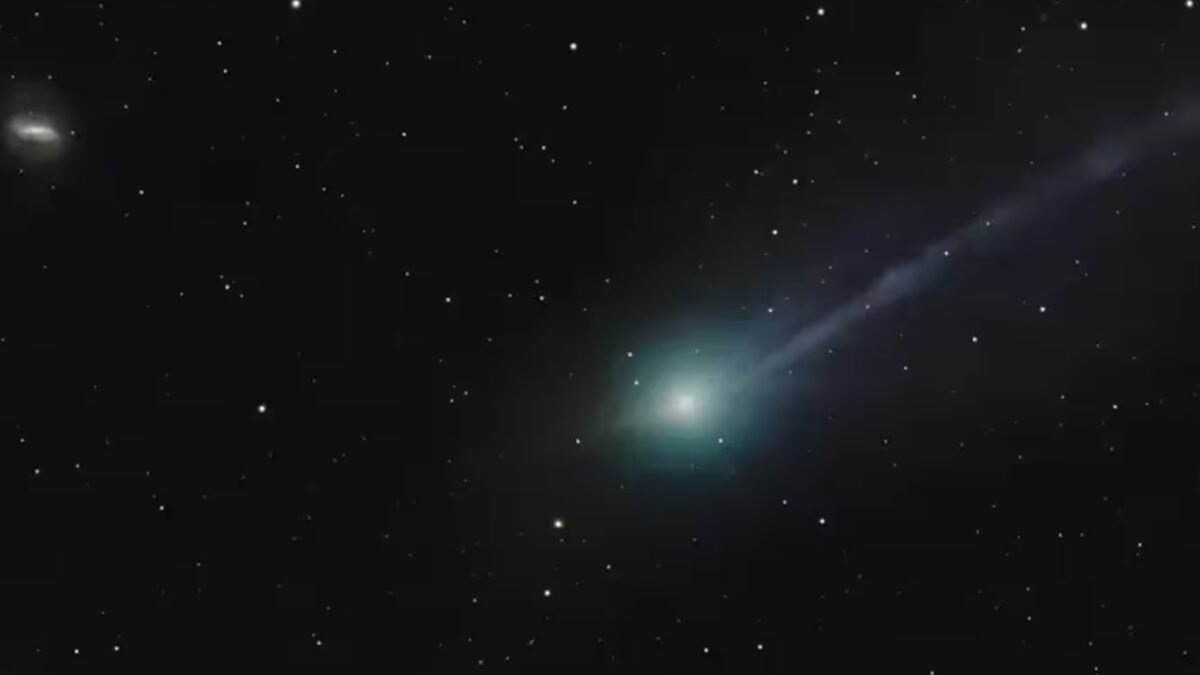
James Webb Space Telescope data suggest that comet 3I/ATLAS, which passed through our Solar System last year, might be the oldest comet ever detected-dating back 10 to 12 billion years. This is more than twice the age of Earth and the entire Solar System, reshaping previous assumptions about the comet’s origins.
When 3I/ATLAS first caught astronomers’ attention, some speculated wildly that it might be an extraterrestrial spacecraft. However, follow-up studies using Webb’s advanced infrared instruments tell a more ordinary story: the comet likely formed in a remote, frigid part of the Milky Way early in its history.
Characteristics and age of comet 3I/ATLAS
The comet’s age of 10-12 billion years places it close to the galaxy’s own age of roughly 13.6 billion years-and not far behind the Universe’s 13.8-billion-year timeline. This makes 3I/ATLAS potentially one of the most ancient objects ever observed in interstellar space.
Data came from observations made during the comet’s Solar System flyby at the end of 2025. Webb analyzed the gas released as sunlight caused surface ices to sublimate-which is typical comet behavior-and measured isotope ratios, revealing a distinct chemical fingerprint unlike comets native to our Solar System.
Previous estimates on the comet’s age ranged between 3 and 11 billion years, but Romain Maggiolo, a lead researcher on the study, says the isotope patterns confirm a formation timeframe of 10-12 billion years ago, well before our Sun and planets existed.
Astronomers estimate 3I/ATLAS measures roughly 440 meters across at its narrowest and up to 5.6 kilometers at its longest dimension. Observations from Hubble tracked its speed as it entered the Solar System at about 221,000 km/h.
The comet’s closest approach to Earth was on December 19, 2025, at a distance of approximately 270 million kilometers. Despite internet rumors suggesting otherwise, all evidence points to 3I/ATLAS being a natural interstellar object, not an artificial probe or alien technology.
Significance of ancient interstellar comet observations
Interstellar comets like 3I/ATLAS are extremely rare visitors, offering unique insights into the early galaxy’s conditions. Unlike Solar System comets that formed less than 5 billion years ago, these ancient travelers preserve clues about chemistry and star formation in the Milky Way’s infancy.
For example, the isotope differences detected by Webb hint at distinct chemical environments billions of years ago.
Comparisons to previous interstellar objects and future research
Such discoveries follow in the wake of ’Oumuamua and comet Borisov, earlier interstellar objects that sparked intense scrutiny and speculation. While 3I/ATLAS confirms the existence of ancient interstellar wanderers, it also raises new questions about their origins and how often they traverse our neighborhood.
Looking ahead, astronomers will continue to analyze Webb’s detailed spectra and track future interstellar visitors. The hunt for ancient, pristine comets like 3I/ATLAS could deepen our understanding of the galactic past-and help map the diversity of objects drifting between stars.