

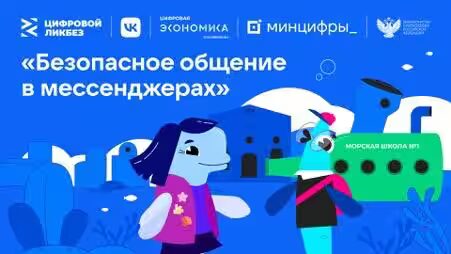
VK and the nonprofit Digital Economy Agency have launched a new season of their educational project ”Digital Literacy Crash Course,” focusing specifically on messaging app security. School students across Russia and the CIS will learn safe communication practices and explore features of the national messenger. Interactive exercises within a mini-app on the Sferum platform, integrated into VK’s MAX ecosystem, reinforce these lessons.
Designed for students from grades 1 through 11, the project is supported by Russia’s Ministry of Education and Ministry of Digital Development. Educational materials are freely accessible on the official portal цифровойликбез.рф. The lesson is set in a fictional underwater city called Nizhneforelsk and stars blogger Anton Koryushkin and schoolgirl Olya Belukha. Together, they guide children through enabling two-factor authentication, activating ”Safe Mode,” and understanding how ”Family Protection” features help parents manage kids’ privacy settings in messengers.
The latest season introduces a knowledge checkpoint via the ”Path in the Network” quest game inside the mini-app on Sferum in MAX. Tasks simulate real-life cybersecurity scenarios to deepen students’ skills. Teachers receive detailed methodological guides to conduct lessons even in classrooms with limited technological resources. The content is scientifically validated by the Institute for Childhood, Family, and Education Studies, ensuring educational rigor.
How the Digital Literacy Crash Course teaches messaging app security
The Digital Literacy Crash Course aims to educate students on safe internet communication principles and basic digital literacy. Messaging apps are central to teen interaction but pose risks without proper security knowledge. The program offers step-by-step instructions for enabling two-factor authentication, highlights tools to restrict personal data access, and shows how parents can configure ”Family Protection” controls for privacy management.
This initiative arrives amid growing digitalization of schools across Russia and neighboring countries. Unlike standard lecture formats, the integration of a quest game in the mini-app transforms learning into an interactive experience that better captures students’ attention and encourages independent thinking.
The Russian cybersecurity education field also includes projects from Rostelecom and Yandex.Uchebnik offering similar programs. However, the Digital Literacy Crash Course stands out through its integration with the Sferum platform and its focus on Russia’s national messenger, making the content highly relevant and practical for its audience.
Teacher resources and lesson design for digital literacy
Supporting educators is a key element of the project. The Digital Economy Agency has developed comprehensive teaching materials that enable lessons to be delivered in classrooms ranging from tech-rich environments to those with minimal equipment. This approach ensures all students have access to vital security knowledge regardless of their school’s resources.
The materials cover technical details such as adjusting messenger settings and activating privacy features, combined with fostering critical thinking skills about online safety. The game-based verification through the mini-app boosts engagement and practical learning outcomes.
Using Sferum’s quest game to build digital safety skills
The ”Path in the Network” mini-app on Sferum in MAX applies gamification to cybersecurity education. Students select characters and complete tasks that reflect real dangers, from misconfigured accounts to risky contact with strangers.
This method teaches youngsters to anticipate consequences of their digital actions and internalize security habits-essential in today’s widespread use of messaging apps and social networks. The quest format suits a wide age range, from primary school children to teens, broadening the initiative’s reach.
By blending theoretical knowledge with immersive, hands-on activities, the project sets a high standard for domestic digital education efforts and cybersecurity awareness.
As digital tools continue to dominate youth communication, projects like this one will need to evolve rapidly to address emerging threats and technological shifts. Future updates are expected to expand interactive learning elements and integrate lessons with other popular platforms.