

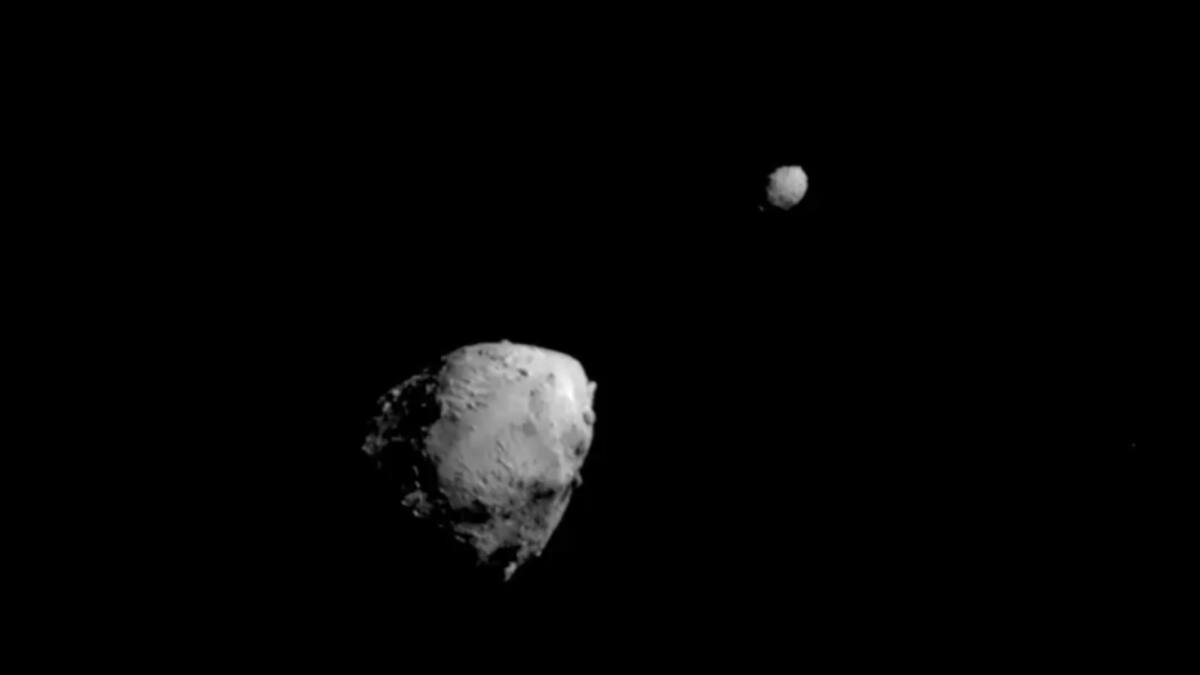
NASA has successfully nudged the orbit of a small asteroid, marking a milestone in planetary defense. The Double Asteroid Redirection Test (DART), launched in late 2021, collided with Dimorphos, the smaller member of a binary asteroid system, in September 2022. This kinetic impact shortened Dimorphos’ 12-hour orbit around its larger companion, Didymos, by about 33 minutes and slightly altered their orbit around the Sun, demonstrating for the first time that humanity can influence the trajectory of celestial objects.
While the changes in orbit might appear modest-Dimorphos’ orbital speed changed by just 11.7 microns per second-these small nudges can have profound effects over time. Given the vast distances asteroids travel through space, even minute deflections can translate into missing Earth by millions of miles decades or centuries later. This proof of concept is crucial, as it validates a practical method to protect our planet from future asteroid threats.

Dimorphos itself, about 170 meters wide, is too small to pose a global threat but could still cause regional devastation comparable to the impact that could wipe out a major city. Its larger partner, Didymos, at roughly 805 meters across, presents a more serious hazard should it ever pose a threat to Earth. Thankfully, NASA confirms neither asteroid was on a collision course with Earth before or after the impact.
The mission also underscores NASA’s increasing focus on early detection and prevention. The agency is building its first dedicated space telescope to identify hazardous near-Earth objects (NEOs), enabling earlier interventions through kinetic impact or other means. Detecting threats well in advance is key to shifting trajectories with minimal effort and maximum success.
This achievement brings asteroid deflection technology out of theoretical space science and into operational reality. It arrives amid growing awareness of the asteroid threat, a concern that has motivated government and private efforts alike. Still, challenges loom: the solar system harbors countless smaller objects, many hard to detect with current resources, and response times can be limited.
With the DART test behind it, NASA and global partners can refine impact strategies, simulate various impact scenarios, and develop faster detection systems. Will kinetic impact be enough if a larger, faster-moving asteroid is detected with little warning? That remains unproven. However, this successful mission is a rare instance where humanity literally nudged the cosmos, proving that with the right tech, we might one day defend Earth from extinction-level threats.