

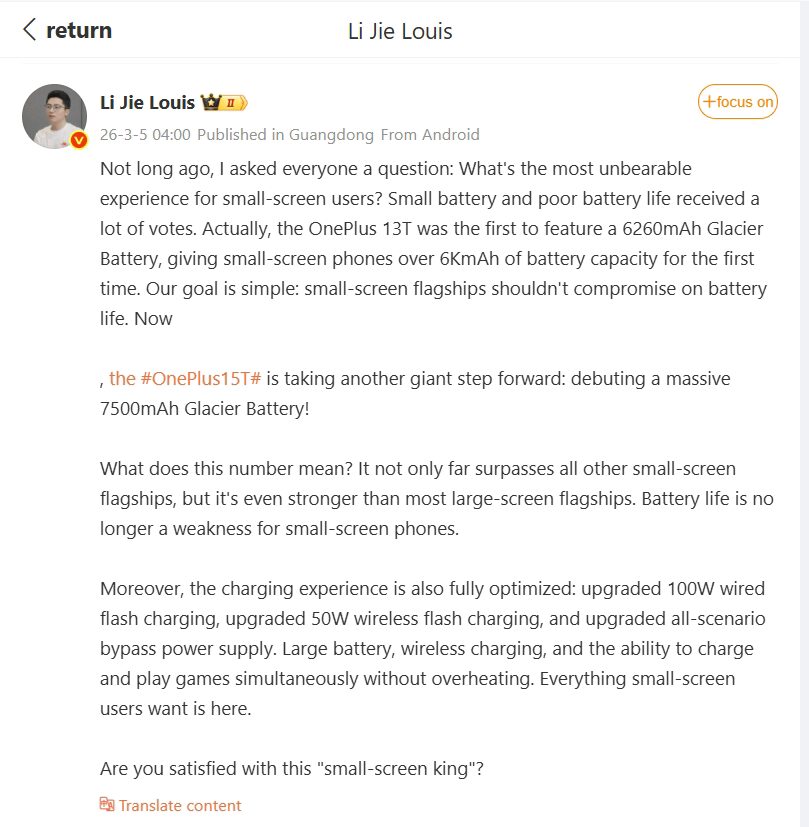
In a bold move that tech fans worldwide will want to watch closely, OnePlus has officially confirmed that its upcoming OnePlus 15T will pack a massive 7,500mAh battery-significantly larger than what’s typical for compact smartphones. This announcement is especially striking because the 15T pairs this powerhouse battery with a relatively small 6.32-inch display, hitting a sweet spot for users who crave both portability and endurance. For context, the Samsung Galaxy S26, one of its closest competitors in this size category, comes with a 4,300mAh battery. That means the OnePlus 15T offers roughly 74% more battery capacity than the Galaxy S26, a notable advantage for anyone tired of daily recharging.
Achieving such battery density doesn’t come easy. OnePlus revealed it’s utilizing a new ”Glacier Battery” technology that swaps out traditional lithium-ion cells for silicon-carbon ones. This innovation allows for cramming more milliamp-hours into a compact chassis without making the phone bulkier. Users will also benefit from superfast charging speeds: 100W wired and 50W wireless, matching what was introduced with the OnePlus 15 and 15R models.
But the OnePlus 15T isn’t just about stamina-it’s also packing serious performance credentials. Recently, a leaked AnTuTu benchmark score for the device hit an eye-popping 4,455,423 points. Powering this beast is the Snapdragon 8 Elite Gen 5 chipset paired with Android 16 out of the box. This combo even outperforms the gaming-focused flagship IQOO 15 Ultra, which is especially impressive considering the 15T’s compact size and the typical thermal challenges small phones face.
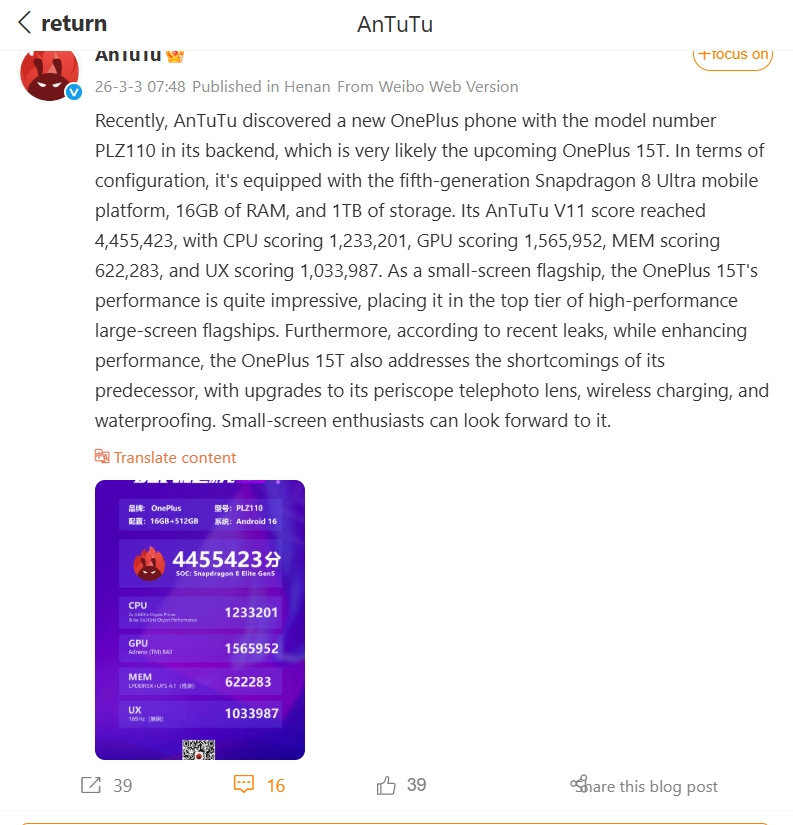
According to available info, the OnePlus 15T will likely launch with one main configuration: 16GB of RAM and 512GB of storage, although smaller variants may appear later. The camera setup is expected to mirror the OnePlus 15’s: a 50MP main sensor, a 50MP periscope telephoto lens, and a 32MP front-facing camera. Pricing is tentatively set around $650, with a release planned for March 2026.
For those familiar with the Russian market, this kind of spec sheet-offering flagship-level power and battery capacity in a compact form-represents one of the rare challenges to Samsung’s dominance here, where consumers have long gravitated towards either powerhouses or more compact, but less capable, devices. OnePlus’s strategy clearly aims to disrupt this by clamping together large battery life, top-tier performance, and the latest Android, all wrapped up in a manageable size.
In an industry increasingly dominated by big-screen phones that often sacrifice portability, the OnePlus 15T stands out as a compelling option. It breaks the traditional trade-off between size, battery life, and performance-showcasing how compact smartphones don’t have to be compromises. For global users who want a phone that can keep up with intense daily use without the bulk, the 15T is shaping up to be a serious contender. As we edge toward its March 2026 launch, it’ll be fascinating to see if OnePlus can push Samsung and others to rethink their approach to compact flagships.