

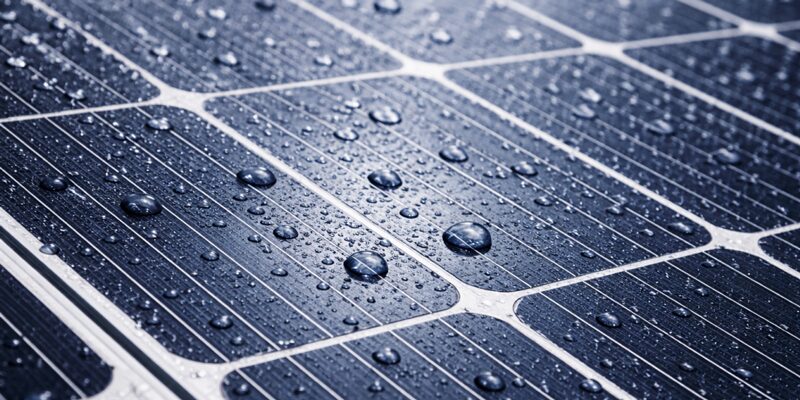
Researchers in Seville, Spain, have designed a novel solar cell that harnesses energy not only from sunlight but also from raindrops, offering a promising path toward all-weather solar technologies. This hybrid device combines a perovskite-based photovoltaic layer with a triboelectric layer sensitive to raindrop impacts, enabling electricity generation in diverse weather conditions where traditional solar panels underperform.
The innovation centers on integrating a standard perovskite solar cell with a thin fluorinated polymer film called CFₓ, which is both highly transparent and water-repellent (hydrophobic). This layer protects the sensitive perovskite from moisture-a notorious enemy of next-gen solar cells-while also generating electricity through a triboelectric effect when raindrops hit and then detach from the surface.
Triboelectricity arises from contact electrification; as raindrops strike and separate from the polymer surface, charges accumulate, producing a measurable electric pulse. In controlled experiments, the rain-harvesting component generated open-circuit voltages up to 110 volts per drop and power densities around 4 milliwatts per square meter. Meanwhile, the perovskite layer achieved a respectable photovoltaic efficiency of nearly 18 percent.
When operating together under moderate sunlight-around half the intensity of a sunny day-the hybrid cell showed short-circuit current densities of 11.6 milliamps per square meter, with raindrop impacts adding pulses reaching 12 volts. The researchers demonstrated practical potential by powering a supercapacitor that lit a string of LEDs, highlighting how such hybrid devices might keep energy flowing even on cloudy, rainy days.
Toward resilient solar power in unpredictable climates
This proof-of-concept emerges from European-funded initiatives aiming to diversify energy harvesting methods and improve solar panel reliability in regions prone to weather variability. While sunlight remains the dominant energy source, harvesting otherwise wasted raindrop energy could enhance solar panel performance during overcast or wet periods, a long-standing limitation for conventional photovoltaics.
However, moving this technology from lab prototypes to commercial applications presents challenges. Scalability, durability of the triboelectric layer under extended outdoor conditions, and cost-effectiveness need thorough evaluation before hybrid solar cells become widespread. Additionally, integration with existing solar infrastructure requires new design considerations.
The hybrid approach addresses an emerging trend: blending multiple energy conversion mechanisms to boost output regardless of environment. Comparably, other researchers have explored combining solar with wind or thermal harvesting. The Spanish team’s innovation stands out by leveraging the frequent yet overlooked kinetic energy of raindrops, turning a solar panel’s weakness in wet weather into a minor strength.