

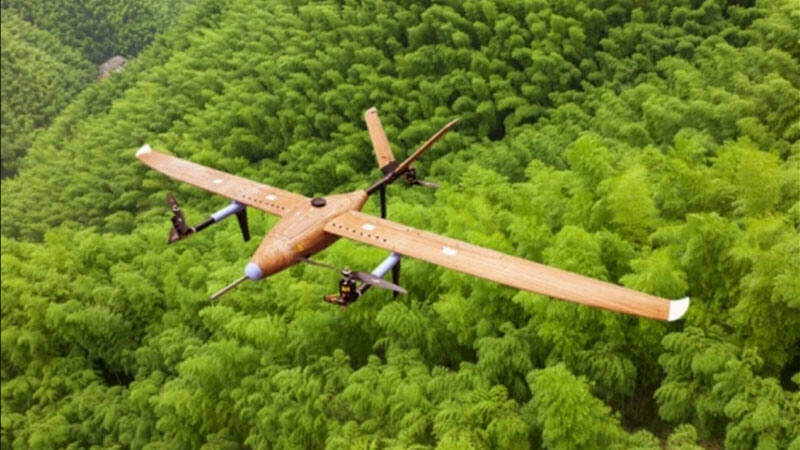
In a surprising blend of tradition and innovation, Chinese researchers have crafted the world’s first drone with over a quarter of its structure made from bamboo composites-a renewable material offering cost and environmental benefits. This lightweight, vertical takeoff and landing (VTOL) aircraft recently completed its maiden flight in Tianjin, signaling a push toward sustainable materials in high-tech aerospace sectors, including future satellite development.
Bamboo’s return to aerospace engineering
The innovative drone project was a collaboration among the International Centre for Bamboo and Rattan, Beihang University’s Ningbo Institute of Technology, and Long Bamboo Technology Group. By integrating bamboo-based composites into more than 25% of its framework, they have set a new benchmark for natural materials in drone construction. The drone’s fixed-wing span exceeds 2.5 meters, weighs roughly 7 kilograms, and can cruise at speeds over 100 km/h for more than an hour-perfectly suited for surveillance, delivery, and reconnaissance tasks.
Bamboo’s lightweight strength helps the drone weigh 20% less than carbon-fiber counterparts while maintaining durability. The material costs are up to four times lower than conventional carbon fiber, effectively reducing overall production expenses by at least 20%. For some components, savings reportedly reach as high as 75%. These economic incentives come alongside the ecological advantage of using a rapidly renewable resource instead of petroleum-based composites, which are energy-intensive to produce and nearly non-biodegradable.
Beyond drones: Bamboo’s wider tech ambitions
The project’s success has broadened the conversation around bamboo composites as a viable alternative in various high-tech fields. Proponents envision the material being used in electric vehicles, marine equipment, and satellites-even more complex space vehicles. Utilizing bamboo helps cut carbon footprints and fosters sustainability in manufacturing sectors often criticized for their environmental impact. Chinese authorities emphasize that their bamboo sourcing is strictly controlled, ensuring ecological balance and protecting native wildlife like pandas.
This approach reflects a growing global interest in revisiting natural materials with modern engineering techniques to challenge the dominance of synthetic composites. Comparable efforts, such as Japan’s satellite components made from magnolia wood, indicate a regional trend of embracing eco-conscious materials for advanced technology.
While the bamboo drone’s debut is promising, questions remain about the scalability and durability of such materials in harsher environments like orbit. Nevertheless, China’s experiment pushes the boundaries of sustainable aerospace design. It will be telling to watch whether these natural composites can gain traction amid the predominance of carbon fiber and other synthetics, especially as environmental concerns push manufacturers to rethink material choices.