

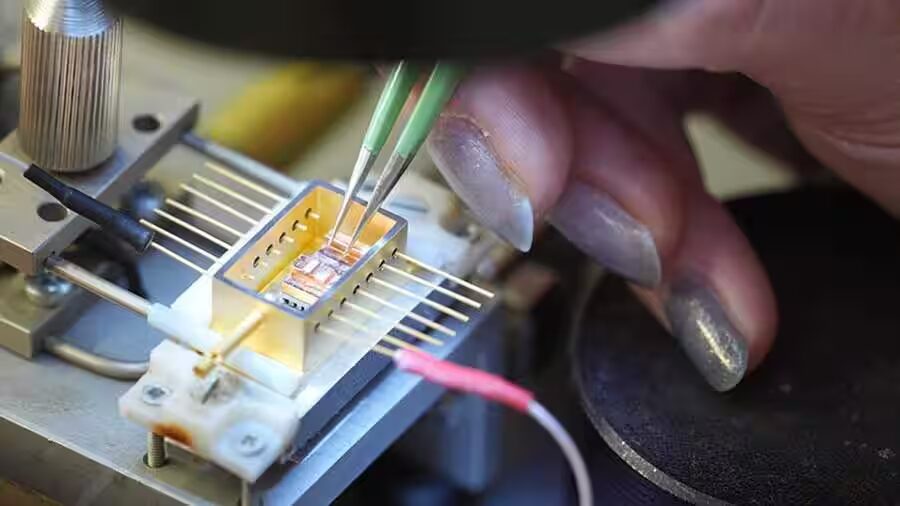
The international tech community keeps a close eye on breakthroughs in quantum computing because they promise to revolutionize computing power, secure communications, and sensing technologies. Russia’s latest achievement-a prototype quantum random-access memory chip boasting record efficiency-signals that the global race for quantum supremacy is intensifying. This innovation not only outperforms existing foreign equivalents by several metrics but also highlights Russia’s push to build its own quantum technology ecosystem, with implications spanning from computing to defense and deep-space exploration.
Russian researchers from Quantum Park and the Dukhov All-Russian Research Institute of Automatics have unveiled a prototype quantum RAM chip designed to store and reproduce quantum signals with groundbreaking efficiency. The information retention time reaches 1.51 microseconds, while readout efficiency hits an impressive 57.5%-figures that significantly surpass those of current international models.
The quantum memory operates at microwave frequencies and is built as a system of resonators-”cells” tuned to different frequencies-and an active switch based on a Josephson junction. This setup utilizes the quantum tunneling effect, allowing particles to ”leak” through an insulator, which enables precise control of quantum states and minimizes data loss during storage.
Notably, the chip’s design employs just a single control line, simplifying integration with existing quantum processors and enhancing scalability. Moreover, the development is compatible with superconducting qubits-the foundational technology behind many next-generation quantum computers.
Applications of quantum memory and outlook for military and scientific fields
The potential uses for this new type of quantum memory go far beyond computing. The technology promises a major leap forward in error correction for quantum algorithms-a critical bottleneck for practical quantum computing.
Additionally, this device opens up new possibilities in ultra-sensitive detectors, including quantum radars capable of detecting stealth-coated objects-such as stealth aircraft and drones-that are notoriously difficult to track with conventional radar systems.
Looking ahead, the researchers envision quantum telescopes based on this technology that could perform detailed observations of exoplanet surfaces tens of light-years away. This could be a game-changer in the search for extraterrestrial life beyond our solar system.
Creating this Russian quantum memory chip isn’t just about competing with Western labs; it represents a crucial step toward developing an independent quantum technology ecosystem in Russia. Such advancements are poised to reshape computing, intelligence gathering, and space exploration strategies in the years to come.