

Bosch’s former Engels factory relaunching as a Russian brand matters beyond a single plant. It’s a test case for how industrial ecosystems adapt when multinational ownership collapses under geopolitical pressure. For global tech watchers, this is where manufacturing, IT modernization and import substitution policy intersect: a legacy German line, 210 retained engineers and technicians, and a local holding trying to keep product quality while reshaping logistics, sourcing and the software stack. Softline’s involvement signals that digital transformation – from ERP to fleet telematics and import-independent systems – will be central, not optional. If Engels can preserve Bosch-grade competencies while localizing parts and building a viable R&D pipeline, it becomes a blueprint for other sectors facing sanctions and disrupted supply chains. Conversely, failures here would highlight the limits of rebranding without supplier networks. Either outcome offers lessons about resilience, national industrial strategy and how software companies can become linchpins in hardware recovery.
Context for international readers: Engels is a city in the Saratov region on the Volga, home to a Bosch production site until its change of ownership. The plant has been taken under the umbrella of the Russian holding АО «Е1 Групп» and relaunched under the domestic brand «ЭНГЕЛЬС». Softline is a major Russian IT group; its role here is to modernize IT infrastructure and help move systems toward import-independent solutions. For Russian audiences this fits into the broader import substitution (importozameshchenie) push – a government-backed effort to replace foreign suppliers with domestic alternatives amid sanctions and disrupted supply chains.
What changed at the Engels plant
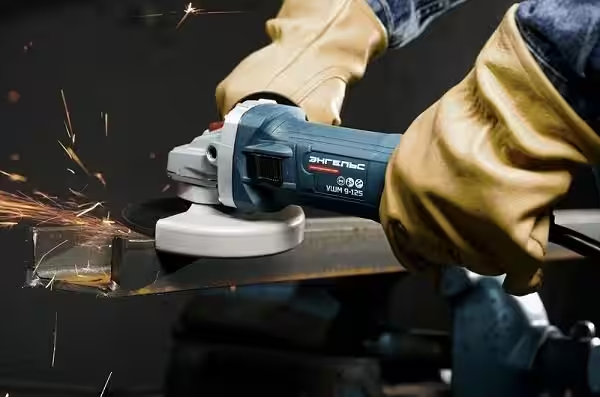
The factory, previously part of the German conglomerate Bosch and located in Engels in Saratov region, has resumed operations under the Russian brand «ЭНГЕЛЬС». The enterprise will continue producing professional power tools while retaining most technical competencies and staff. Of 210 employees, almost all are specialists retained from the previous team. The plant now operates as part of the Russian holding АО «Е1 Групп» and manufactures power tools under the name «ЭНГЕЛЬС». The partnership with Softline is aimed at modernizing IT infrastructure and moving to import-independent systems.
Restarting production under a national brand is intended to cut logistics costs and delivery times across Russia. That matter is heightened by worsening global supply chains and tightening sanctions on Russia, when localization becomes a survival issue for many sectors.
Market and strategies for power tools in Russia
There are virtually no large Russian manufacturers of professional power tools today – most offerings on the market are from foreign brands. Even after Bosch’s exit the market is open to big local initiatives. The new «ЭНГЕЛЬС» brand is aimed at construction firms, industrial-mining companies and government bodies for which high functionality and reliability are critical.
– Planned to ramp up production of the existing model range
– Expand the assortment of tools across several segments
– Implement digital solutions for fleet management
– Develop an in-house R&D center for innovation
– Increase the level of localization of components
Softline says it will go beyond basic automation: digitalization will be used to boost worker productivity and reduce maintenance costs for equipment. That marks a move not just toward making hardware but toward building integrated software-hardware solutions for the construction sector.
Prospects and challenges of the new production model
The shift from an international conglomerate to a Russian brand brings obvious challenges: the plant needs to keep Bosch-level quality, secure supplies of local components, compete with imported products and develop its own technical know-how. The factory’s team says that with retained experience and technical potential they have every chance to build a competitive product at a world-class level.
Creating an industrial cluster in the Saratov region is presented as a strategic response to import substitution problems in Russia. Increasing local jobs, reducing dependence on foreign suppliers and introducing digital production processes all feature prominently in near-term plans. With the holding and partners able to grow R&D capacity, the project could become a notable market player.
Conclusion and analysis
The Engels reboot is less about a name change and more about whether a localized supply chain, supported by a domestic IT stack, can substitute for decades of multinational engineering and global sourcing. If the plant manages to keep the technical know-how of its original workforce, marry that with modern IT systems from Softline and steadily increase parts localization, it could serve as a template for other industries in Russia facing similar constraints.
But the road is narrow. Quality control, supplier development and R&D investment are expensive and slow. Competing on price alone won’t win contracts where reliability is non-negotiable – construction and mining customers will test any new brand against long-established alternatives. International export ambitions will also be limited while sanctions and component availability remain unresolved.
Ultimately, the real story to watch is the fusion of software and manufacturing: Softline’s role shows that digitalization can be decisive in squeezing efficiencies from legacy lines, managing fleets and shifting to domestic stacks. Whether that combination produces a durable, high-quality Russian power-tool brand or exposes the limits of rapid relaunches will matter to anyone tracking how hardware supply chains adapt under geopolitical stress.