

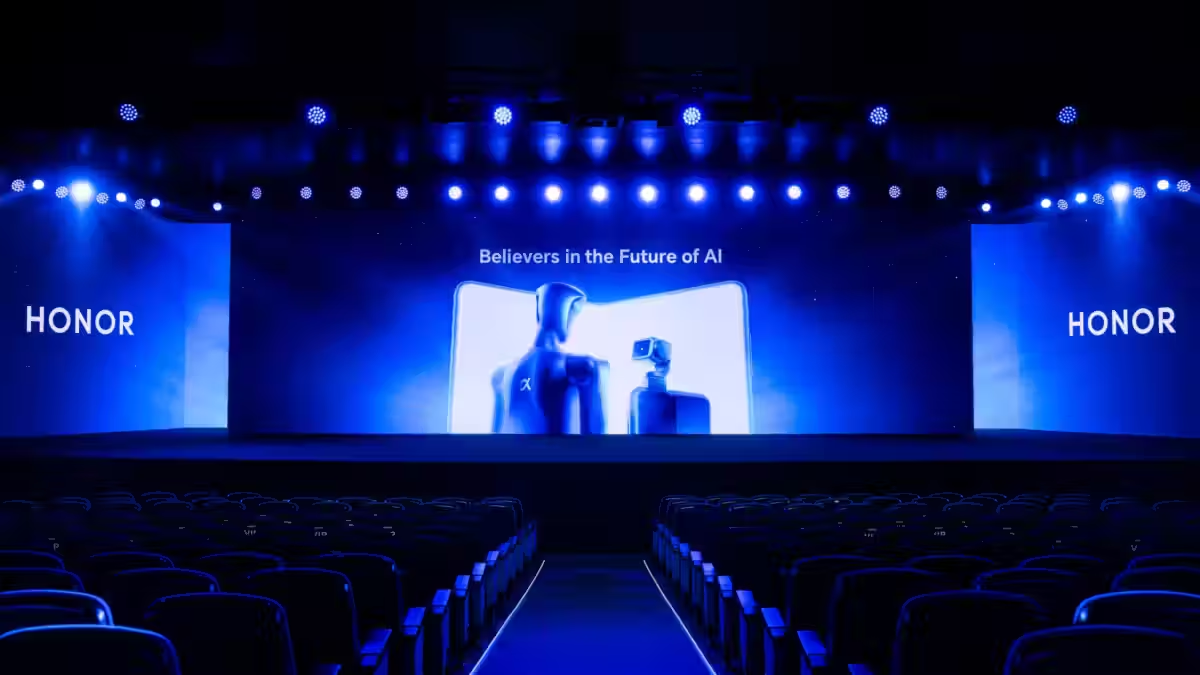
MWC 2026 was the stage for HONOR’s announcement that it plans to bring together 20 000 AI services by the end of 2026. For international tech audiences, this matters because it signals a move from standalone devices to unified, open AI platforms. A company that can link phones, tablets, cars and smart-home gear through persistent AI agents could shift where intelligence lives – and who controls it. That would force carriers, OEMs and developers to rethink partnerships and distribution, and could accelerate AI hardware beyond the usual US-China cloud axis. It also raises questions about privacy, data flows and who curates the user’s digital twin. Announcing this at MWC amplifies its reach, but the real test will be whether HONOR turns the number into a functioning, cross-device ecosystem rather than a marketing milestone. For carriers and regional regulators, that difference between promise and delivery will shape local competition and consumer trust too.
HONOR presented a large-scale strategy to build an open AI device ecosystem based on the updated HONOR AI Connect platform. The company expects to unite more than 20 000 AI services by the end of 2026, expanding beyond smartphones and positioning itself as a key player in the AI-device market.
Note for Russian readers: HONOR originally spun out of Huawei and remains a familiar name in Russia’s smartphone market. The reference to Orange might need context for English readers – Orange is a major French telecom operator and indicates HONOR’s push into European carrier partnerships rather than relying solely on device channels.
HONOR AI Connect as the center of an open AI platform
HONOR AI Connect creates a platform of personal digital twins – AI agents that run across all of a user’s devices, including phones, smart-home gear and cars. The agent doesn’t just obey commands; it reads intent and enables seamless handoffs between gadgets. That approach moves devices from passive tools to proactive digital partners and embodies the idea of ”augmented human intelligence.”
The company stresses that closed AI ecosystems are becoming a thing of the past – HONOR intends to collaborate with major partners like Orange to enter new markets: education, smart home, audio, pet products and toys. According to HONOR’s president of products, Fan Fei, we’re witnessing a ”Cambrian explosion” of AI devices – a rapid growth and diversification of intelligent hardware comparable to an evolutionary leap millions of years ago.
From smartphones to AI companions and robots
HONOR is actively developing products that go beyond classic gadgets. At the March 2026 ”Creators of the AI future” event, the company introduced: Magic V6 – a flagship foldable smartphone; MagicPad 4 – the world’s thinnest tablet; MagicBook Pro 14 – a powerful laptop; a prototype HONOR Robot Phone – a hybrid of smartphone and robot; an anthropomorphic robot; and an ultrathin silicon-carbon battery called HONOR Blade.
Those reveals underline HONOR’s intent to build not just standalone devices but full AI ecosystems where robotics and artificial intelligence are first-class citizens and enhance each other’s capabilities.
How an open ecosystem changes the market
HONOR’s current strategy differs from giants like Apple, where AI and devices are tightly bound inside a closed ecosystem. HONOR AI Connect’s openness promises a broad coalition of developers and partners that could turn HONOR into a unifying hub for diverse AI services. If the company executes well, it could galvanize the market and speed the spread of AI gadgets in new form factors.
Competition is already heating up: Huawei, Xiaomi and Samsung are building their own AI platforms and smart ecosystems. HONOR is trying to stand out with a comprehensive toolset in AI Connect and collaborations with carriers like Orange. That bet on multi-platform compatibility and ecosystem synergy could pay off in the fight for users.
HONOR AI Connect already shows potential by allowing not only a wider range of intelligent devices but also a more natural, personalized way to interact with them. This opens the door to deeper AI integration into everyday life and, crucially, reduces dependence on closed ecosystems – creating space for creative and technological growth.
Analysis: HONOR’s pitch at MWC is strategically smart – aiming squarely at the pain points of developers, carriers and OEMs who want flexibility beyond locked ecosystems. The company’s strengths are clear: a recognizable device lineup, carrier talks (Orange) and a platform narrative that suits multiple categories from wearables to robots. But the promise of 20 000 services is ambitious and hinges on developer momentum, clear privacy and data controls, and real interoperability across hardware vendors. Execution risks include fragmented developer APIs, inconsistent device performance, and regulatory scrutiny over data flows when agents span cars, homes and cloud services. If HONOR can deliver robust tools, transparent data governance, and fast partner onboarding, AI Connect could become a compelling alternative to closed platforms – otherwise it risks being a headline number without the stickiness to reshape the market.