

By launching the ID. Era 9X, Volkswagen is prioritizing the Chinese market with a dedicated electric SUV designed from the ground up for local tastes. This move contrasts with VW’s previous strategy, which often involved stretching global platforms to fit China’s preference for large vehicles. The fresh design language goes hand in hand with bold new colors like Fairy Green and Desert Gold and is the first chapter in VW’s ambitious plan to introduce over 20 new energy vehicles (pure EVs and plug-in hybrids) in China by 2027.
However, Volkswagen’s aggressive push faces stiff competition. Even its sibling brand Audi recently experienced a rocky market entry in China, struggling to gain traction with its new AUDI brand that notably lacks the Four Rings logo. Volkswagen’s success with the ID. Era 9X and its broader electrification efforts in China will reveal whether building hyper-tailored vehicles with high-tech interiors can sway consumers in a fiercely contested EV arena.
The ID. Era 9X’s electric pedigree includes a flat floor thanks to its battery placement, but what sets this EV apart is the availability of a range extender-a 1.5-liter turbocharged inline-four gasoline engine developed under Volkswagen’s established ”EA211” family. This engine emphasizes ideal combustion with a precise air-fuel mix, aiming to maximize efficiency and reduce emissions, an approach that aligns with the direction of Mazda’s upcoming Skyactiv-Z and Porsche’s T-Hybrid powertrains.
Dimensionally, the SUV is a behemoth. It measures just over 20 feet long and nearly 6.5 feet wide, riding on a 120.8-inch wheelbase that accommodates either a 51.1-kWh or an optional 65.2-kWh battery pack-the larger battery standard on the all-wheel-drive version. This translates to up to 249 miles of electric driving range according to China’s more lenient CLTC cycle. The dual-motor variant tips the scales at almost 6,000 pounds, showcasing the challenge of balancing tech-heavy interiors with practical weight constraints.
By launching the ID. Era 9X, Volkswagen is prioritizing the Chinese market with a dedicated electric SUV designed from the ground up for local tastes. This move contrasts with VW’s previous strategy, which often involved stretching global platforms to fit China’s preference for large vehicles. The fresh design language goes hand in hand with bold new colors like Fairy Green and Desert Gold and is the first chapter in VW’s ambitious plan to introduce over 20 new energy vehicles (pure EVs and plug-in hybrids) in China by 2027.
However, Volkswagen’s aggressive push faces stiff competition. Even its sibling brand Audi recently experienced a rocky market entry in China, struggling to gain traction with its new AUDI brand that notably lacks the Four Rings logo. Volkswagen’s success with the ID. Era 9X and its broader electrification efforts in China will reveal whether building hyper-tailored vehicles with high-tech interiors can sway consumers in a fiercely contested EV arena.
The ID. Era 9X’s electric pedigree includes a flat floor thanks to its battery placement, but what sets this EV apart is the availability of a range extender-a 1.5-liter turbocharged inline-four gasoline engine developed under Volkswagen’s established ”EA211” family. This engine emphasizes ideal combustion with a precise air-fuel mix, aiming to maximize efficiency and reduce emissions, an approach that aligns with the direction of Mazda’s upcoming Skyactiv-Z and Porsche’s T-Hybrid powertrains.
Dimensionally, the SUV is a behemoth. It measures just over 20 feet long and nearly 6.5 feet wide, riding on a 120.8-inch wheelbase that accommodates either a 51.1-kWh or an optional 65.2-kWh battery pack-the larger battery standard on the all-wheel-drive version. This translates to up to 249 miles of electric driving range according to China’s more lenient CLTC cycle. The dual-motor variant tips the scales at almost 6,000 pounds, showcasing the challenge of balancing tech-heavy interiors with practical weight constraints.
By launching the ID. Era 9X, Volkswagen is prioritizing the Chinese market with a dedicated electric SUV designed from the ground up for local tastes. This move contrasts with VW’s previous strategy, which often involved stretching global platforms to fit China’s preference for large vehicles. The fresh design language goes hand in hand with bold new colors like Fairy Green and Desert Gold and is the first chapter in VW’s ambitious plan to introduce over 20 new energy vehicles (pure EVs and plug-in hybrids) in China by 2027.
However, Volkswagen’s aggressive push faces stiff competition. Even its sibling brand Audi recently experienced a rocky market entry in China, struggling to gain traction with its new AUDI brand that notably lacks the Four Rings logo. Volkswagen’s success with the ID. Era 9X and its broader electrification efforts in China will reveal whether building hyper-tailored vehicles with high-tech interiors can sway consumers in a fiercely contested EV arena.
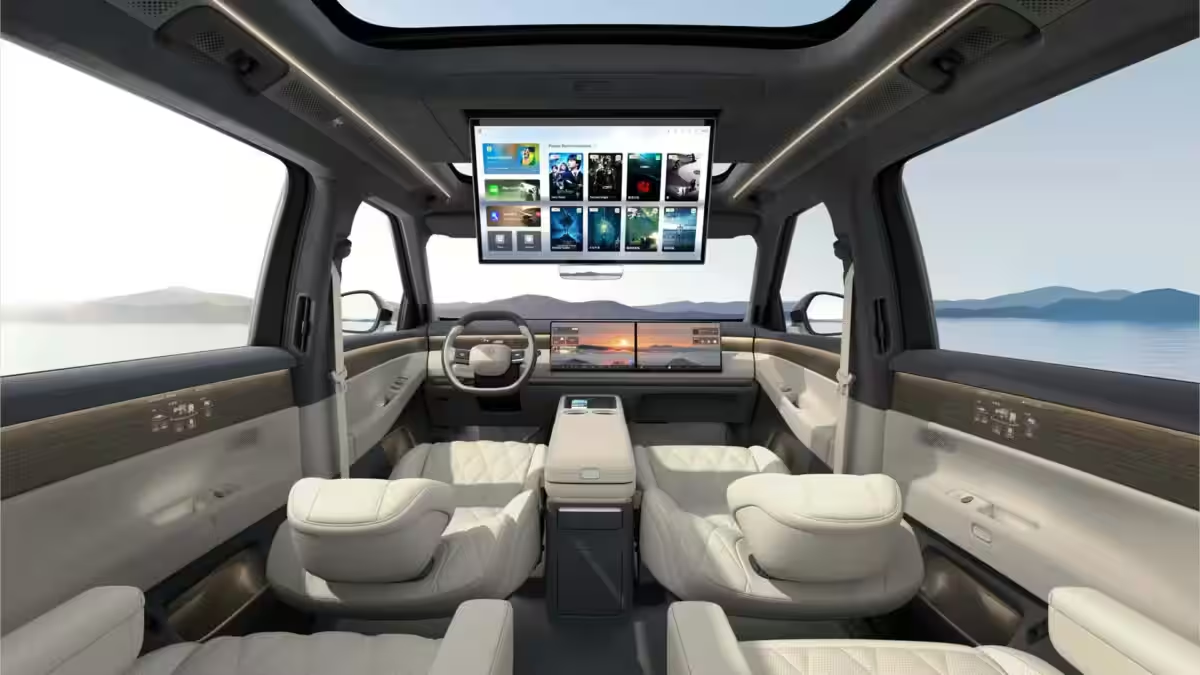
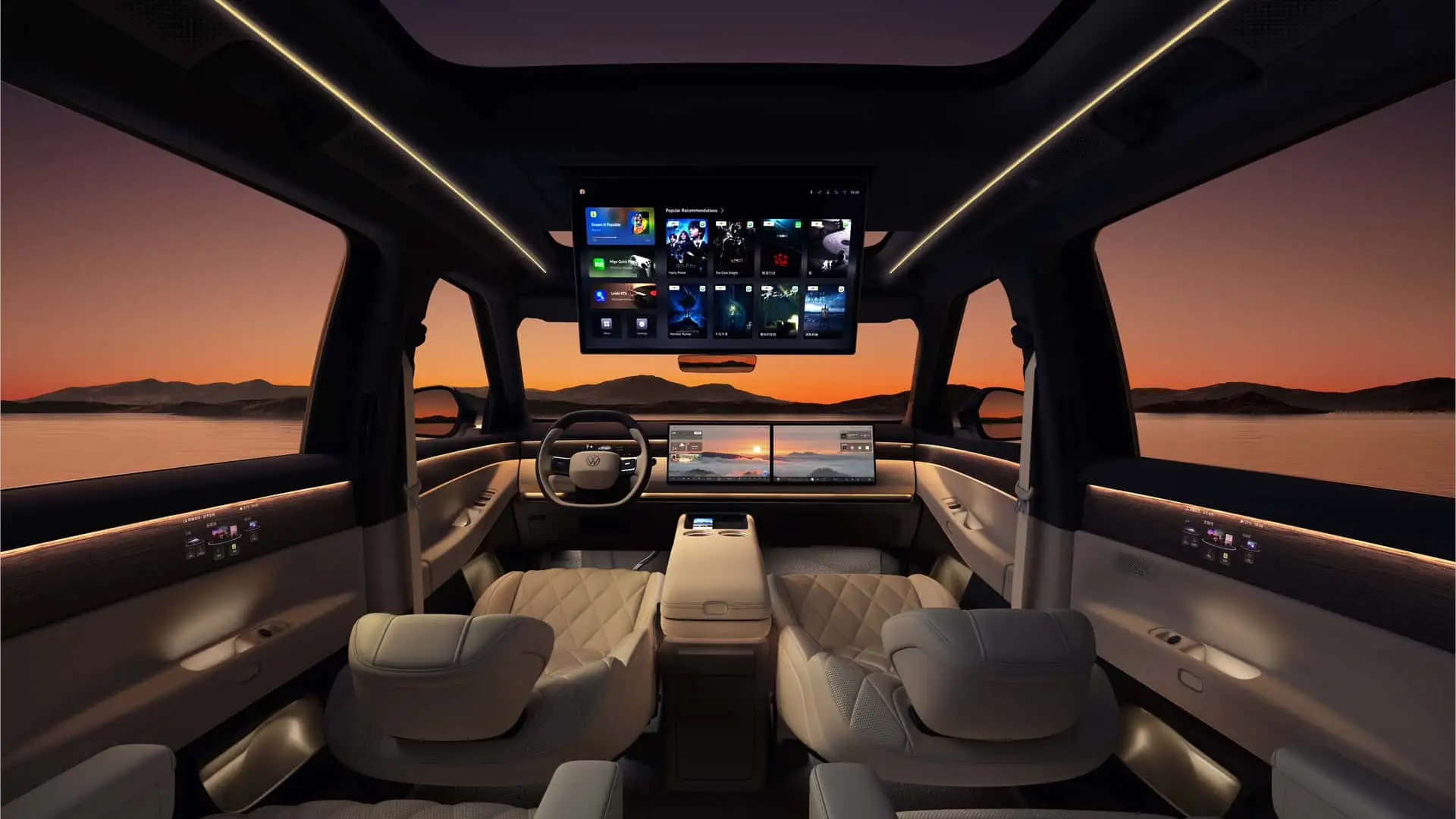
While Volkswagen plans to revive physical buttons in its upcoming ID.2 Polo for European buyers nostalgic for analog controls, the Chinese market demands a different approach. Volkswagen’s China chief highlighted that customers there favor ”AI-first, connected vehicles with seamless voice control and smart cockpits.” The ID. Era 9X answers that call with an interior dominated by dual 15.6-inch front screens and a remarkable 21.4-inch display that folds down from the ceiling, offering a tablet-style entertainment experience for rear passengers. Captain’s chairs in the second row even feature door-mounted projectors for supplemental multimedia displays.
The generally button-free environment extends to the driver’s console, which replaces the digital instrument cluster with a head-up display, effectively making room for the sprawling screen setup. This sea of glass is paired with elaborate ambient lighting stretched over 42 feet inside the cabin, including the ceiling flanking the panoramic sunroof-immersing occupants in a blend of ”German aesthetics with Eastern charm.”
The ID. Era 9X’s electric pedigree includes a flat floor thanks to its battery placement, but what sets this EV apart is the availability of a range extender-a 1.5-liter turbocharged inline-four gasoline engine developed under Volkswagen’s established ”EA211” family. This engine emphasizes ideal combustion with a precise air-fuel mix, aiming to maximize efficiency and reduce emissions, an approach that aligns with the direction of Mazda’s upcoming Skyactiv-Z and Porsche’s T-Hybrid powertrains.
Dimensionally, the SUV is a behemoth. It measures just over 20 feet long and nearly 6.5 feet wide, riding on a 120.8-inch wheelbase that accommodates either a 51.1-kWh or an optional 65.2-kWh battery pack-the larger battery standard on the all-wheel-drive version. This translates to up to 249 miles of electric driving range according to China’s more lenient CLTC cycle. The dual-motor variant tips the scales at almost 6,000 pounds, showcasing the challenge of balancing tech-heavy interiors with practical weight constraints.
By launching the ID. Era 9X, Volkswagen is prioritizing the Chinese market with a dedicated electric SUV designed from the ground up for local tastes. This move contrasts with VW’s previous strategy, which often involved stretching global platforms to fit China’s preference for large vehicles. The fresh design language goes hand in hand with bold new colors like Fairy Green and Desert Gold and is the first chapter in VW’s ambitious plan to introduce over 20 new energy vehicles (pure EVs and plug-in hybrids) in China by 2027.
However, Volkswagen’s aggressive push faces stiff competition. Even its sibling brand Audi recently experienced a rocky market entry in China, struggling to gain traction with its new AUDI brand that notably lacks the Four Rings logo. Volkswagen’s success with the ID. Era 9X and its broader electrification efforts in China will reveal whether building hyper-tailored vehicles with high-tech interiors can sway consumers in a fiercely contested EV arena.
Volkswagen is betting big on the Chinese market with its ID. Era 9X, a massive six-seater SUV that ditches traditional controls in favor of an all-digital cockpit layered with screens and ambient lighting. This model signals VW’s pivot to offer vehicles tailored specifically to Chinese consumers’ appetite for high-tech, AI-driven interiors rather than recycling global designs with minor tweaks.
While Volkswagen plans to revive physical buttons in its upcoming ID.2 Polo for European buyers nostalgic for analog controls, the Chinese market demands a different approach. Volkswagen’s China chief highlighted that customers there favor ”AI-first, connected vehicles with seamless voice control and smart cockpits.” The ID. Era 9X answers that call with an interior dominated by dual 15.6-inch front screens and a remarkable 21.4-inch display that folds down from the ceiling, offering a tablet-style entertainment experience for rear passengers. Captain’s chairs in the second row even feature door-mounted projectors for supplemental multimedia displays.
The generally button-free environment extends to the driver’s console, which replaces the digital instrument cluster with a head-up display, effectively making room for the sprawling screen setup. This sea of glass is paired with elaborate ambient lighting stretched over 42 feet inside the cabin, including the ceiling flanking the panoramic sunroof-immersing occupants in a blend of ”German aesthetics with Eastern charm.”
The ID. Era 9X’s electric pedigree includes a flat floor thanks to its battery placement, but what sets this EV apart is the availability of a range extender-a 1.5-liter turbocharged inline-four gasoline engine developed under Volkswagen’s established ”EA211” family. This engine emphasizes ideal combustion with a precise air-fuel mix, aiming to maximize efficiency and reduce emissions, an approach that aligns with the direction of Mazda’s upcoming Skyactiv-Z and Porsche’s T-Hybrid powertrains.
Dimensionally, the SUV is a behemoth. It measures just over 20 feet long and nearly 6.5 feet wide, riding on a 120.8-inch wheelbase that accommodates either a 51.1-kWh or an optional 65.2-kWh battery pack-the larger battery standard on the all-wheel-drive version. This translates to up to 249 miles of electric driving range according to China’s more lenient CLTC cycle. The dual-motor variant tips the scales at almost 6,000 pounds, showcasing the challenge of balancing tech-heavy interiors with practical weight constraints.
By launching the ID. Era 9X, Volkswagen is prioritizing the Chinese market with a dedicated electric SUV designed from the ground up for local tastes. This move contrasts with VW’s previous strategy, which often involved stretching global platforms to fit China’s preference for large vehicles. The fresh design language goes hand in hand with bold new colors like Fairy Green and Desert Gold and is the first chapter in VW’s ambitious plan to introduce over 20 new energy vehicles (pure EVs and plug-in hybrids) in China by 2027.
However, Volkswagen’s aggressive push faces stiff competition. Even its sibling brand Audi recently experienced a rocky market entry in China, struggling to gain traction with its new AUDI brand that notably lacks the Four Rings logo. Volkswagen’s success with the ID. Era 9X and its broader electrification efforts in China will reveal whether building hyper-tailored vehicles with high-tech interiors can sway consumers in a fiercely contested EV arena.
Volkswagen is betting big on the Chinese market with its ID. Era 9X, a massive six-seater SUV that ditches traditional controls in favor of an all-digital cockpit layered with screens and ambient lighting. This model signals VW’s pivot to offer vehicles tailored specifically to Chinese consumers’ appetite for high-tech, AI-driven interiors rather than recycling global designs with minor tweaks.
While Volkswagen plans to revive physical buttons in its upcoming ID.2 Polo for European buyers nostalgic for analog controls, the Chinese market demands a different approach. Volkswagen’s China chief highlighted that customers there favor ”AI-first, connected vehicles with seamless voice control and smart cockpits.” The ID. Era 9X answers that call with an interior dominated by dual 15.6-inch front screens and a remarkable 21.4-inch display that folds down from the ceiling, offering a tablet-style entertainment experience for rear passengers. Captain’s chairs in the second row even feature door-mounted projectors for supplemental multimedia displays.
The generally button-free environment extends to the driver’s console, which replaces the digital instrument cluster with a head-up display, effectively making room for the sprawling screen setup. This sea of glass is paired with elaborate ambient lighting stretched over 42 feet inside the cabin, including the ceiling flanking the panoramic sunroof-immersing occupants in a blend of ”German aesthetics with Eastern charm.”
The ID. Era 9X’s electric pedigree includes a flat floor thanks to its battery placement, but what sets this EV apart is the availability of a range extender-a 1.5-liter turbocharged inline-four gasoline engine developed under Volkswagen’s established ”EA211” family. This engine emphasizes ideal combustion with a precise air-fuel mix, aiming to maximize efficiency and reduce emissions, an approach that aligns with the direction of Mazda’s upcoming Skyactiv-Z and Porsche’s T-Hybrid powertrains.
Dimensionally, the SUV is a behemoth. It measures just over 20 feet long and nearly 6.5 feet wide, riding on a 120.8-inch wheelbase that accommodates either a 51.1-kWh or an optional 65.2-kWh battery pack-the larger battery standard on the all-wheel-drive version. This translates to up to 249 miles of electric driving range according to China’s more lenient CLTC cycle. The dual-motor variant tips the scales at almost 6,000 pounds, showcasing the challenge of balancing tech-heavy interiors with practical weight constraints.
By launching the ID. Era 9X, Volkswagen is prioritizing the Chinese market with a dedicated electric SUV designed from the ground up for local tastes. This move contrasts with VW’s previous strategy, which often involved stretching global platforms to fit China’s preference for large vehicles. The fresh design language goes hand in hand with bold new colors like Fairy Green and Desert Gold and is the first chapter in VW’s ambitious plan to introduce over 20 new energy vehicles (pure EVs and plug-in hybrids) in China by 2027.
However, Volkswagen’s aggressive push faces stiff competition. Even its sibling brand Audi recently experienced a rocky market entry in China, struggling to gain traction with its new AUDI brand that notably lacks the Four Rings logo. Volkswagen’s success with the ID. Era 9X and its broader electrification efforts in China will reveal whether building hyper-tailored vehicles with high-tech interiors can sway consumers in a fiercely contested EV arena.
Volkswagen is betting big on the Chinese market with its ID. Era 9X, a massive six-seater SUV that ditches traditional controls in favor of an all-digital cockpit layered with screens and ambient lighting. This model signals VW’s pivot to offer vehicles tailored specifically to Chinese consumers’ appetite for high-tech, AI-driven interiors rather than recycling global designs with minor tweaks.
While Volkswagen plans to revive physical buttons in its upcoming ID.2 Polo for European buyers nostalgic for analog controls, the Chinese market demands a different approach. Volkswagen’s China chief highlighted that customers there favor ”AI-first, connected vehicles with seamless voice control and smart cockpits.” The ID. Era 9X answers that call with an interior dominated by dual 15.6-inch front screens and a remarkable 21.4-inch display that folds down from the ceiling, offering a tablet-style entertainment experience for rear passengers. Captain’s chairs in the second row even feature door-mounted projectors for supplemental multimedia displays.
The generally button-free environment extends to the driver’s console, which replaces the digital instrument cluster with a head-up display, effectively making room for the sprawling screen setup. This sea of glass is paired with elaborate ambient lighting stretched over 42 feet inside the cabin, including the ceiling flanking the panoramic sunroof-immersing occupants in a blend of ”German aesthetics with Eastern charm.”
The ID. Era 9X’s electric pedigree includes a flat floor thanks to its battery placement, but what sets this EV apart is the availability of a range extender-a 1.5-liter turbocharged inline-four gasoline engine developed under Volkswagen’s established ”EA211” family. This engine emphasizes ideal combustion with a precise air-fuel mix, aiming to maximize efficiency and reduce emissions, an approach that aligns with the direction of Mazda’s upcoming Skyactiv-Z and Porsche’s T-Hybrid powertrains.
Dimensionally, the SUV is a behemoth. It measures just over 20 feet long and nearly 6.5 feet wide, riding on a 120.8-inch wheelbase that accommodates either a 51.1-kWh or an optional 65.2-kWh battery pack-the larger battery standard on the all-wheel-drive version. This translates to up to 249 miles of electric driving range according to China’s more lenient CLTC cycle. The dual-motor variant tips the scales at almost 6,000 pounds, showcasing the challenge of balancing tech-heavy interiors with practical weight constraints.
By launching the ID. Era 9X, Volkswagen is prioritizing the Chinese market with a dedicated electric SUV designed from the ground up for local tastes. This move contrasts with VW’s previous strategy, which often involved stretching global platforms to fit China’s preference for large vehicles. The fresh design language goes hand in hand with bold new colors like Fairy Green and Desert Gold and is the first chapter in VW’s ambitious plan to introduce over 20 new energy vehicles (pure EVs and plug-in hybrids) in China by 2027.
However, Volkswagen’s aggressive push faces stiff competition. Even its sibling brand Audi recently experienced a rocky market entry in China, struggling to gain traction with its new AUDI brand that notably lacks the Four Rings logo. Volkswagen’s success with the ID. Era 9X and its broader electrification efforts in China will reveal whether building hyper-tailored vehicles with high-tech interiors can sway consumers in a fiercely contested EV arena.