

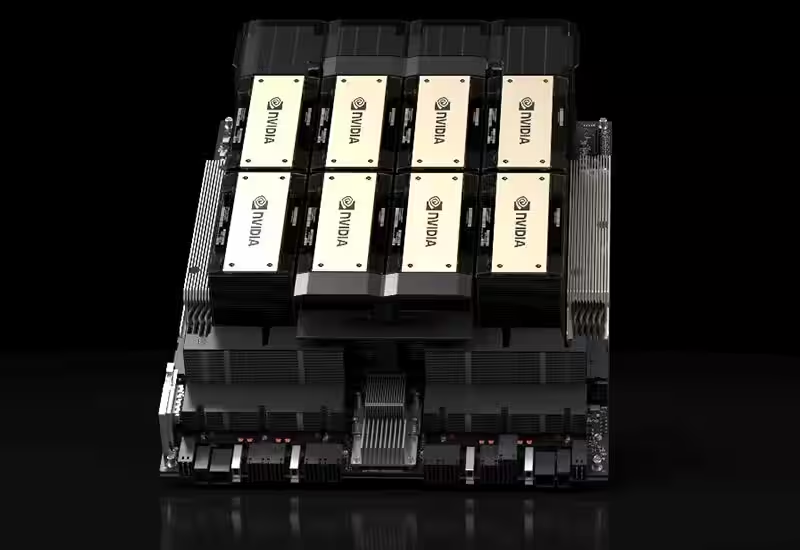
American investigators uncovered a brazen smuggling operation funneling Nvidia’s high-end AI chips directly from US soil into China, despite stringent export restrictions. The scheme involved a Texas-based company buying massive batches of Nvidia’s H100 and H200 accelerators through Lenovo’s US division, then rerouting them via multiple transit points to evade detection. This case highlights the continuing challenges in policing advanced technology exports and the porous nature of global supply chains when it comes to sanctioned products.
Contrary to prior assumptions that illicit shipments of US-origin AI chips destined for China mostly relied on third countries as middlemen, this investigation reveals a direct procurement route inside the United States. The criminal group purchased thousands of expensive Nvidia accelerators-key components for AI workloads-and concealed their destination through complex logistics involving warehouses in New York, Singapore, and Hong Kong before reaching Shenzhen.
The intercepted shipments included over 7,000 Nvidia accelerators, with initial deals supposedly targeting US needs. Lenovo, whose US unit sold the chips, maintained it strictly followed government compliance measures to prevent sanctioned exports, and no evidence tied Lenovo directly to the illicit scheme. Yet, the buyer-a company named Hao Global founded by an American citizen of Chinese descent-successfully circumvented these controls by repackaging and rerouting the goods.
In a notable deceit tactic, workers at the New York warehouse removed Nvidia branding from the AI chips and labeled them as unrelated ”Sandkyan adapters,” attempting to fool customs and regulatory inspections. When US agents seized a significant shipment in Georgia, they had already infiltrated the smuggling ring, allowing a controlled bust and recovery of thousands of devices. Attempts by the smugglers to buy back confiscated goods for $1 million only confirmed how far they were willing to go.
Export controls face mounting enforcement hurdles
This episode underscores the difficulties inherent in enforcing US export controls on dual-use technologies amid growing geopolitical tensions. While export restrictions on AI accelerators to China aim to limit Beijing’s advancement in critical tech sectors, determined actors demonstrate how commercial supply chains and complex global warehousing can be exploited.
Notably, even with tightened oversight, the smuggling network operated from within US borders, exploiting gaps in verification processes. As China remains a priority target for embargoes, these findings are a stark reminder that compliance programs alone cannot eliminate contraband risks in high-value tech markets.
Other nations face similar enforcement challenges. For example, European and Japanese governments have struggled to prevent diverted semiconductor shipments ending up in sanctioned countries. The competitive urgency around AI hardware production fuels demand for high-end chips, incentivizing illicit trade despite political pressure.
What’s next for US-China tech embargoes?
While this smuggling ring’s exposure led to arrests and seizures, broader questions loom on how the US and allies will adapt export control frameworks to close loopholes exploited through repackaging and intermediary logistics hubs. Enhanced cooperation among private companies, law enforcement, and customs agencies is essential but may not be enough to fully stem unauthorized AI chip exports.
For Nvidia and other chipmakers caught in the squeeze, reputational risks rise as customers worry about compliance failures enabling hostile tech transfers. And for China, persistent smuggling pressures will likely spur investment in domestic chip capabilities to reduce reliance on vulnerable foreign supply chains.
This case reveals that export controls are not just technical hurdles but geopolitical battlegrounds where enforcement resources, commercial ambitions, and international rivalry collide. The unfolding contest over AI chip flows between the US and China remains far from resolved.