

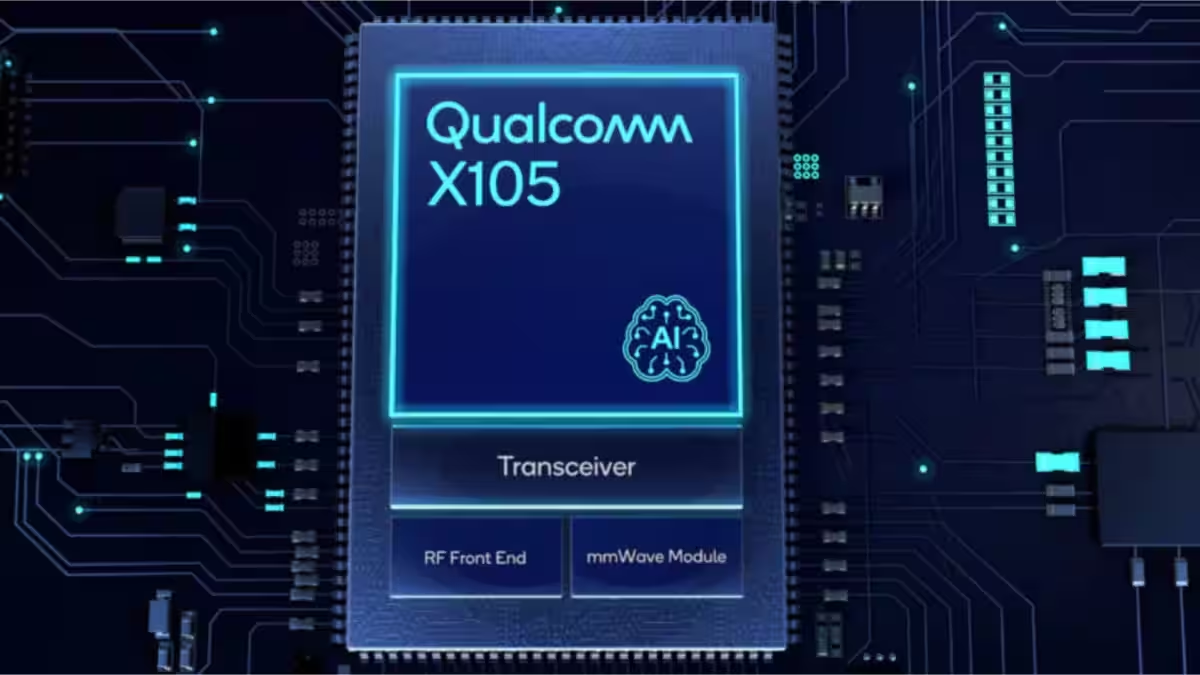
Samsung’s upcoming Galaxy S27 Ultra is shaping up to be a connectivity powerhouse, with Qualcomm’s brand-new X105 5G modem expected to fuel significantly faster data speeds and introduce built-in satellite communication capabilities. Announced at MWC 2026, this modem marks a leap forward in how smartphones handle wireless networks, allowing users to tap into satellite services for calls and messages when traditional cell signals fail.
The Qualcomm X105 modem represents a notable advancement over its predecessor, the X85, primarily by incorporating support for 3GPP Release 19 standards. While still a 5G modem, this gives it a future-proof edge as it lays the groundwork for upcoming 6G technologies. Beyond theoretical benefits, the X105 supports ”5G Advanced,” offering peak download speeds up to 14.8 Gbps and upload speeds reaching 4.2 Gbps-a considerable boost for heavy data users.
Importantly, energy efficiency hasn’t been overlooked: a new RF transceiver paired with the modem cuts power consumption by up to 30%. This could translate into better battery life, addressing one of the perennial pain points for power-hungry 5G smartphones. Enhanced positioning accuracy is another upgrade, thanks to quad-frequency GNSS support, enhancing location services critical for navigation and app functionality.
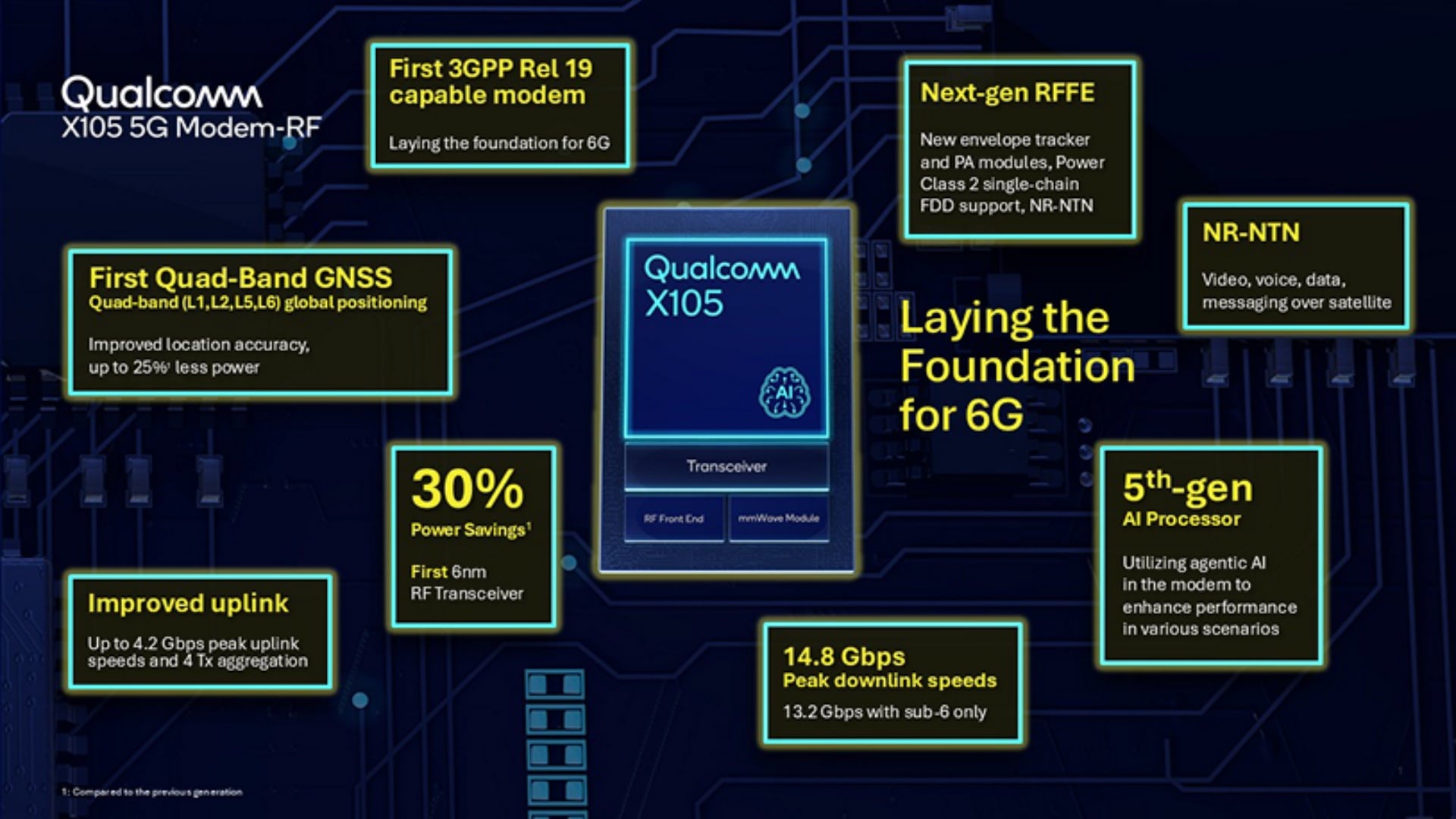
Beyond raw speed and efficiency, the X105 brings integrated satellite connectivity via New Radio Non-Terrestrial Network (NR-NTN) technology. This is a shift that could change how smartphones handle network outages and dead zones by connecting directly to low-Earth orbit satellites. Users will be able to make calls, send texts, and even browse basic data over satellite networks-a feature that moves well past the typical emergency SOS capabilities on select devices today.
What differentiates this further is the modem’s fallback to NB-IoT (narrowband IoT) networks, which provide messaging services even in challenging environments such as underground or densely built urban areas where both cellular and satellite signals might falter. This multi-layered connectivity approach hints at smartphones not just being communication tools but multi-path network devices resilient to interruptions.
The integration of AI on the modem itself is another modern touch, enabling real-time network predictions and optimizations. Qualcomm’s approach includes offering APIs so phone makers can tailor this AI to squeeze even better performance out of their devices under varying network conditions, making this not just a hardware upgrade but a smarter connectivity solution.
Samsung’s Galaxy S27 Ultra will likely be the first flagship to capitalize on the X105 modem’s capabilities when it debuts in late 2026. This partnership promises not only to deliver the fastest 5G experiences yet seen on a Galaxy device but also to pioneer mainstream satellite phone functionality that could redefine how users stay connected in critical situations.
Satellite calling integration has so far been a niche feature, mostly reserved for rugged or specialized phones. The move to lump it into a flagship Android smartphone signals a gradual mainstreaming, spurred partly by shifting broadband demands and a competitive race with Apple’s Emergency SOS via satellite on recent iPhones. As cellular networks face challenges from natural disasters, increasing urban density, and expanding rural demands, multimodal connectivity solutions like Qualcomm’s X105 stand to become standard rather than specialty.
However, challenges remain-including the cost of satellite data, regulatory hurdles, and actual real-world performance with these NR-NTN links. Whether consumers and carriers embrace this integrated satellite approach as a daily utility or mainly for emergencies will dictate how quickly it spreads beyond ultra-premium handsets.
Looking ahead, the Galaxy S27 Ultra’s adoption of Qualcomm’s X105 modem sets a tone for the next phase in mobile networking: a shift from purely terrestrial cell towers to blended network ecosystems combining 5G, satellite, and IoT layers. It also raises questions about how both hardware manufacturers and network operators will balance this complexity while keeping devices affordable, energy-efficient, and truly reliable worldwide.