

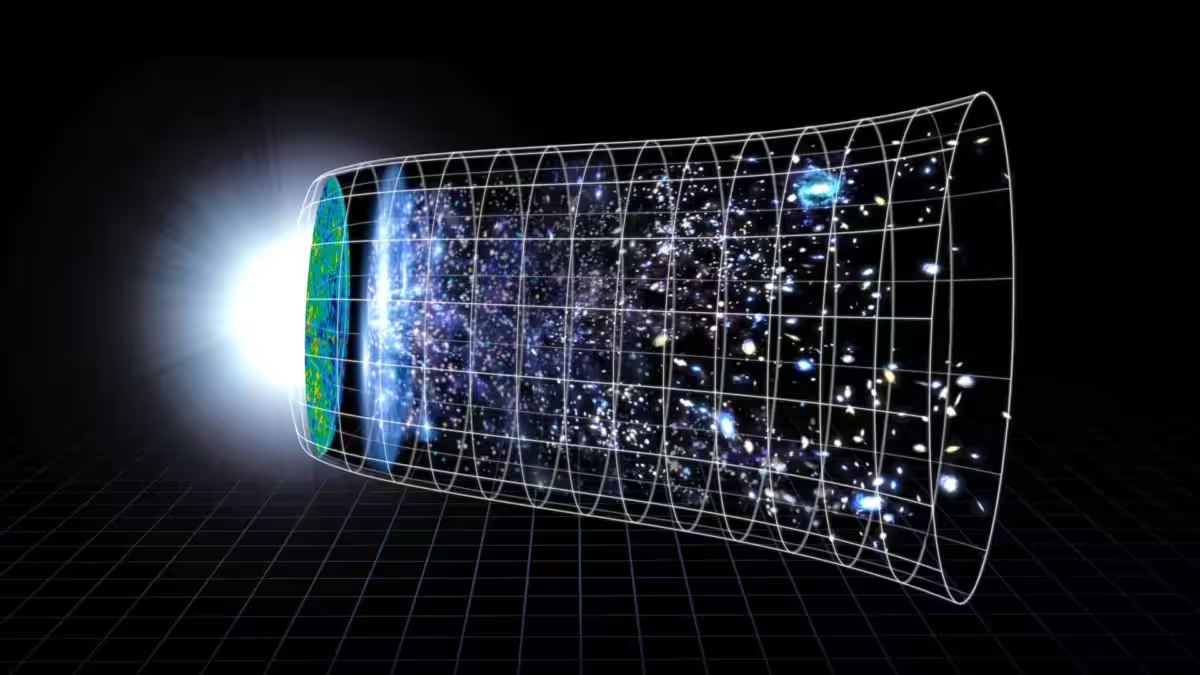
Scientists have proposed a novel method to measure the universe’s expansion rate by tapping into the faint hum of gravitational waves produced by countless black hole mergers too subtle to detect individually. This innovative approach refines existing gravitational wave techniques and promises to sharpen estimates of the Hubble constant-the figure that quantifies how fast the universe is growing-potentially bringing us closer to resolving the long-standing ”Hubble tension” that has puzzled cosmologists for years.
A lingering cosmological puzzle
For nearly a century, astronomers have sought to pin down how rapidly space itself is expanding. The Hubble constant is central to this quest. Yet conflicting measurements lurk at the heart of modern cosmology: values derived from early-universe probes, such as the cosmic microwave background, differ significantly from those using more local observations like supernovae. That discrepancy, dubbed the Hubble tension, suggests our understanding might miss vital pieces of the cosmic puzzle, including possible new physics related to dark energy or dark matter.
Traditional measurements rely heavily on light-based signals, occasionally augmented by gravitational waves from cataclysmic events. These ”standard sirens”-gravitational wave signals from binary black hole or neutron star mergers-offer a way to calculate distances without some of the biases inherent to electromagnetic methods. However, they have had limited precision so far due to the rarity of detectable events and challenges in identifying their host galaxies to determine recession speeds.
Listening to the gravitational-wave hum
The breakthrough from researchers at the University of Illinois and the University of Chicago lies in exploiting the gravitational-wave background-a persistent, low-level signal created by the sum of countless black hole mergers too distant or faint to be observed individually. Instead of looking for isolated ”chirps,” they analyze this background hum to extract cosmological information.
The logic is straightforward yet clever: if the universe’s expansion rate were slower, the volume within our observational reach would shrink, crowding more black hole mergers into a smaller space and making the gravitational-wave background stronger. Conversely, a faster expansion spreads out these events, dimming the background. By setting upper limits on this background’s strength using current data, researchers can rule out certain slow-expansion scenarios.
This ”stochastic siren” method complements existing measurements from individual gravitational wave detections, enhancing overall precision. The approach has already constrained the range of plausible Hubble constant values consistent with the persistent tension, hinting at its promise as detectors gain sensitivity.
Implications for the future of cosmology
As gravitational wave observatories like LIGO, Virgo, and KAGRA continue upgrades, detecting the gravitational-wave background itself might be within reach in the next half-decade. The ability to directly measure this cosmic hum could tighten constraints on not just the Hubble constant but other fundamental cosmological parameters, pushing our understanding of the universe’s composition and history further.
This method uniquely sidesteps some limitations of earlier techniques that require electromagnetic counterparts to gravitational wave events, offering a more universal tool applicable even when no light is detected. Its development underscores how gravitational wave astronomy is evolving beyond rare cosmic fireworks into a steady stream of data capable of confronting big questions.
Still, the Hubble tension proves stubborn, and even refined measurements might reaffirm the discord between early- and late-universe observations. That outcome would compel theorists to seriously reconsider cosmic models involving dark sectors or unknown physics. Either way, this gravitational-wave background method injects fresh momentum into one of astronomy’s most vexing mysteries.