

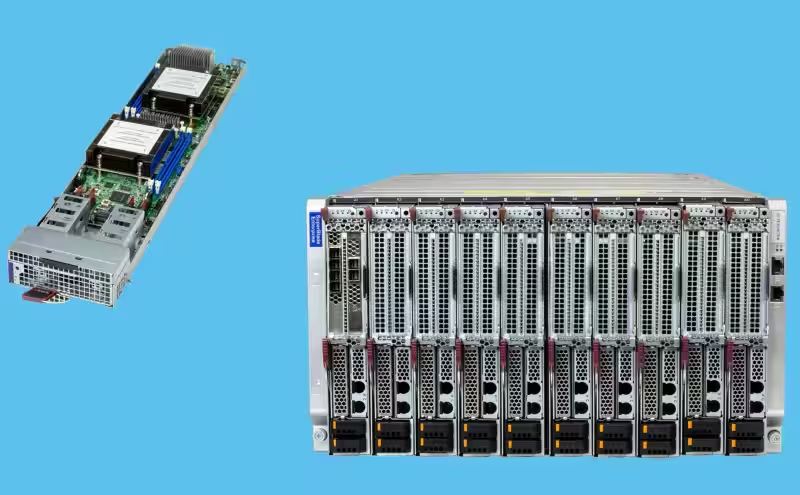
When cloud providers and edge computing companies need to squeeze every inch of compute power into tight spaces, density is king. Supermicro’s latest MicroBlade platform aims to push that advantage further, cramming up to 320 AMD EPYC 4005 processor nodes into a standard 48U rack. This isn’t just about fitting more servers; it’s about rethinking how scalable computing is delivered in constrained environments.
The backbone of MicroBlade is the MBA-315R-1DE12 node, based on AMD’s EPYC 4005 series with AM5 (LGA-1718) socket support. Each node supports processors up to 110 watts TDP, offering up to 16 cores and 32 threads. This balance of performance and power efficiency is critical for dense deployments, especially when thermal and power budgets are tight.
Memory-wise, each node can house up to 128GB of DDR5-5600 RAM across two slots, enabling swift data access for demanding tasks. Networking capabilities aren’t an afterthought; dual 25GbE ports powered by Broadcom’s BCM57414 chipset come standard, supporting modern high-throughput data pipelines. Security and management features include an Aspeed AST2600 BMC controller and TPM 2.0 integration, a nod to the growing focus on hardware-level security.
What truly sets MicroBlade apart is the extreme scale achieved by compact engineering: 40 individual nodes fit into a 6U chassis. Multiply that by eight to fill a 48U rack, and you get an impressive 320 nodes per rack. Such density promises substantial savings on space and energy, assuming cooling and power delivery are up to the task.
Supermicro markets this as ideal for environments running virtual private servers, edge computing applications, microservices, cybersecurity workloads, and e-commerce platforms. These use cases share a common need for efficient, scalable, and cost-effective compute resources close to end users or data sources.
But packing so many nodes into such a small footprint isn’t without challenges. Effective heat dissipation can be a nightmare, especially in edge locations where bulky cooling infrastructure is impractical. Additionally, while AMD’s EPYC 4005 chips offer respectable multi-threaded performance, they sit at the midtier-bear in mind you’re trading raw power per node for quantity.
Competitors like HPE’s Dense Compute or Dell’s PowerEdge MX modules also push the boundaries of server density, though the MicroBlade’s sheer node count per rack is notable. That said, some rivals opt for higher core-count CPUs with fewer nodes, targeting workloads that benefit from beefier single nodes rather than massive parallelism.
Supermicro stepping aggressively into 6U blade-like servers built around AMD’s platform signals broader industry momentum toward hybrid cloud and edge-ready infrastructure. Providers are increasingly hunting for solutions that blend scalability with manageable operational overhead. MicroBlade’s promise hinges on delivering this at scale without exorbitant energy and space footprints.
Looking forward, the question is how well the MicroBlade will integrate with orchestration tools and whether it can maintain performance without thermal throttling in real-world edge deployments. If Supermicro nails the balance, it could become the go-to for dense, secure, and flexible compute layers outside traditional data centers.