

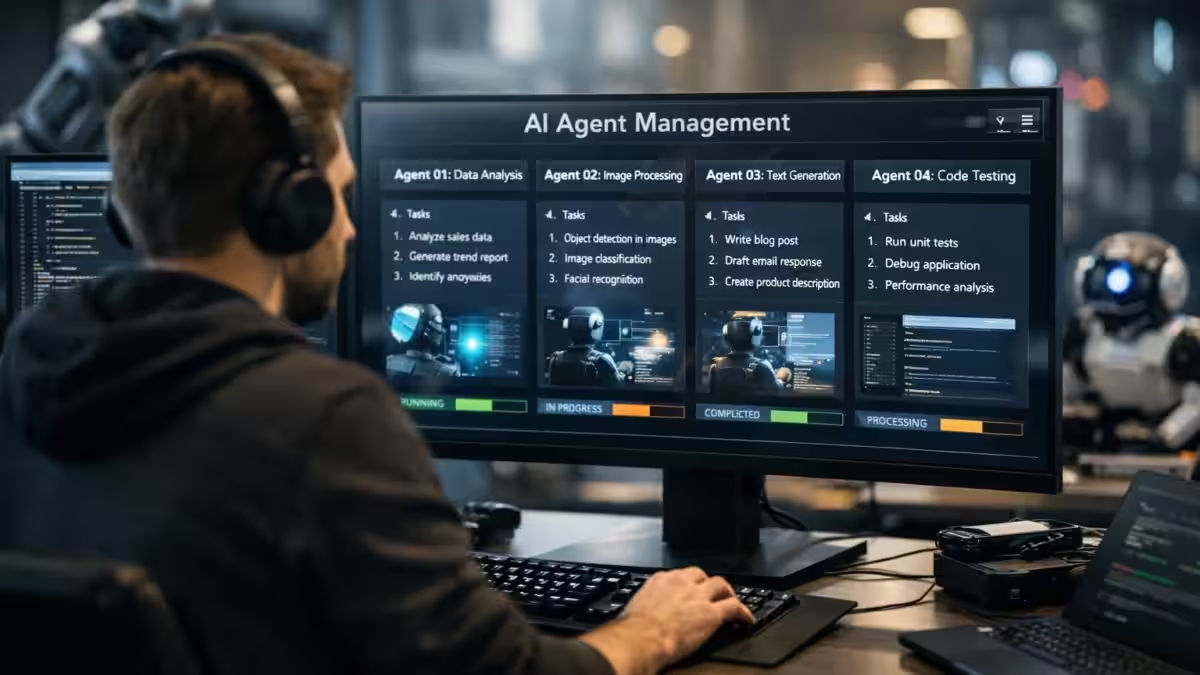
Programming as we knew it is undergoing a dramatic transformation. Tasks that once demanded hours or even entire weekends are now being handled autonomously by advanced AI agents, leaving humans to steer and supervise rather than write every line of code.
Andrey Karpats, an AI expert with experience at Tesla and OpenAI, recently highlighted how AI-driven programming has evolved within a few months. According to him, new models like Opus 4.5 and Codex 5.2 have made AI agents much more reliable, enabling them to maintain focus on complex projects with minimal human intervention.
Karpats shared a striking example: he instructed an AI agent to build a dashboard for video analysis using just a natural language description. The AI tackled the project independently over 30 minutes, solving problems on the fly and delivering a functional result. Previously, such a project would have required days of human effort.
This shift signals the fading era of ”manual” coding-the developer’s role is morphing into managing AI agents, specifying goals in natural language, assessing output quality, and iterating creatively. Karpats declares, ”The age of manual code input has ended.”
Nevertheless, these AI systems are far from flawless. They still require high levels of human oversight, critical evaluation, and creative problem-solving to guide and correct them. Rather than rendering engineers obsolete, they redefine the nature of engineering work itself.
Notably, Karpats was skeptical about AI agents only months ago, dismissing them as overhyped and impractical. His recent enthusiasm underscores how quickly the technology has matured.
While AI agents quickly assume routine and some complex programming tasks, the broader implications raise questions. Will this shift commoditize coding skills, push engineers toward managerial and evaluative roles, or open doors to new forms of creativity?
Competitors like Microsoft with GitHub Copilot and Google’s Codey have also advanced AI-powered programming assistants, yet many developers remain cautious. Problems like AI hallucinations, potential biases, and the challenge of integrating AI output into larger systems mean full autonomy is still a distant horizon.
For now, the emerging norm seems to be a partnership: humans setting high-level objectives and AI agents carrying out the heavy lifting. This hybrid approach could accelerate software development cycles, but the transition will require engineers to develop new skills in AI orchestration and critical oversight.
In short, programming isn’t disappearing; it’s becoming a dialogue between human ingenuity and machine precision. The ”coding” of tomorrow might look a lot less like typing and a lot more like curating.