

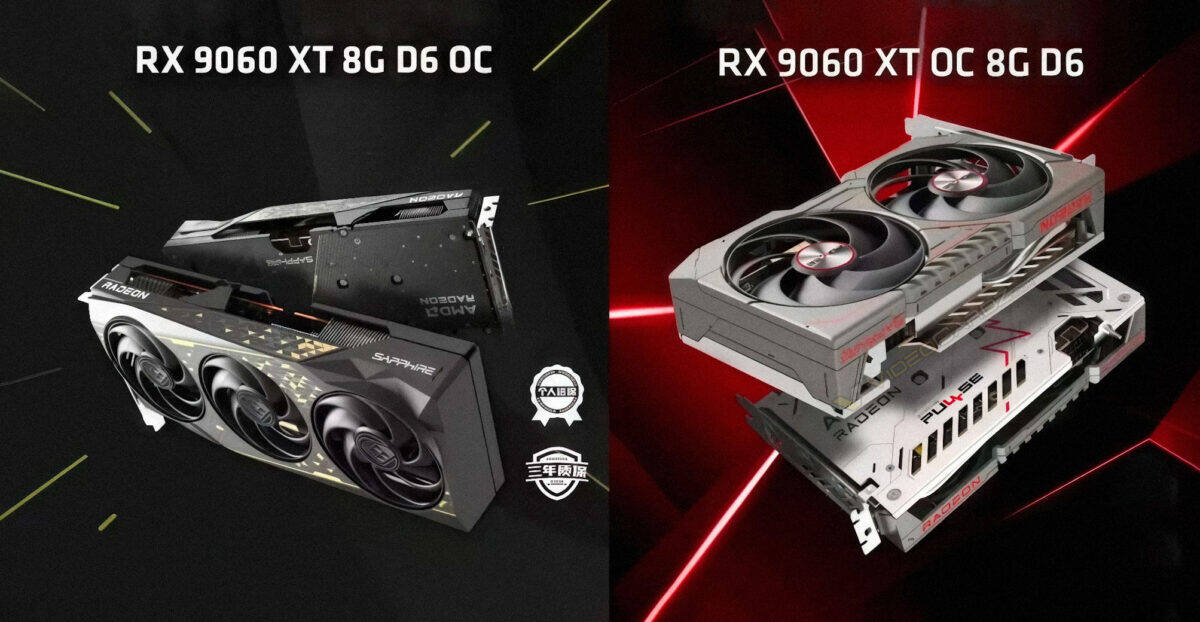
Sapphire’s newest pair of Radeon RX 9060 XT cards arrives as a study in contrasts: a very compact Pulse S model and a large, triple‑fan Black Diamond, yet both share the same limiting spec that will matter most to buyers in 2026 – just 8 GB of GDDR6.
The two SKUs are straightforward. The Pulse S RX 9060 XT 8G is a space‑saving card under 200 mm long, occupying two expansion slots. The Black Diamond RX 9060 XT 8G D6 OC goes the other way with a large triple‑fan cooler – bulky for the class, but still a two‑slot install in terms of bracket width. Clock speeds differ too: Pulse S is listed with a GPU frequency of 3290 MHz, while the Black Diamond is downclocked to 3100 MHz. Both ship with 8 GB of memory. The announcement appeared on February 28, 2026.
Why the 8 GB detail matters more than the cooler
In 2026, 8 GB of VRAM is no longer a neutral spec – it’s a clear positioning choice. At 1080p, many current titles still run fine on 8 GB, but higher texture packs, ray tracing, and increasing use of large texture sets at 1440p or above make 8 GB a practical ceiling for gamers who want longevity or plan to play at higher fidelity. By shipping both a compact and a premium‑looking cooler around the same memory budget, Sapphire is signalling that these cards are intended as affordable midrange options, not future‑proof upgrades.
- Pulse S RX 9060 XT 8G: compact form (<200 mm), two slots, 3290 MHz GPU clock, 8 GB GDDR6.
- Black Diamond RX 9060 XT 8G D6 OC: large triple‑fan cooler (bulky for class), two slots, 3100 MHz GPU clock, 8 GB GDDR6.
What Sapphire is doing (and why)
Two obvious reasons explain the pair: product segmentation and market reach. The compact Pulse S targets small‑form‑factor builds and system integrators who need a short card. The Black Diamond gives buyers who prioritise thermals and noise a bigger cooler – and, interestingly, Sapphire chose a lower boost clock there, suggesting the Black Diamond is tuned for quieter operation rather than peak clocks. At the same time, keeping both at 8 GB helps control bill of materials (BOM) cost and simplifies SKU management for retailers.
Who wins, who loses
- Winners: budget‑conscious gamers, system builders with compact chassis, and anyone who wants an affordable RX 9060 XT option without hunting multiple memory variants.
- Losers: buyers looking for more future‑proofing or higher‑resolution gaming. Power users who want larger frame buffers or who run heavy texture mods and high ray tracing settings will find 8 GB constraining within a couple of years.
From a competition standpoint, vendors have increasingly split midrange SKUs into compact and beefy cooler versions – that’s familiar – but where many rivals have started offering 12-16 GB options to address future needs, Sapphire’s choice to ship two visually different cards with the same 8 GB speaks to a focus on price and logistics over headroom.
What to expect next
If Sapphire follows common industry patterns, we may see additional memory configurations or refreshed boards later if market demand and pricing justify it. For now, these two cards let the company cover small builds and quieter desktops without expanding inventory complexity. Buyers who value longevity over upfront cost should wait for 12 GB or higher variants (either from AMD partners or a different AMD SKU) or consider stepping up to a higher tier if their budget allows.
Practical takeaway: if you need a short card for a compact case, the Pulse S is a clear fit. If you prioritise acoustics and cooling, the Black Diamond is the better bet – but neither solves the larger question of whether 8 GB will be enough beyond the next couple of years.
Source images credited to Videocardz. Announcement posted February 28, 2026.
Tags
- Sapphire
- AMD
- Radeon
- RX 9060
- GPUs
- graphics cards