

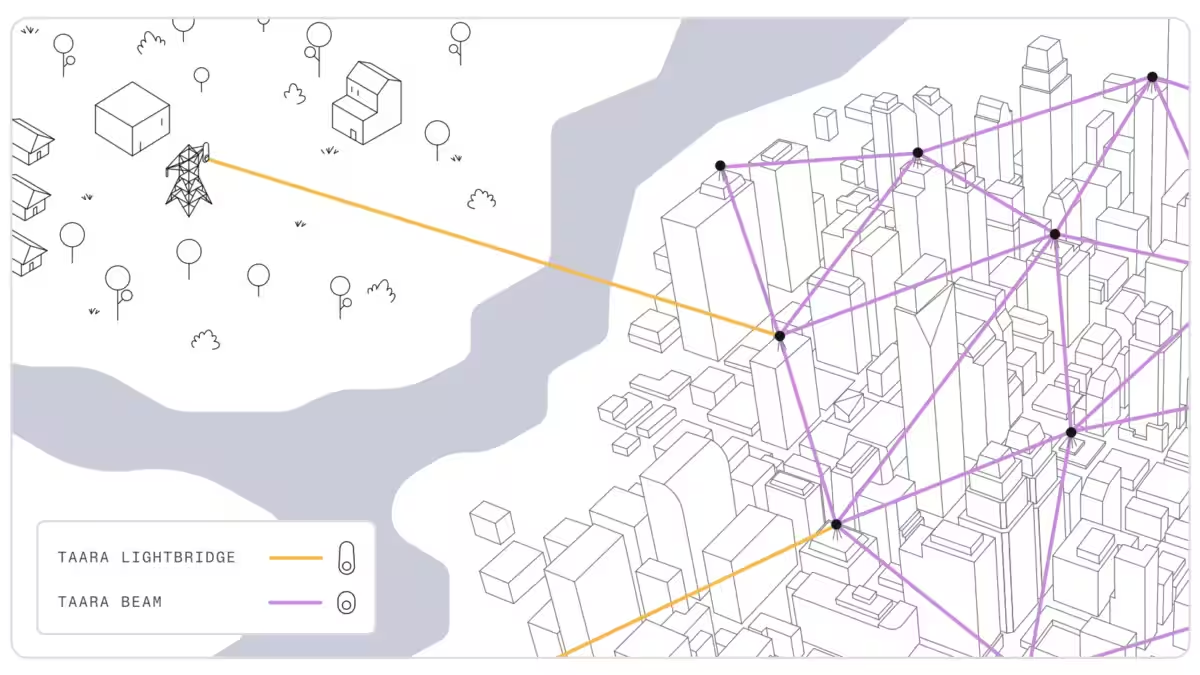
Cities need high-capacity links that can be put in place fast. Trenching fiber takes months and costs a fortune; licensed microwave needs spectrum and careful planning; and satellites are convenient but add latency. Taara’s new product, Beam, is an attempt to fill that middle-mile gap by literally pointing invisible beams of light between poles and rooftops.
What Taara just announced
Taara, the light-based internet provider that spun out of Alphabet’s moonshot incubator last year, has launched Taara Beam – a shoebox-sized device that delivers 25 Gbps over line-of-sight optical links. The unit weighs 8 kg (less than 20 pounds), typically consumes about 90 W, and can reach out to 10 km. Taara positions the product for enterprises and telcos as middle-mile infrastructure rather than a consumer access device.
Taara already markets a longer-range system, Lightbridge, for crossings such as rivers and mountain gaps – Lightbridge can span up to 20 km (over 12 miles) and has been deployed by operators including T‑Mobile and Airtel in more than 20 countries. Beam is the denser urban follow-up: smaller, pole-mountable, and intended for quick city rollouts.
Why this matters
Twenty-five gigabits per second (25 Gbps) and sub-millisecond latency make optical line-of-sight links competitive with fiber on raw throughput – and Taara says Beam offers ultra-low latency (less than 100 μs), far better than any space-based service. That opens obvious use cases for telcos and municipal networks: bulk offloads of lidar and sensor data from parked delivery vans or robotaxis, and low-latency mesh links between intersections to support V2X communications.
Put simply: Taara is selling a way to move large volumes of data across a city without digging or buying radio spectrum. For operators who need middle-mile capacity on short notice – event venues, logistics hubs, campuses, and smart-city projects – that convenience can translate to real savings and faster time to service.
The trade-offs they’re glossing over
Line-of-sight optics behave differently than buried fiber. Weather and atmospheric conditions matter: dense fog, heavy rain, or large particles in the air can attenuate optical beams and reduce reliability. That’s why free-space optical (FSO) systems have been tried before with mixed commercial success – they excel where you can guarantee clear sight lines and predictable conditions, but they’re less forgiving than buried infrastructure.
There are also practical deployment headaches. Even though an FSO unit doesn’t need RF spectrum, municipalities still control poles, rooftops, and street furniture. Operators will face permitting, pole-load engineering, and ongoing maintenance – tasks that can slow projects even if the hardware itself can be mounted in hours. Power (about 90 W per unit) and alignment tolerances matter too, especially when a citywide mesh needs dozens of units.
How this compares with alternatives
Fiber: unmatched for reliability and long-term capacity, but slow and expensive to deploy in dense urban areas because of civil works.
Microwave and millimeter-wave links: fast to install and proven for urban backhaul, but limited by available spectrum, interference, and line-of-sight constraints; performance can drop in dense RF environments.
Satellites (low-Earth orbit, LEO): wide coverage and simple user installs, but higher latency and per-link economics that favor end-user access over dense intracity middle-mile. Taara pitches Beam as a complementary option: similar throughput to fiber, far lower latency than LEO satellites, and much faster deployment than trenching.
Who stands to gain – and who won’t
Winners: telcos and enterprise network operators that need rapid, high-capacity links without waiting months for fiber; smart-city projects and fleets that must move terabytes of sensor data quickly and with predictable latency.
Losers (or at least challenged): contractors and municipal budgets built around fiber deployments; operators who bet on satellite or wireless-only middle-mile architectures and now need denser urban capacity. Residents won’t suddenly get cheaper consumer broadband from Beam – it’s a wholesale/middle-mile product, not last-mile access for households.
What to watch for at MWC and after
Expect live demos and operator partnerships to be front and center at Mobile World Congress. The real test won’t be the headline throughput number; it will be multi-week, multi-season reliability in real city conditions, and how quickly operators can integrate Beam into existing network management and service-level agreements.
If Taara can show consistent uptime through foggy months and convince cities to streamline pole access and maintenance, Beam could become a standard tool in the operator toolkit. If not, it may settle into niche roles – stadiums, ports, and temporary events – where quick, high-capacity links are valuable enough to accept some environmental sensitivity.
Either way, Beam is a reminder that the middle-mile is becoming as competitive and inventive as the last mile. Moving large amounts of data across a city without digging is an attractive idea. The challenge is doing it reliably and cheaply enough to replace the decades-old default: fiber.