

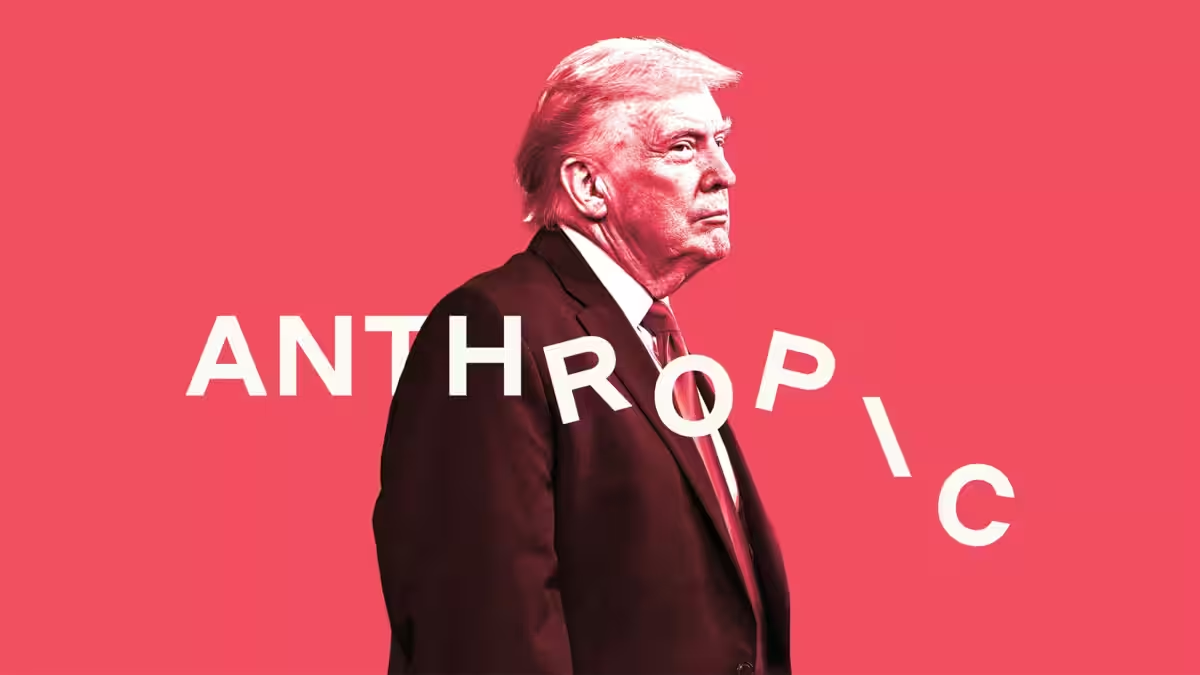
President Donald Trump’s order to halt all federal use of Anthropic’s AI forces an uncomfortable choice onto U.S. national security: accept vendor-drawn ethical limits on how powerful models are used, or hand sourcing for classified work to politically aligned alternatives.
In a Truth Social post on February 27, the president ordered ”EVERY Federal Agency in the United States Government to IMMEDIATELY CEASE all use of Anthropic’s technology.” The directive followed weeks of tense negotiations between Anthropic and the Department of War over whether Claude, Anthropic’s model family, could be used for ”any lawful use” – terms the company said would include autonomous lethal systems and mass domestic surveillance, both of which Anthropic has said it will not enable.
”THE UNITED STATES OF AMERICA WILL NEVER ALLOW A RADICAL LEFT, WOKE COMPANY TO DICTATE HOW OUR GREAT MILITARY FIGHTS AND WINS WARS!”
Truth Social
Anthropic CEO Dario Amodei publicly declined to ”accede” to the Pentagon’s proposed contract terms. The company had until 5:01 pm ET on February 27 to agree; Trump’s order effectively renders that deadline academic. The president said agencies will get a six-month phase-out window in which Anthropic must help with the transition, and warned of unspecified ”major civil and criminal consequences” if the company fails to cooperate.
That move narrows the field for classified AI work. Inc. reports that Claude was one of two models approved to operate in classified settings; the other is Elon Musk’s Grok. OpenAI CEO Sam Altman also spoke in defense of Anthropic and said OpenAI is negotiating with the Department of War and would hold similar ”red lines.”
Why this matters: government AI procurement has always been political, but this is different. It’s a frontal clash over operational red lines – whether companies can refuse uses they judge unethical – and the executive branch’s willingness to remove a vendor entirely from federal systems for taking that stance. The result won’t be just a vendor swap; it will shape how future AI systems are architected, contracted, and governed.
There is precedent for tech companies setting limits on military work. In 2018, a large wave of internal protests at a major cloud provider over a Department of Defense imagery-analysis contract led that company to narrow its involvement. Since then, defense contractors and cloud providers have experimented with compartmentalized, on-premises, or ”government-only” model deployments as a way to reconcile commercial product road maps with sensitive use cases.
The Pentagon also operates under its own policy guardrails: the Department of Defense published AI ethical principles and has directives on autonomy in weapon systems that require human judgment in the use of lethal force. But those policies don’t resolve the procurement stalemate when a vendor refuses to agree to blanket language allowing ”any lawful use.”
Who wins and who loses
Winners
– Elon Musk and any provider willing to accept the Pentagon’s broader terms; with Anthropic sidelined, Grok looks positioned to pick up classified work.
– Political customers who favor vendors that align with the administration’s rhetoric about ”woke” corporations.
Losers
– Anthropic, at least short-term, losing a path to federal contracts and the revenue, datasets, and integration advantages that come with them.
– U.S. agencies that now face either a narrower supplier base or the operational friction of reengineering systems to run alternative models.
Longer-term consequences
Expect increased fragmentation in how governments source advanced AI. Companies that want to keep ethical guardrails may offer hardened, isolated government deployments – models trained or certified specifically for defense customers and run on dedicated infrastructure. Others will compete to be the default ”no-questions-asked” vendor for classified use.
Politicizing procurement also creates strategic risk. If access to the most capable commercial models becomes a function of political alignment, the government could end up relying on fewer, more centralized providers, increasing single points of failure and giving outsized leverage to any vendor chosen for political reasons.
What to watch next
– Will federal agencies comply with the directive or seek legal or procedural workarounds through existing procurement rules?
– Will Congress intervene with hearings or legislation to clarify whether vendors may set use restrictions without losing access to government contracts?
– Will Anthropic take legal action, adapt with a government-specific product, or find allies among other cloud and AI providers to bridge the capability gap?
Trump framed the move as stopping a ”radical left, woke company” from telling the military how to fight. But the deeper conflict is about who controls the behaviors of increasingly capable systems: the engineers who build them, the companies that sell them, or the institutions that buy them. For the next six months, the question is practical: can the government replace Claude without a costly capability hole? After that, the answer will shape whether U.S. defense AI becomes a patchwork of politically-safe solutions or a more resilient, policy-driven ecosystem.