


Xiaomi hasn’t put a laptop under its own brand on the market since the Xiaomi Book 14 in 2023. Now a leak points to a return – a featherweight, AI-focused 14-inch notebook that pairs Intel’s newest Ultra processors with 24 GB or 32 GB of RAM. That sounds neat on paper. The bigger story is why Xiaomi might be choosing this moment to re-enter the premium ultraportable ring.
The leak: what we now know
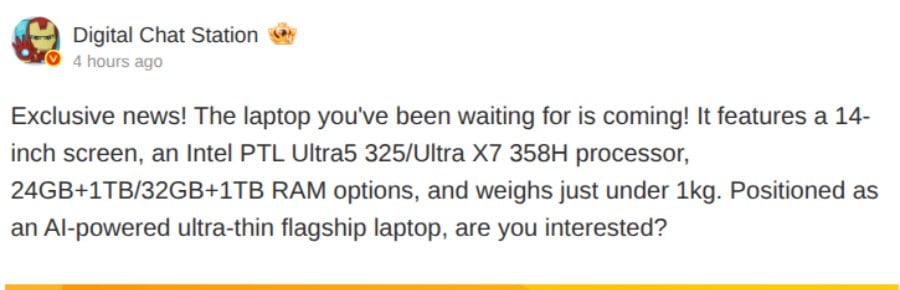
A widely circulated tip from Chinese blogger Digital Chat Station outlines a Xiaomi-branded 14-inch notebook weighing around 1 kg. Two processor options are listed: the Intel Core Ultra 5 325 and the Intel Ultra X7 358H, both chips Intel introduced at CES 2026. The Ultra 5 325 is described as an 8-core part in a 4P + 4LPE layout, with 8 threads and a maximum frequency of 4.5 GHz. The Ultra X7 358H is the higher-end option, a 16-core design in a 4 + 8 + 4 configuration, up to 4.8 GHz, with 18 MB of L3 cache and integrated Radiant B390 graphics.
Storage is said to top out at a 1 TB SSD, and memory choices reported are 24 GB or 32 GB. The tipster also noted there won’t be a 16-inch model. Crucially, the leak does not explain what the promised ”AI” capabilities are – details like on-device accelerators, model support, or software integrations weren’t listed.
Why this matters beyond specs
There are three industry currents colliding in that short leak. First, OEMs are racing to ship laptops that claim AI features, often before anyone explains what those features actually do for users. Second, Intel’s Ultra line is being promoted as the Windows answer to on-device AI, and design wins in thin-and-light laptops validate that pitch. Third, sub-1kg laptops are a contested niche – they signal premium design and mobility, and they’re where brand perception gets forged.
If Xiaomi really launches a 1 kg, Intel-powered machine with 24-32 GB of RAM, it will be staking a claim in a segment dominated by the likes of Dell, HP, Lenovo, and a handful of lighter challengers. Xiaomi’s strength has been aggressive pricing and vertical control over hardware; if it repeats that playbook it could shift expectations on what a true ultraportable costs.
What’s missing and what to watch for
The leak supplies CPU names, core counts and memory options, but leaves out the things that decide whether a portable is worth buying: battery life, display resolution and brightness, cooling design (can a 1 kg chassis contain an Ultra X7 without throttling?), ports, webcam and microphone quality, and – ironically – the actual AI features and privacy model. Xiaomi’s last mainstream laptop, the Xiaomi Book 14, competed on balanced specs; this new device will be judged on whether the company can deliver sustained performance and useful AI software, not just top-line frequencies.
Also worth watching: pricing and branding. Xiaomi has split its PC lineup between Xiaomi and Redmi in recent years. Returning with a premium Xiaomi-branded model signals a strategic shift – one that could reposition Redmi as budget-friendly and Xiaomi as the aspirational option. If the company undercuts incumbents on price while delivering Intel’s higher-end Ultra silicon, that will force competitors to respond on either cost or features.
The likely winners and losers
In the short term, consumers could win if Xiaomi packs strong hardware and reasonable pricing into a light chassis. Intel wins if this becomes another design win that validates its Ultra marketing. OEMs that compete on premium margins and that can’t match Xiaomi’s cost structure could lose share.
But there’s a risk for Xiaomi too. Calling a laptop ”AI” without clear, differentiating software is a hollow promise. If performance sags, thermals are poor, or the AI features are limited to vague cloud hooks, the product could underperform and damage the brand’s return to flagship PCs.
Verdict and next steps
The leak is credible enough to be interesting but light on the practical details buyers care about. Expect an official announcement or more detailed leaks that clarify battery, cooling, display and – most importantly – what ”AI” means in everyday use. Until then, treat the specs as an outline, not a buying guide.
If Xiaomi does follow through, the bigger story won’t be the GHz or the 24 GB option – it will be whether Xiaomi can turn AI messaging into tangible on-device features and whether it can build a real premium laptop identity after years of focusing on value segments.