


Benchmarks show up online all the time. Most are harmless curiosities. Every so often one forces a decision: is this an early look at next-generation silicon, or just a noisy prototype that will embarrass nobody but a test engineer? A recent Geekbench entry for a device listed as ”Google Kodiak” falls squarely into that gray area.
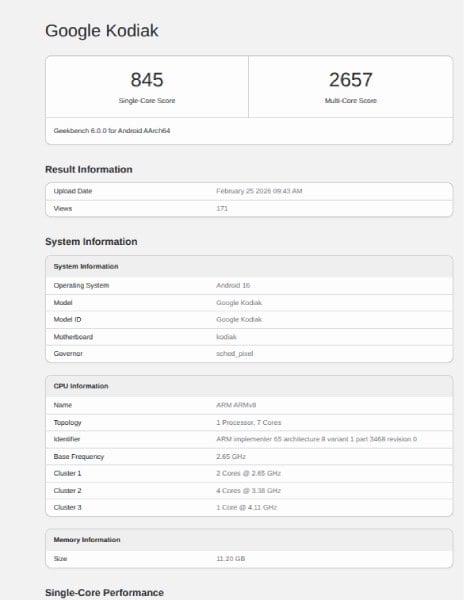
The listing describes a seven-core system-on-chip with an unusual core mix: one Arm C1-Ultra at 4.11GHz, four Arm C1-Pro at 3.38GHz, and two more C1-Pro at 2.65GHz. The GPU is named as a PowerVR C-Series CXTP-48-1536. Single-core and multi-core Geekbench scores in the listing are 845 and 2657, respectively.
Why this matters – and why you shouldn’t panic
On paper the entry is interesting because it breaks from the usual eight-core pattern Google has used recently. It also lists higher clock speeds than the chip used in the Pixel 10 Pro XL, which the same database shows as an octa-core layout with one Cortex-X4 at 3.78GHz, five Cortex-A725 at 3.05GHz, and two Cortex-A520 at 2.25GHz.
But the headline numbers are the problem: 845/2657 are tiny for a modern flagship-class chip. Early-looking benchmarks often show weak scores – not because the silicon is bad, but because firmware, scheduler tweaks, and GPU drivers are still missing. Prototype SoCs can also be built with disabled blocks or test firmware that prioritizes debug visibility over performance.
What’s probably going on
There are three plausible explanations: 1) this is an early engineering sample missing firmware and optimizations, 2) it’s a mislabeled or fake entry in a public benchmark database, or 3) Google is experimenting with a deliberately asymmetric core setup tuned for efficiency and on-device machine learning rather than peak single-thread throughput.
All three are common in mobile silicon development. Vendors iterate across microarchitectures and core counts to balance battery life, heat, and AI workloads. The unusual C1-Ultra/C1-Pro naming suggests a family of Arm cores focused on efficiency and ML performance rather than raw single-thread speed, while the PowerVR CXTP GPU ID points to a new or tweaked Imagination Technologies design in the pipeline.
Who wins and who loses
If this is an honest early sample, Google wins by testing bold microarchitectural choices in public silicon; the company has repeatedly steered Tensor toward on-device AI capabilities rather than chasing benchmark bragging rights. Qualcomm and Apple win in marketing terms if they can position their chips as measurably faster while Google sorts software. Consumers lose only if half-baked numbers become the story instead of the features that matter – battery life, photos, and on-device intelligence.
There is one practical risk: leaks like this create expectations and talking points months before a product ships. The Pixel 11 family is not expected until summer 2026, and early, low-number leaks can become persistent narratives that are hard to correct at launch.
Verdict and what to watch next
Treat this Geekbench entry as a hint, not a verdict. The seven-core layout and the new PowerVR identifier are worth noting because they suggest Google and its partners are exploring different trade-offs for the next Tensor. The low scores tell a more mundane story: this is likely early hardware or a misconfigured test image.
Over the next few months watch for three signals: additional benchmarks (especially from other suites), driver and firmware updates tied to engineering builds, and corroborating sightings that tie the ”Kodiak” name explicitly to Pixel 11 hardware. Until then, the safe assumption is that any final Tensor G6 will look and benchmark better than this single snapshot – but leaks will keep pundits busy in the meantime.
Short version: intriguing microarchitecture notes, weirdly weak numbers, and a reminder that early benchmarks are a poor yardstick for how a phone will feel in your pocket.