

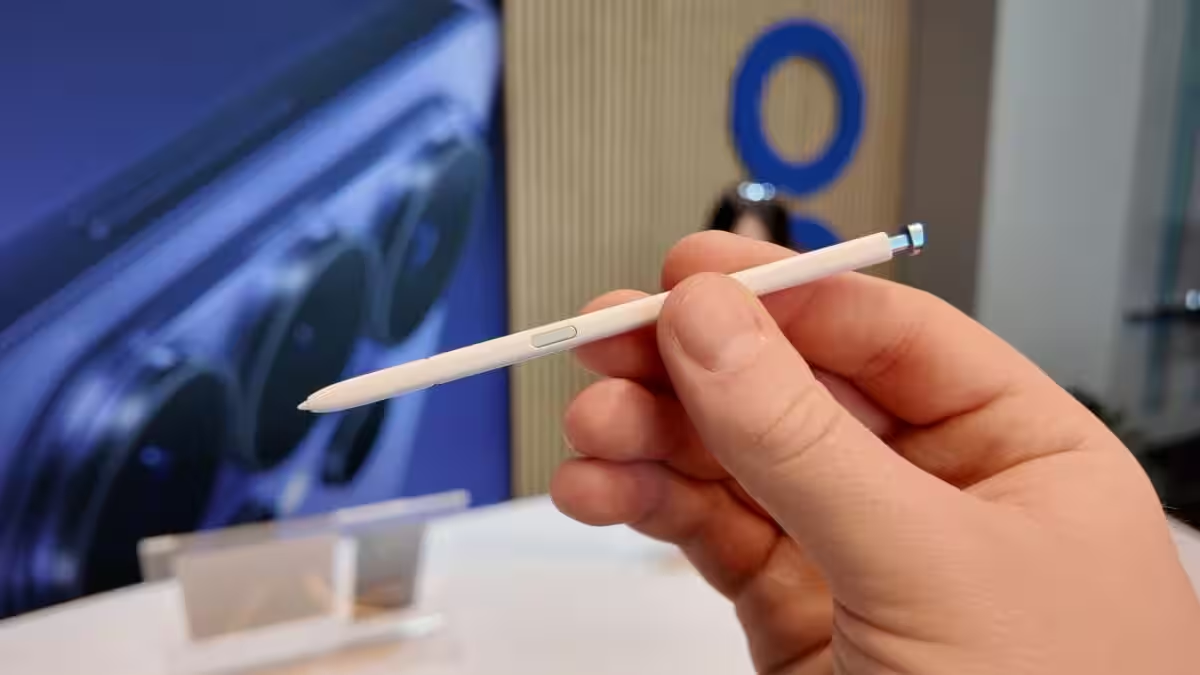
Manufacturers have long treated built-in styluses as a tactical trade-off: great for creative control, awkward for thin phones. Samsung’s S Pen has been the marquee example – beloved by power users, resented by engineers who call the extra thickness and magnetics the ”pen penalty.” Now Samsung says it intends to reduce that penalty by redesigning the S Pen and the display around it.
The update comes after a handful of stumbles that exposed the tension between features and fit. Samsung removed Bluetooth functionality from the S Pen with the Galaxy S25 Ultra, and that change carried into the Galaxy S26 Ultra, disappointing users who relied on the pen’s remote controls. Executives have repeatedly insisted the S Pen won’t disappear – but the company is clearly rethinking how it integrates a functioning stylus without compromising device thinness or wireless charging.
”We’re working on a more advanced technology within S Pen to come up with a new structure of display, so the penalty of having S Pen is diminished. S Pen will continue to be one of the core technologies.”
Bloomberg
That comment, made in an interview with Bloomberg, is Samsung’s clearest signal yet that it plans a deeper engineering change rather than a simple stylus refresh. The company said it may adopt the Universal Stylus Initiative’s USI 2.0 standard (or a later revision) for future pens and displays – a choice that would reshape both hardware and accessory ecosystems.
Why USI 2.0 matters
USI 2.0 is notable because it targets the exact problems Samsung flagged. The spec supports in-cell display panels similar to the OLEDs Samsung uses, adds tilt support, a color palette of 16 million colors, and up to 4,096 levels of pressure sensitivity. It also includes a path for wireless charging via NFC, which could let Samsung power a pen without adding a Bluetooth battery pack.
Perhaps more important in practical terms: adopting a USI-based stylus could avoid interference with newer magnetic wireless charging systems like Qi2, letting manufacturers place the magnets for charging and for pen storage without them fighting each other.
Where this fits in the broader stylus market
The stylus market is fragmented. Apple uses a proprietary Pencil system that pairs over Bluetooth and charges magnetically on iPad hardware, while many Windows and Chrome OS devices use vendor APIs and protocols such as Microsoft Pen Protocol or Wacom’s tech. USI aims to be the common denominator across Android, Chrome OS, and other platforms – an interoperability play that could simplify accessories and lower costs over time.
For Samsung, USI would be a way to get sophisticated pen features back without reintroducing the elements users disliked: a heavier, battery-filled pen and awkward internal components that complicate slim phones. It would also make it easier for third-party styluses to work across more devices, which could broaden the accessory market for Samsung phones and tablets.
What Samsung still has to solve
Designing the display and chassis around a new stylus standard is nontrivial. Samsung needs to preserve low latency and accurate tilt and pressure, ensure apps and Android itself expose the new features to developers, and keep the pen reliably charged and paired. There’s also an experience trade-off: many users miss the S Pen’s remote functions – camera shutter, media controls, and presentation gestures – that relied on Bluetooth. USI’s NFC charging doesn’t by itself restore long-range remote features unless Samsung pairs it with another wireless link or a tiny battery.
Finally, this is an engineering bet with timing implications. Reworking display layers to integrate stylus sensing can add development time and cost. For consumers, that could mean a multi-year transition during which some Galaxy models get full pen support and others remain limited.
Verdict and what to watch
Samsung’s approach is sensible: rather than retiring the S Pen or shipping a bulkier pen, it wants to make the pen and phone coexist without one compromising the other. If Samsung pulls it off, the winners will be users who want pro-level input on a mainstream phone and the broader accessory market. The risks are fragmentation during the transition and the potential loss of certain convenience features if remote functionality can’t be restored in a compact way.
Watch for two signals in the next year: whether Samsung formally announces USI 2.0 support in product literature, and whether app developers start building to the new tilt, color, and pressure capabilities. Those signs will tell us if this is an incremental update or the kind of rethink Samsung hinted at – a redesign that finally makes the S Pen less of an architectural afterthought.
CONTENT_END